
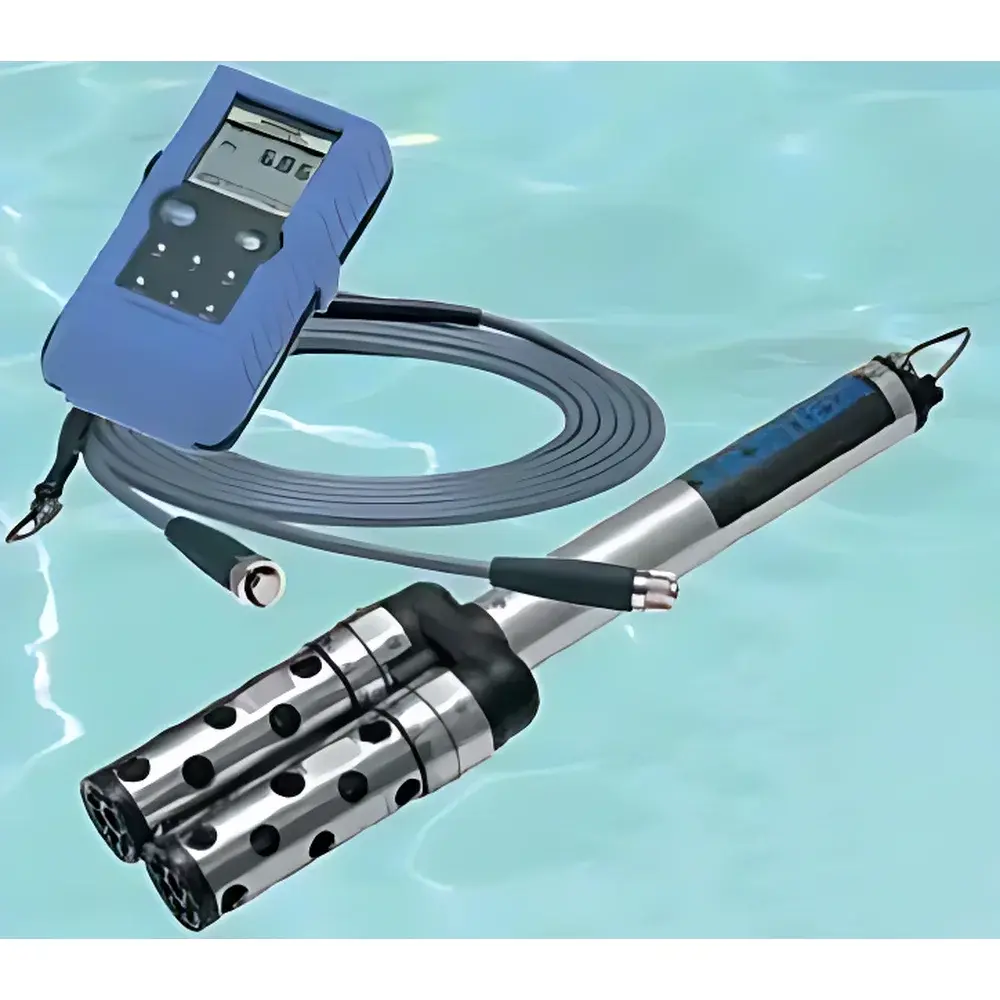
HORIBA W-20XD Series Multi-Parameter Water Quality Monitoring System
| Brand | HORIBA |
|---|---|
| Origin | Japan |
| Model | W-20XD Series |
| Instrument Type | Online Water Quality Analyzer |
| Operating Depth | Up to 100 m |
| Data Logging Duration | 30 days (2880 records, 15-min interval) |
| IP Rating | IP67 (Control Unit) |
| Simultaneous Parameters | Up to 13 |
| Temperature Range | 0–55 °C (Operation), −5–60 °C (Storage) |
| Probe Dimensions | Ø95 mm × 430 mm |
| Measurement Principles | Glass Electrode (pH), Membrane-Based Galvanic Cell (DO), AC 4-Electrode Conductivity, Pressure Transduction (Depth), Thermistor (Temperature), Dual-Beam Optical Transmission/Scattering (Turbidity), Platinum Electrode (ORP), Ion-Selective Electrodes (NO₃⁻, Cl⁻, Ca²⁺, F⁻, K⁺, NH₃) |
Overview
The HORIBA W-20XD Series is an autonomous, submersible multi-parameter water quality monitoring system engineered for long-term, unattended deployment in diverse aquatic environments—including rivers, lakes, reservoirs, coastal zones, groundwater wells, municipal wastewater outfalls, industrial effluent streams, and aquaculture systems. Designed and manufactured in Japan, the system operates on a robust electrochemical and optical sensing architecture compliant with international field measurement conventions. Its core functionality integrates real-time, in-situ measurement of up to 13 critical water quality parameters using standardized analytical principles: glass electrode potentiometry for pH; membrane-covered galvanic cell detection for dissolved oxygen (DO); AC four-electrode conductivity measurement with automatic temperature compensation to 25 °C; pressure-based depth profiling; thermistor-based temperature sensing; dual-beam optical turbidity assessment via combined transmission and scattering; platinum redox electrode for ORP; and ion-selective electrodes (ISEs) for targeted anion/cation quantification (e.g., NO₃⁻, Cl⁻, Ca²⁺, F⁻, K⁺, NH₃). All sensors are housed within a pressure-rated, impact-resistant probe assembly rated for continuous operation at depths up to 100 meters—validated per IEC 60529 for IP67 ingress protection on the control unit and equivalent hydrostatic integrity for the submerged probe.
Key Features
- Autonomous 30-day data logging: Internal non-volatile memory stores up to 2,880 timestamped records (15-minute intervals) without external power or connectivity.
- True field-deployable design: No cables required during measurement—probe operates independently upon submersion; data retrieval and configuration performed post-recovery or via optional wireless telemetry.
- Depth-rated sensor suite: Newly developed electrodes and transducers maintain metrological stability under hydrostatic pressure up to 100 m, enabling reliable coastal, lacustrine, and deep-well applications.
- Multi-parameter integration: Single-probe platform supports concurrent acquisition of pH, DO, conductivity, salinity, TDS, seawater specific gravity (δt, δ₀, δ₁₅), turbidity, depth, temperature, ORP, and up to six ion species—reducing site visit frequency and cross-calibration uncertainty.
- Automatic calibration support: Built-in two-point pH calibration routine with temperature compensation; conductivity auto-ranging and salinity conversion algorithms aligned with PSS-78 and UNESCO standards.
- Ruggedized mechanical construction: Anodized aluminum housing, corrosion-resistant wetted materials (e.g., titanium, PEEK, EPDM), and shock-absorbing protective shroud ensure longevity in high-turbidity, biofouling-prone, or debris-laden environments.
Sample Compatibility & Compliance
The W-20XD Series is validated for use across freshwater, brackish, and full-strength seawater matrices (salinity up to 40 ppt). Sensor response characteristics adhere to established reference methods: pH measurements follow ISO 10523 and ASTM D1293; DO conforms to ISO 5814 and APHA 4500-O; conductivity and salinity calculations implement the Practical Salinity Scale (PSS-78); turbidity aligns with ISO 7027 and EPA Method 180.1; and depth/pressure readings comply with IEC 61298-2. The system meets GLP documentation requirements for environmental monitoring programs and supports audit-ready data export formats (CSV, XML) compatible with regulatory reporting frameworks including EU WFD, US Clean Water Act Section 304(h), and Japan’s Water Pollution Control Law. While not intrinsically certified for hazardous locations, its IP67-rated control unit satisfies NEMA 4X equivalency for outdoor enclosure protection.
Software & Data Management
Data configuration, retrieval, and visualization are managed through HORIBA’s proprietary PC-based software suite (WQ-Manager), which supports secure local storage, time-synchronized parameter overlay, trend analysis, and customizable alarm thresholds. Raw datasets include embedded metadata (sensor ID, calibration timestamps, firmware version, GPS coordinates if externally tagged) to satisfy traceability requirements under ISO/IEC 17025 and FDA 21 CFR Part 11 (when deployed with electronic signature-enabled workflow modules). Export options include ASCII-delimited files for integration into LIMS, SCADA, or GIS platforms. Firmware updates are delivered via encrypted USB interface; no cloud dependency is required for core operation—ensuring data sovereignty and operational continuity in remote or low-connectivity regions.
Applications
- Long-term ecological monitoring of eutrophication indicators (pH, DO, NO₃⁻, NH₃) in stratified lakes and reservoirs.
- Tidal and estuarine salinity gradient mapping using synchronized conductivity, temperature, and depth profiles.
- Regulatory compliance monitoring at wastewater discharge points (Cl⁻, ORP, turbidity, TDS) per ISO 10510 and JIS K 0102.
- Aquaculture pond management—real-time tracking of DO saturation, NH₃ toxicity thresholds, and Ca²⁺ availability for shellfish health.
- Groundwater contamination plume delineation via multi-ion fingerprinting (F⁻, NO₃⁻, Cl⁻) coupled with redox potential (ORP) profiling.
- Post-disaster water safety assessment—rapid deployment for simultaneous screening of turbidity, pH, conductivity, and fecal indicator surrogates (e.g., Cl⁻/Br⁻ ratios).
FAQ
What is the maximum recommended deployment duration without maintenance?
The W-20XD probe is rated for continuous unattended operation up to 30 days at 15-minute logging intervals. For extended deployments (>60 days), biweekly anti-fouling inspection and optional wiper module activation are advised.
Can the system be calibrated in the field without returning to a lab?
Yes—two-point pH calibration and single-point DO zero/span verification can be performed in situ using NIST-traceable buffer solutions and sodium sulfite standard. Conductivity and ion calibrations require pre-deployment bench validation.
Is pressure-compensated depth measurement traceable to national standards?
Depth transducers are factory-calibrated against deadweight testers accredited to JCSS (Japan Calibration Service System) and provide NIST-traceable certificates upon request.
Which ion parameters require optional probe configurations?
All ion-selective electrodes (NO₃⁻, Cl⁻, Ca²⁺, F⁻, K⁺, NH₃) are field-swappable modules—no hardware modification is needed, but each requires dedicated ISE cartridge installation and individual slope verification.
Does the system support integration with third-party telemetry networks?
Yes—via RS-485 Modbus RTU output (optional interface kit), enabling direct connection to LoRaWAN gateways, cellular RTUs, or SCADA master stations without proprietary middleware.
Related Products







