
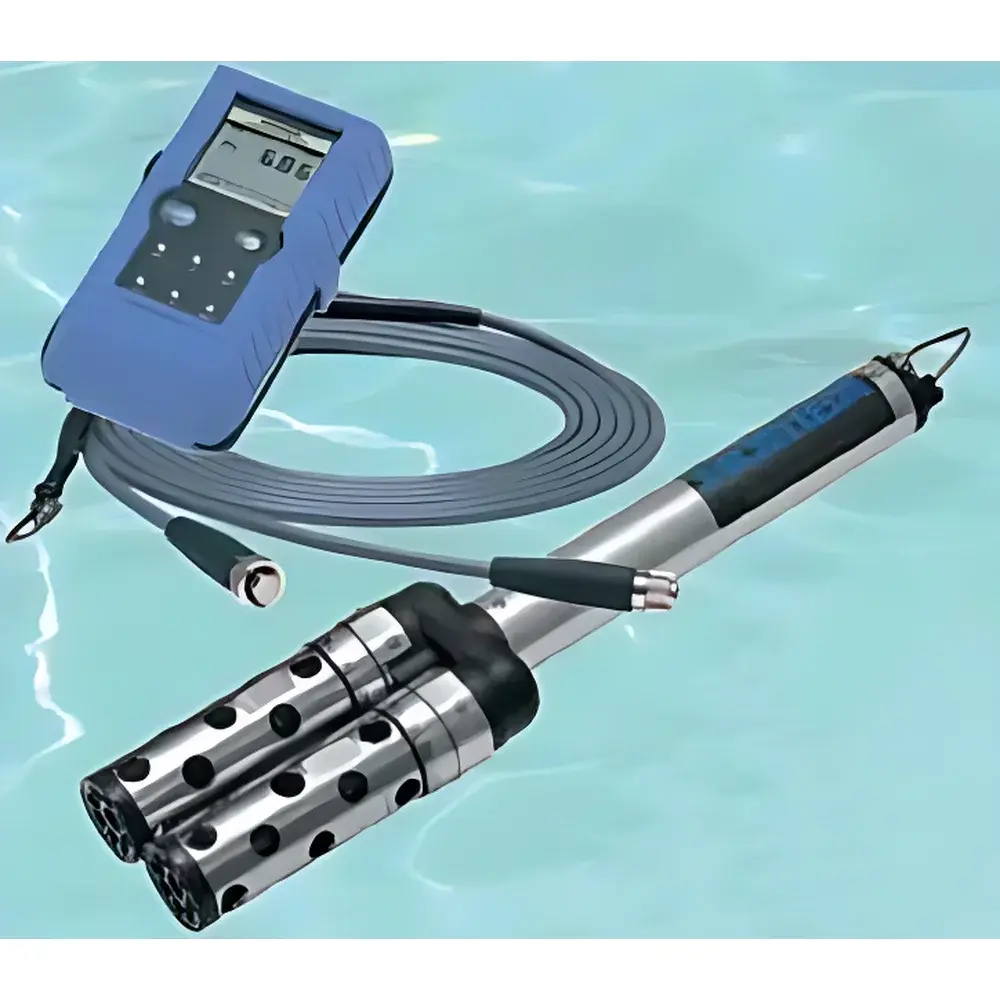
HORIBA W-20XD Series Multi-Parameter Water Quality Monitoring System
| Brand | HORIBA |
|---|---|
| Origin | Japan |
| Model | W-20XD Series |
| Instrument Type | Portable/Handheld Water Quality Analyzer |
| Waterproof Rating (Control Unit) | IP67 |
| Operating Depth | Up to 100 m |
| Continuous Deployment Duration | 30 days |
| Data Logging Capacity | 2,880 records (15-min interval) |
| Simultaneous Parameters | Up to 13 (W-23XD variant) |
| Key Measured Parameters | pH, Dissolved Oxygen (DO), Electrical Conductivity (EC), Salinity, Total Dissolved Solids (TDS), Seawater Specific Gravity (δt), Turbidity, Temperature, Depth (Pressure), ORP, and Select Ions (NO₃⁻, Cl⁻, Ca²⁺, F⁻, K⁺, NH₃) |
| Measurement Principles | Glass Electrode (pH), Membrane-Based Galvanic Cell (DO), AC 4-Electrode (EC), Nephelometric/Transmissometric (Turbidity), Thermistor (Temperature), Piezoresistive Pressure Transducer (Depth), Platinum Electrode (ORP), Ion-Selective Electrodes (ISEs) |
| Calibration | Automatic or Manual (pH 2-point, DO salinity/temperature compensation, EC temperature compensation at 25°C) |
| Storage Temperature | –5 to 60°C |
| Operating Temperature | 0 to 55°C |
| Probe Dimensions | Ø95 mm × 430 mm |
| Data Transmission | Remote wireless telemetry (optional) |
Overview
The HORIBA W-20XD Series is a field-deployable, autonomous multi-parameter water quality monitoring system engineered for long-term, unattended operation in diverse aquatic environments—from coastal seawater and deep reservoirs to groundwater wells, municipal wastewater outfalls, agricultural runoff channels, and aquaculture ponds. Designed around a robust pressure-rated probe housing and integrated data logger, the system operates independently for up to 30 days without external power or physical intervention. Its core architecture implements proven electrochemical, optical, and physical sensing principles: pH is measured via temperature-compensated glass electrode potentiometry; dissolved oxygen employs a membrane-covered galvanic cell with automatic salinity and temperature correction; conductivity utilizes an AC-driven four-electrode configuration to minimize polarization effects and fouling artifacts; turbidity is quantified using dual-beam nephelometric and transmissometric detection; depth is derived from high-stability piezoresistive pressure transduction; and ion concentrations (NO₃⁻, Cl⁻, Ca²⁺, F⁻, K⁺, NH₃) are determined via selective membrane-based ion-selective electrodes (ISEs). All measurements adhere to fundamental analytical standards underpinning regulatory water quality assessment—principles aligned with ASTM D1293 (pH), ASTM D888 (DO), ASTM D5391 (conductivity), and ISO 7027 (turbidity).
Key Features
- Autonomous 30-day deployment: Integrated non-volatile memory stores up to 2,880 timestamped records at user-configurable intervals (minimum 15 minutes), eliminating need for on-site operator presence during monitoring campaigns.
- 100-meter depth rating: Pressure-resistant probe housing (IP68 equivalent for sensor section) and newly developed corrosion-resistant electrodes enable reliable real-time measurement in marine benthic zones, dam intakes, and deep-well applications.
- Simultaneous 13-parameter capability (W-23XD model): Co-located sensing minimizes spatial discrepancy between parameters—critical for kinetic interpretation of redox gradients, nutrient cycling, and stratification dynamics.
- Field-ruggedized control unit: IP67-rated enclosure ensures operational integrity under rain, dust, and temporary submersion during handling and deployment.
- Automatic calibration support: Onboard routines facilitate 2-point pH calibration; DO compensation for salinity (0–40 ppt) and temperature; EC normalization to 25°C; and optional auto-zero for turbidity baseline drift correction.
- Modular probe architecture: Sensor cartridges—including optional ORP and ISE modules—are replaceable in-field, extending service life and enabling configuration-specific deployments without full-system replacement.
Sample Compatibility & Compliance
The W-20XD Series is validated for use across freshwater, brackish, and full-strength seawater matrices (up to 40 ppt salinity). Its electrode materials—including platinum for ORP, doped silver/silver chloride reference systems, and polymer-encapsulated ISE membranes—are chemically stable in aggressive media containing sulfides, hydrogen sulfide, organic humics, and suspended solids typical of wastewater and eutrophic lakes. The system supports compliance workflows aligned with EPA Method 150.1 (conductivity), EPA Method 360.1 (TDS), USGS NWIS protocols for continuous stream monitoring, and ISO 5667-22 for environmental water sampling. While not pre-certified for GLP or 21 CFR Part 11, its audit-ready data structure—including immutable timestamps, sensor ID tagging, and raw/processed value pairs—facilitates integration into validated laboratory information management systems (LIMS) and electronic lab notebooks (ELNs) under GxP-aligned QA/QC frameworks.
Software & Data Management
Data retrieval is accomplished via Bluetooth or USB-C interface to the HORIBA AquaLink™ Desktop Software (Windows/macOS), which provides visualization, spectral trending, statistical summary (min/max/mean/std dev), and export in CSV, Excel, or XML formats compliant with WQX (Water Quality Exchange) schema. Optional cellular or LoRaWAN telemetry modules enable encrypted remote data push to cloud-hosted dashboards (e.g., AWS IoT Core or Azure IoT Hub), supporting configurable alert thresholds (e.g., DO 9.5) and automated report generation. All logged entries include embedded metadata: sensor serial numbers, firmware revision, battery voltage, self-diagnostic flags (e.g., membrane dryness, electrode offset drift), and GPS-assisted location tagging (when paired with external GNSS receiver). Raw sensor outputs are preserved alongside processed values, satisfying traceability requirements for method validation and regulatory submission.
Applications
- Long-term limnological studies: Tracking seasonal thermal stratification, hypolimnetic anoxia development, and nutrient flux across lake sediment–water interfaces.
- Coastal zone management: Monitoring diurnal DO cycles, salinity intrusion fronts, and chlorophyll-a proxy signals (via turbidity-correlated scattering) in estuarine mixing zones.
- Industrial effluent compliance: Continuous verification of discharge parameters against NPDES permit limits for pH, TDS, and specific ions (e.g., Cl⁻ from desalination brine, NO₃⁻ from fertilizer processing).
- Aquaculture optimization: Real-time feedback control of aeration systems based on dynamic DO demand and early detection of ammonia toxicity events (NH₃ mode, pH ≥ 12).
- Groundwater vulnerability assessment: Mapping redox zonation (via ORP/pH/DO triad) and chloride/bromide ratios to identify saline intrusion pathways in coastal aquifers.
- Infrastructure health monitoring: Assessing biofouling onset on dam intake screens through progressive turbidity and conductivity hysteresis patterns.
FAQ
What is the maximum recommended deployment duration without maintenance?
The system is rated for continuous unattended operation up to 30 days at 15-minute logging intervals, assuming nominal battery charge and ambient temperatures between 10–30°C.
Can the W-20XD be used in full-strength seawater (35 ppt)?
Yes—the conductivity, salinity, and specific gravity algorithms are calibrated across 0–40 ppt, and all wetted materials (titanium housing, PEEK insulators, Ag/AgCl reference junctions) resist chloride-induced pitting and crevice corrosion.
Is ORP measurement included as standard or optional?
ORP is available as a factory-installed option on W-22XD and W-23XD models; it requires a dedicated platinum working electrode and double-junction reference assembly.
How is data integrity ensured during extended submersion?
All stored records include CRC-32 checksums; the flash memory uses wear-leveling firmware; and timestamping is governed by a temperature-compensated crystal oscillator (±2 ppm stability over 0–55°C).
Does the system support third-party SCADA integration?
Yes—Modbus RTU over RS-485 (via optional interface module) and MQTT over TCP/IP (with telemetry add-on) provide direct compatibility with industrial control systems and environmental data acquisition platforms.







