
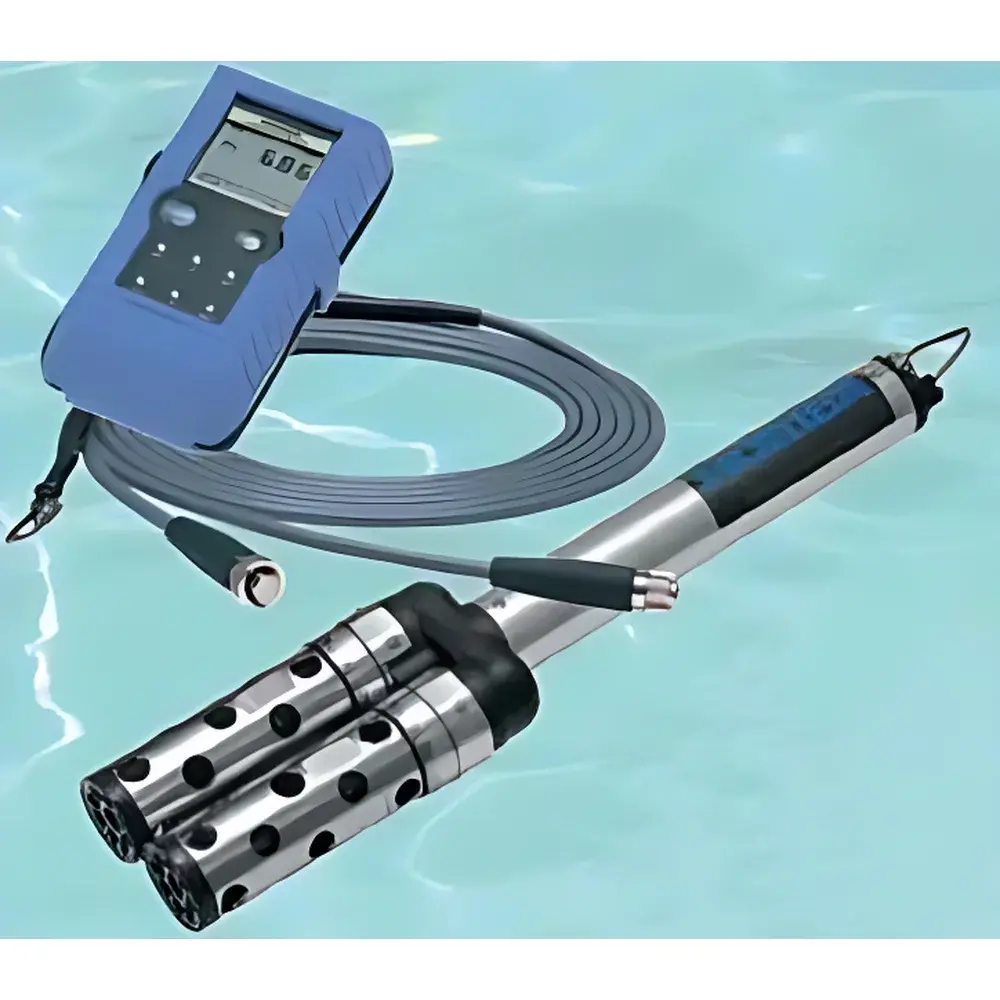
HORIBA W-20XD Series Multi-Parameter Water Quality Monitoring System
| Brand | HORIBA |
|---|---|
| Origin | Japan |
| Model | W-20XD Series |
| Instrument Type | Portable/Handheld Water Quality Analyzer |
| IP Rating | IP67 (Control Unit) |
| Operating Depth | Up to 100 m |
| Continuous Deployment Duration | 30 days |
| Data Logging Interval | 15 minutes |
| Total Data Capacity | 2,880 records |
| Sensor Types | pH, Dissolved Oxygen (DO), Conductivity, Salinity, TDS, Seawater Specific Gravity (δt), Turbidity, Depth, Temperature, ORP, and Optional Ion Sensors (NO₃⁻, Cl⁻, Ca²⁺, F⁻, K⁺, NH₃) |
| Measurement Principle | Glass Electrode (pH), Membrane-Based Galvanic Cell (DO), AC 4-Electrode (Conductivity), Nephelometric/Transmittance (Turbidity), Piezoresistive Pressure (Depth), Pt Electrode (ORP), Solid-State/Ion-Selective Electrodes (Ions) |
| Temperature Compensation | Automatic (for pH, DO, Conductivity, Salinity, TDS, δt, ORP) |
| Calibration | Auto-calibration support |
Overview
The HORIBA W-20XD Series is a ruggedized, submersible multi-parameter water quality monitoring system engineered for long-term, unattended deployment in diverse aquatic environments—from coastal seawater and deep reservoirs to groundwater wells, municipal wastewater outfalls, agricultural irrigation channels, and aquaculture ponds. Designed around a modular architecture, the system integrates a pressure-rated probe assembly with an IP67-rated control unit, enabling autonomous operation at depths up to 100 meters. Its core measurement methodology combines electrochemical, optical, and physical transduction principles: pH is measured via temperature-compensated glass electrode potentiometry; dissolved oxygen employs a membrane-covered galvanic cell with automatic salinity and temperature correction; conductivity utilizes AC-driven 4-electrode technology to minimize polarization and fouling effects; turbidity relies on dual-beam nephelometric and transmittance detection per ISO 7027; depth is determined by high-stability piezoresistive pressure sensing; and optional ion-selective electrodes (ISEs) provide direct potentiometric quantification of NO₃⁻, Cl⁻, Ca²⁺, F⁻, K⁺, and NH₃ across defined pH windows. All measurements are synchronized, timestamped, and stored onboard without external power or data cables—eliminating logistical constraints associated with real-time telemetry.
Key Features
- True autonomous deployment: Fully self-contained unit operates continuously for up to 30 days at 15-minute logging intervals—no external power, no tethered communication required.
- High-pressure probe housing rated for 100 m depth (1 MPa), incorporating newly developed corrosion-resistant electrode materials and reinforced polymer encapsulation for marine-grade durability.
- Integrated data storage: 2,880 measurement sets retained internally (equivalent to one month at 15-min intervals); data exportable via USB or optional Bluetooth/Wi-Fi module post-retrieval.
- Multi-parameter capability: Standard configuration measures pH, DO, conductivity, salinity, TDS, seawater specific gravity (δt), turbidity, depth, temperature, and ORP; expandable to six additional ion species via plug-in ISE cartridges.
- Field-validated accuracy: pH ±0.1, DO ±0.2 mg/L, conductivity ±3% FS, turbidity ±5% NTU, temperature ±1.0°C—all compliant with ASTM D1293, ISO 5814, ISO 7888, and USP where applicable.
- Intelligent auto-compensation: Real-time temperature and salinity corrections applied to DO, conductivity, TDS, δt, and ORP outputs per recognized standard algorithms (e.g., UNESCO TEOS-10 for seawater density).
Sample Compatibility & Compliance
The W-20XD Series is validated for use in freshwater, brackish water, estuarine systems, and full-strength seawater (up to 40 ppt). Its sensor suite meets material compatibility requirements for prolonged immersion in biologically active, sediment-laden, or chemically aggressive matrices—including chlorinated effluents and high-Ca²⁺ irrigation water. Probe surfaces utilize biofouling-resistant coatings, and the pressure housing conforms to IEC 60529 IP67 (control unit) and IP68 (probe assembly). The system supports GLP-compliant data integrity through embedded audit trails, user-accessible calibration logs, and non-volatile memory write protection. While not pre-certified for FDA 21 CFR Part 11, its data structure and metadata tagging (timestamp, sensor ID, calibration status, environmental flags) align with GMP/GLP documentation expectations for environmental QA/QC programs.
Software & Data Management
Data retrieval and analysis are supported via HORIBA’s proprietary WQ-Manager software (Windows/macOS), which imports binary .wqd files and exports CSV, Excel, or PDF reports with customizable visualization templates. The software enables batch calibration curve management, outlier flagging based on configurable thresholds (e.g., rapid pH drift >0.3 units/hour), and compliance reporting aligned with EPA Method 160.1 and ISO 5667-22. Raw sensor voltage outputs, temperature-corrected values, and diagnostic flags (e.g., membrane saturation, electrode impedance) are preserved in native format for traceable reprocessing. Optional cloud integration (via third-party MQTT brokers) allows secure remote data ingestion into enterprise environmental monitoring platforms—subject to local data sovereignty regulations.
Applications
- Long-term limnological studies: Stratified profiling in lakes and reservoirs using depth-synchronized parameter correlation (e.g., DO depletion vs. temperature gradient).
- Regulatory compliance monitoring: Continuous discharge verification for NPDES permits, including simultaneous tracking of NH₃, NO₃⁻, and Cl⁻ in industrial effluent streams.
- Aquaculture health management: Early detection of hypoxia events, pH swings, or nitrite accumulation in recirculating systems.
- Coastal zone assessment: δt and salinity-conductivity cross-validation for oceanographic modeling; turbidity spikes linked to stormwater runoff events.
- Groundwater vulnerability mapping: Multi-ion fingerprinting (Ca²⁺/Cl⁻/F⁻ ratios) to distinguish natural geochemistry from anthropogenic contamination plumes.
FAQ
What is the maximum recommended deployment duration without maintenance?
The W-20XD Series is rated for continuous, unattended operation for up to 30 days at 15-minute logging intervals under typical ambient conditions (5–30°C, moderate biofouling pressure).
Can the system be deployed in full-strength seawater (35 ppt)?
Yes—the probe assembly and all standard sensors (including DO, conductivity, and δt modules) are validated for continuous operation in seawater up to 40 ppt, with automatic salinity compensation applied to relevant parameters.
Is field calibration possible without returning the unit to a lab?
Two-point pH calibration and single-point DO zero/span verification can be performed in situ using certified buffer solutions and sodium sulfite or air-saturated water standards.
How is data security and traceability ensured during long-term deployments?
All logged records include immutable timestamps, sensor serial identifiers, calibration epoch stamps, and diagnostic status codes—enabling full chain-of-custody reconstruction per ISO/IEC 17025 requirements.
Which ion sensors are available as factory-installed options versus field-upgradable modules?
NO₃⁻, Cl⁻, and F⁻ sensors are offered as pre-calibrated, drop-in cartridge modules; Ca²⁺, K⁺, and NH₃ require separate factory configuration due to pH window dependencies and membrane lifetime considerations.
Related Products







