
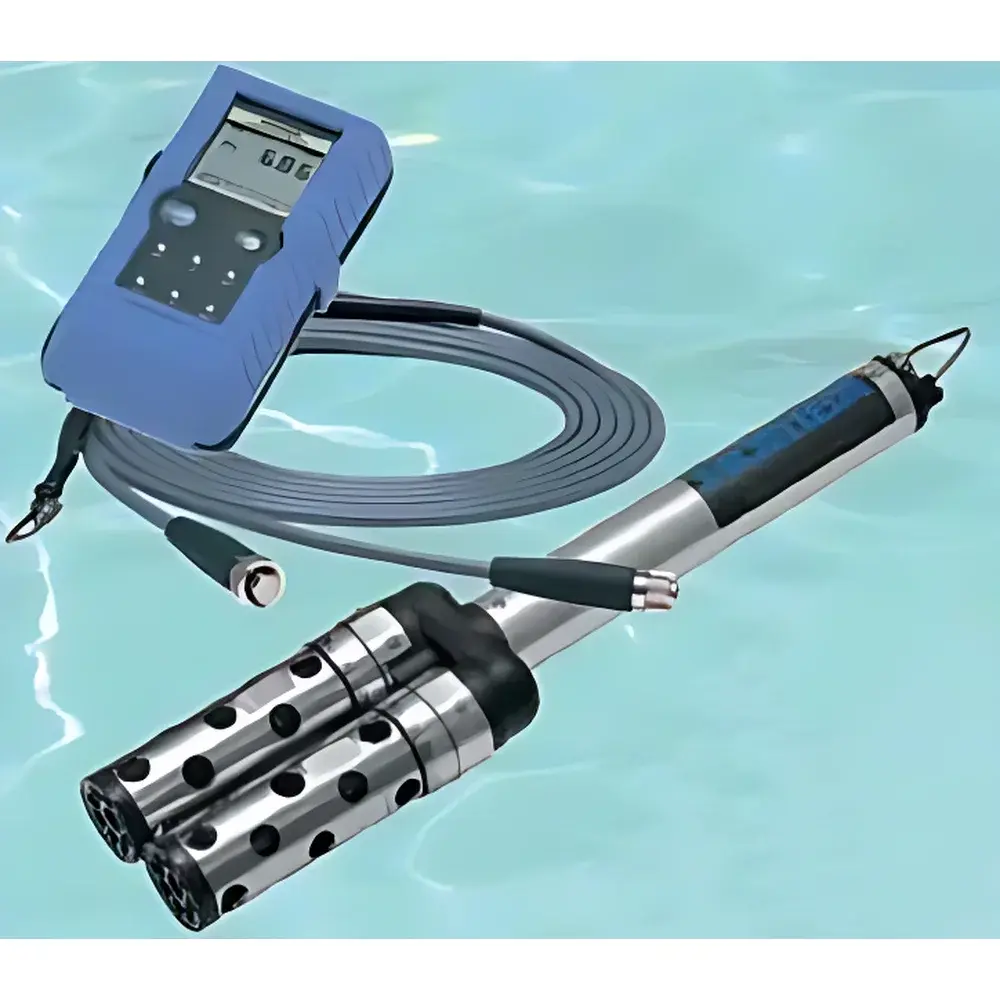
HORIBA W-20XD Series Multi-Parameter Water Quality Monitoring System
| Brand | HORIBA |
|---|---|
| Origin | Japan |
| Model | W-20XD Series |
| Instrument Type | Online Water Quality Analyzer |
| Waterproof Rating (Control Unit) | IP67 |
| Operating Depth | Up to 100 m |
| Continuous Deployment Duration | 30 days |
| Data Logging Interval | 15 minutes |
| Total Data Capacity | 2,880 records |
| Temperature Range (Operation) | 0–55 °C |
| Temperature Range (Storage) | −5–60 °C |
| Probe Max Diameter | 95 mm |
| Probe Length | 430 mm |
| Simultaneous Parameters | Up to 13 (pH, DO, EC, Salinity, TDS, Seawater Specific Gravity, Turbidity, Depth, ORP, and optional ion-selective electrodes for NO₃⁻, Cl⁻, Ca²⁺, F⁻, K⁺, NH₃) |
| pH Measurement Principle | Glass Electrode Method |
| DO Measurement Principle | Membrane-Based Galvanic Cell |
| EC Measurement Principle | AC 4-Electrode Conductivity |
| Salinity/TDS/Seawater Specific Gravity Calculation | Conductivity-based conversion with temperature compensation at 25 °C |
| Turbidity Measurement Principle | Combined Transmission & Scattering (NTU) |
| Depth Measurement Principle | Pressure Transduction |
| ORP Measurement Principle | Platinum Electrode |
| Ion Measurement Principle | Solid-State or Liquid-Membrane Ion-Selective Electrodes |
| pH Accuracy | ±0.1 pH |
| DO Accuracy | ±0.2 mg/L |
| EC Accuracy | ±3% FS |
| Salinity Accuracy | ±0.3% |
| TDS Accuracy | ±5 g/L |
| Seawater Specific Gravity Accuracy | ±5 δt |
| Turbidity Accuracy | ±5% |
| Depth Accuracy | ±5% |
| ORP Accuracy | ±15 mV |
| Ion Accuracy | ±10% (varies by ion and matrix) |
Overview
The HORIBA W-20XD Series is an autonomous, submersible multi-parameter water quality monitoring system engineered for long-term, unattended deployment in diverse aquatic environments—from coastal marine zones and deep reservoirs to groundwater wells, municipal wastewater outfalls, and agricultural irrigation channels. Built upon HORIBA’s legacy of precision electrochemical and optical sensor design, the W-20XD employs robust, field-proven measurement principles including glass electrode potentiometry (pH), membrane-integrated galvanic cell detection (dissolved oxygen), AC-driven four-electrode conductivity (EC), pressure-based hydrostatic depth sensing, and dual-path (transmission + scattering) turbidimetry. All core sensors are housed within a pressure-rated, corrosion-resistant probe assembly rated to 100 m water column (≈10 bar), enabling reliable operation in high-hydrostatic-stress environments such as dam intakes, offshore moorings, and deep aquifer observation wells. The system operates independently without external power or data cables—its internal lithium-thionyl chloride battery supports continuous 15-minute interval logging for up to 30 days, storing 2,880 timestamped records onboard prior to remote retrieval.
Key Features
- True autonomous operation: No external power supply, telemetry cable, or manual intervention required during deployment—ideal for remote or hazardous locations.
- IP67-rated control unit with optional ruggedized housing for terrestrial interface and data offload.
- Modular probe architecture supporting up to 13 simultaneous parameters—including factory-calibrated pH, DO, EC, salinity, TDS, seawater specific gravity (δt, δ₀, δ₁₅), turbidity (NTU), depth, and temperature—with optional ion-selective electrode (ISE) slots for NO₃⁻, Cl⁻, Ca²⁺, F⁻, K⁺, and NH₃.
- Integrated automatic temperature compensation across all electrochemical and conductometric measurements per ISO 7888, ASTM D1125, and USP .
- Pressure-compensated depth transducer with ±5% full-scale accuracy and 0.1 m resolution—validated per IEC 61000-6-2 for electromagnetic immunity in industrial field settings.
- Onboard memory with non-volatile flash storage ensures data integrity during power cycling or mechanical shock.
- Real-time sensor diagnostics and self-test routines support GLP-compliant audit trails and preventive maintenance scheduling.
Sample Compatibility & Compliance
The W-20XD Series is validated for use in freshwater, brackish water, estuarine systems, and full-strength seawater (up to 40 ppt salinity). Its titanium-alloy probe body and PEEK-sheathed electrodes resist biofouling and chloride-induced pitting, meeting ASTM D511 and ISO 5667-3 requirements for long-term in-situ sampling integrity. All electrochemical sensors comply with ISO 10523 (pH), ISO 5814 (DO), and ISO 7888 (conductivity), while turbidity performance adheres to ISO 7027-1. The system supports configurable data export formats (CSV, SDI-12, Modbus RTU) compatible with EPA-approved data acquisition platforms and satisfies key elements of 21 CFR Part 11 for electronic record retention when paired with HORIBA’s certified software suite.
Software & Data Management
Data retrieval is performed via Bluetooth 5.0 or USB-C direct download using HORIBA’s proprietary W-QM Manager software—a Windows-based application that enables calibration history review, sensor drift trending, statistical summary generation (min/max/avg/std dev), and automated report export compliant with ISO/IEC 17025 documentation standards. Raw time-series datasets include embedded metadata (GPS-assisted location stamping, sensor serial IDs, firmware revision, and environmental condition flags). For networked deployments, optional GSM/GPRS or LoRaWAN modules enable encrypted, scheduled transmission of compressed datasets to cloud-hosted dashboards—supporting role-based access control and automated anomaly alerts based on user-defined thresholds.
Applications
- Regulatory compliance monitoring for NPDES permits and EU Water Framework Directive (WFD) status assessment.
- Early-warning detection of eutrophication events through synchronized pH, DO, and nutrient ion trends.
- Hydrological modeling input: Long-duration depth, temperature, and conductivity profiles inform aquifer recharge rate estimation and saltwater intrusion mapping.
- Aquaculture health management: Real-time DO, NH₃, and temperature correlation supports feed optimization and mortality risk forecasting.
- Industrial effluent characterization: Simultaneous measurement of Cl⁻, NO₃⁻, and ORP enables redox-state profiling of treated wastewater prior to discharge.
- Climate-resilient infrastructure planning: Multi-year deployment datasets quantify seasonal variability in turbidity, salinity intrusion, and thermal stratification dynamics.
FAQ
What is the maximum recommended deployment duration without battery replacement?
The W-20XD Series supports continuous operation for up to 30 days at 15-minute logging intervals using its integrated primary battery. Battery life scales inversely with logging frequency and optional sensor activation.
Can the system be recalibrated in the field?
Yes—two-point pH calibration and single-point DO zero/span verification are supported via the control unit interface using NIST-traceable buffer solutions and sodium sulfite standards.
Is pressure compensation applied automatically to conductivity and salinity calculations?
Yes—depth-derived hydrostatic pressure is used to correct conductivity readings per UNESCO 1983 Practical Salinity Scale algorithms, ensuring accuracy across variable bathymetric conditions.
How is data security maintained during wireless transmission?
All optional telemetry modules employ TLS 1.2 encryption and device-authenticated handshake protocols; local data remains isolated until explicit user-initiated export.
Does the system meet GLP or GMP requirements for regulated laboratories?
When operated with validated procedures, calibrated reference standards, and W-QM Manager’s audit-log functionality, the W-20XD meets foundational GLP data integrity criteria per OECD Principles of Good Laboratory Practice.







