
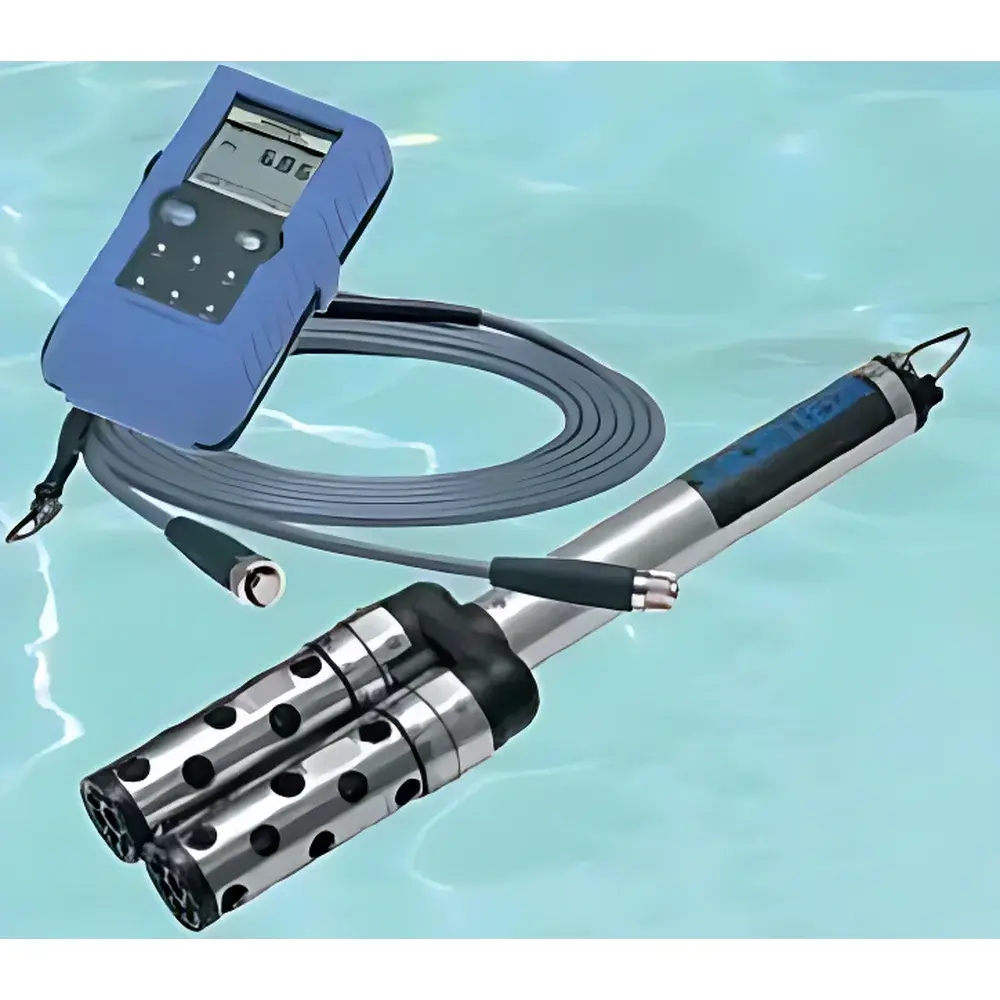
HORIBA W-20XD Series Portable Multi-Parameter Water Quality Analyzer
| Brand | HORIBA |
|---|---|
| Origin | Japan |
| Model | W-20XD Series |
| Instrument Type | Portable / Handheld Water Quality Analyzer |
| IP Rating | IP67 (Control Unit) |
| Operating Depth | Up to 100 m |
| Continuous Logging Duration | 30 days (2880 data points at 15-min intervals) |
| Measured Parameters | pH, Dissolved Oxygen (DO), Electrical Conductivity (EC), Salinity, Total Dissolved Solids (TDS), Seawater Specific Gravity (δt), Turbidity, Water Depth (Pressure), Temperature, ORP, and Optional Ion-Specific Electrodes (NO₃⁻, Cl⁻, Ca²⁺, F⁻, K⁺, NH₃) |
| pH Range | 0–14 |
| DO Range | 0–19.99 mg/L |
| EC Range | 0–9.99 S/m |
| Turbidity Range | 0–800 NTU |
| Temperature Range | 0–55 °C |
| Depth Range | 0–100 m |
| Data Transmission | Remote wireless data retrieval capability |
Overview
The HORIBA W-20XD Series is a ruggedized, submersible multi-parameter water quality analyzer engineered for unattended, long-term environmental monitoring in diverse aquatic environments—including rivers, lakes, reservoirs, coastal zones, groundwater wells, municipal wastewater outfalls, industrial effluents, aquaculture systems, and agricultural runoff channels. Designed around a modular sensor architecture and sealed pressure-resistant housing, the W-20XD operates autonomously for up to 30 days without human intervention. Its measurement principle integrates electrochemical sensing (glass electrode for pH, Clark-type membrane-covered galvanic cell for DO, platinum electrode for ORP), four-electrode AC conductivity for EC and derived parameters (salinity, TDS, seawater specific gravity), thermistor-based temperature compensation, optical transmission/scattering for turbidity, and piezoresistive pressure transduction for depth profiling. All sensors are calibrated in accordance with ISO 7888 (conductivity), ISO 5814 (dissolved oxygen), and ASTM D1293 (pH of water), ensuring metrological traceability and regulatory acceptability in environmental compliance workflows.
Key Features
- Submersible probe rated for continuous operation at depths up to 100 meters, validated per IEC 60529 IP68 equivalent pressure testing (1 MPa static water pressure)
- Integrated data logger with non-volatile memory storing up to 2,880 records—configured at user-selectable intervals as short as 15 minutes
- True autonomous deployment: no cables or external power required during field operation; powered by replaceable lithium-thionyl chloride batteries with >1-year shelf life
- IP67-rated control unit enables operation in harsh outdoor conditions including rain, dust, and temporary immersion
- Real-time temperature compensation across all electrochemical and optical measurements, eliminating manual correction steps
- Auto-calibration routines for pH (two-point) and conductivity (single-point), reducing field maintenance burden while maintaining analytical consistency
- Modular probe design supports optional ion-selective electrodes (ISEs) for nitrate, chloride, calcium, fluoride, potassium, and ammonia—each compliant with ISO 10523 and EPA Method 300.0 guidelines
Sample Compatibility & Compliance
The W-20XD is validated for use in freshwater, brackish water, seawater, and wastewater matrices with total suspended solids (TSS) ≤ 500 mg/L and salinity up to 40 ppt. Its sensor materials—including PEEK housing, titanium pressure body, and platinum/glass/platinum-iridium electrode assemblies—are chemically inert to common environmental contaminants (e.g., H₂S, Fe²⁺, organic humics, chloramines). The system meets ISO/IEC 17025 requirements for field-deployable instrumentation when operated within specified environmental limits (0–55 °C operating, −5–60 °C storage). Data integrity complies with GLP and GMP principles through time-stamped, tamper-evident logging and optional audit-trail-enabled firmware (aligned with FDA 21 CFR Part 11 when paired with HORIBA’s certified software platform).
Software & Data Management
Data retrieval is supported via Bluetooth 5.0 or optional cellular/GSM telemetry module, enabling remote download without physical probe recovery. HORIBA’s proprietary AquaManager™ software (Windows/macOS compatible) provides visualization, statistical analysis (min/max/avg/std dev), trend mapping, and automated report generation in PDF/CSV formats. All datasets include embedded metadata: GPS coordinates (when paired with external GNSS module), sensor serial numbers, calibration timestamps, and environmental context tags. Raw binary logs are exportable for third-party integration with LIMS (e.g., LabWare, Thermo Fisher SampleManager) or GIS platforms (ArcGIS, QGIS) using documented ASCII/JSON schema.
Applications
- Long-term limnological studies of eutrophication dynamics in lakes and reservoirs
- Regulatory compliance monitoring for NPDES permits and EU Water Framework Directive (WFD) status assessment
- Early-warning detection of hypoxia events in aquaculture ponds and mariculture zones
- Baseline characterization and post-remediation verification at brownfield sites and landfill leachate plumes
- Climate-driven salinity intrusion tracking in coastal aquifers and estuarine transition zones
- Validation of real-time sensor networks deployed in smart water infrastructure programs
FAQ
What is the maximum deployment duration without battery replacement?
The W-20XD achieves 30 days of continuous logging at 15-minute intervals on a single battery set under standard temperature conditions (25 °C); extended durations are achievable at lower sampling frequencies.
Can the probe be deployed in turbulent or sediment-laden water?
Yes—the probe’s hydrodynamic shape and abrasion-resistant sensor windows minimize fouling; optional anti-fouling wipers or copper-alloy housings are available for high-TSS environments.
Is calibration traceable to national standards?
All factory calibrations are performed against NIST-traceable reference materials, with certificates of calibration provided per ISO/IEC 17025 Annex A.3.
Does the system support simultaneous measurement of all 13 parameters?
Yes—W-23XD configuration enables concurrent acquisition of pH, DO, EC, salinity, TDS, δt, turbidity, depth, temperature, ORP, and up to four ISE channels; W-20XD and W-22XD models support subsets based on probe configuration.
How is data security ensured during wireless transmission?
Bluetooth communication uses AES-128 encryption; cellular telemetry modules support TLS 1.2+ end-to-end encrypted data tunnels compliant with ISO/IEC 27001 information security frameworks.
Related Products







