
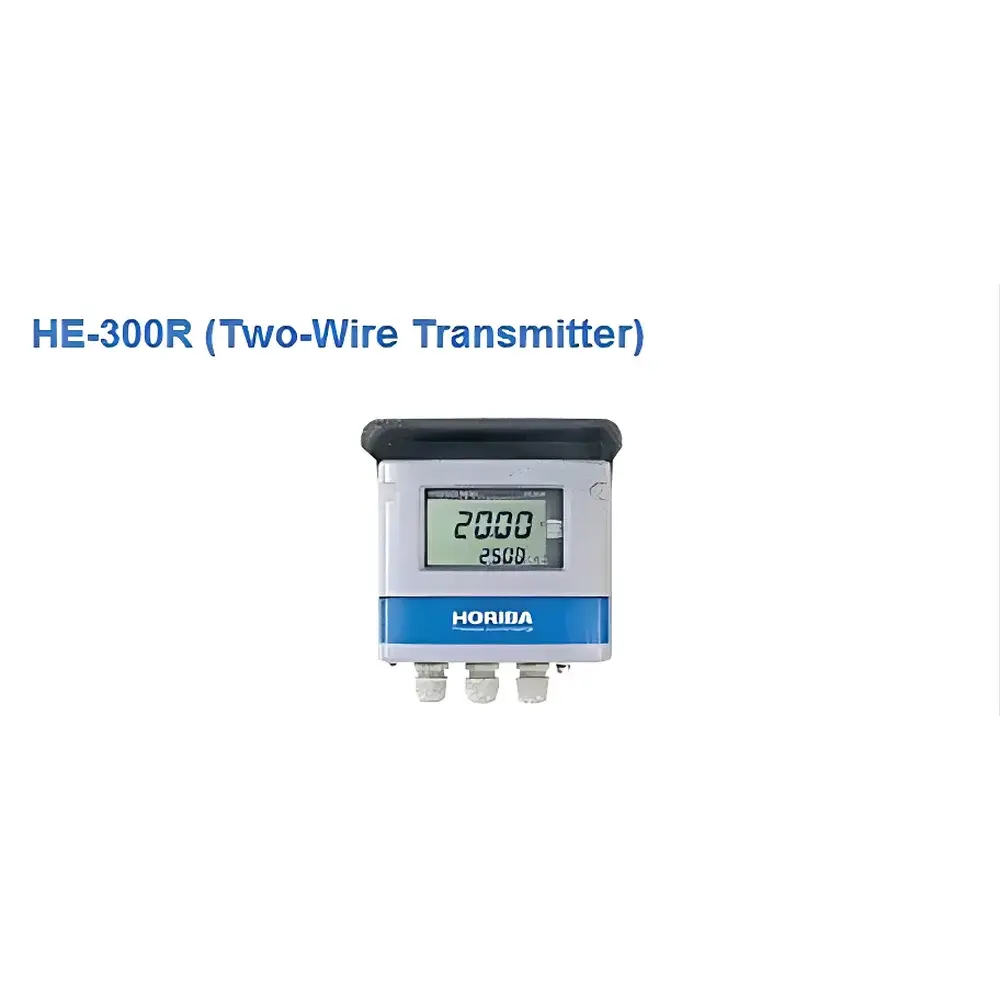
HORIBA HE-300R Industrial Online Resistivity Monitor
| Brand | HORIBA |
|---|---|
| Origin | Japan |
| Model | HE-300R |
| Enclosure Rating | IP65 |
| Measurement Principle | Two-Electrode Conductivity Method (Inverse Calculation for Resistivity) |
| Resistivity Range | 0.000–2.000 MΩ·cm (with 0.01 cm⁻¹ electrode), 0.00–20.00 kΩ·cm (with 0.1 cm⁻¹ electrode), 0.0–200.0 kΩ·cm (with 1.0 cm⁻¹ electrode) |
| Temperature Range | 0–100 °C |
| Temp. Resolution | 0.01 °C |
| Temp. Accuracy | ±0.02 °C (at reference point, Pt1000 sensor) |
| Resistivity Accuracy | ±0.01 MΩ·cm (max, calibrated per electrode constant) |
| Repeatability | ±0.1% (resistivity), ±0.1 °C (temperature) |
| Linearity | ±0.5% (resistivity), ±0.5 °C (temperature) |
| Output | Isolated 4–20 mA DC (max load 600 Ω) |
| Digital Interface | RS-485 (2-wire, galvanically isolated I/O) |
| Power Supply | 24 V DC (21–32 V DC operating range), ≤0.6 W |
| Operating Ambient | −20 to +60 °C |
| Housing Material | Anodized Aluminum |
| Mounting | Pole-mount (50A pipe) or wall-mount |
| Sensor Compatibility | HORIBA ERF-series resistivity sensors (e.g., ERF-001, electrode constant 0.01 cm⁻¹) |
| Compliance | CE, FCC, RoHS, WEEE |
Overview
The HORIBA HE-300R is a rugged, outdoor-rated industrial online resistivity monitor engineered for continuous, high-stability measurement of ultrapure and process water in demanding environments. It operates on the two-electrode conductivity principle—measuring conductance across a defined cell geometry and computing resistivity (ρ = K × R, where K is the cell constant and R is measured resistance). This inverse calculation enables precise tracking of ionic contamination levels in semiconductor rinse water, pharmaceutical water-for-injection (WFI) loops, power plant boiler feedwater, and high-purity cooling circuits. Designed as part of HORIBA’s H-1 series of field-deployable analyzers, the HE-300R features an IP65-rated aluminum enclosure, wide operating temperature tolerance (−20 to +60 °C), and intrinsic compatibility with ERF-series resistivity sensors—including the low-cell-constant ERF-001 (K = 0.01 cm⁻¹) optimized for sub-1 MΩ·cm to >18 MΩ·cm ranges. Its architecture prioritizes long-term calibration stability, minimal drift under thermal cycling, and immunity to electromagnetic interference common in industrial plants.
Key Features
- Rugged outdoor design with die-cast anodized aluminum housing and IP65 ingress protection—suitable for unsheltered mounting on utility poles or facility walls.
- Large-format backlit LCD display providing simultaneous real-time readouts of resistivity (MΩ·cm or kΩ·cm) and temperature (°C), with intuitive menu navigation and status icons.
- Integrated self-diagnostic system monitoring electrode integrity, signal continuity, sensor connection, and internal circuit health—alerts via display and configurable relay output.
- Temperature compensation using Pt1000 RTD (0 °C reference), programmable within 0–100 °C range; supports both linear and non-linear (standard curve) compensation models per application requirements.
- Configurable 4–20 mA analog output with galvanic isolation (600 Ω max load), supporting direct integration into DCS, PLC, or SCADA systems without signal degradation.
- RS-485 Modbus RTU interface (2-wire, isolated I/O) enabling multi-device daisy-chaining, remote parameter configuration, and firmware updates via standard industrial protocols.
- Secure mechanical design featuring screw-type terminal blocks (no spring clamps), preventing accidental disconnection in high-vibration settings; calibration history stored onboard with timestamped records.
Sample Compatibility & Compliance
The HE-300R is validated for use with deionized water, reverse osmosis permeate, distilled water, and ultrapure water streams meeting ASTM D1193 Type I/II, ISO 3696 Grade 1, or USP specifications. When paired with ERF-series sensors (e.g., ERF-001), it meets the metrological requirements for resistivity verification in GMP-compliant pharmaceutical water systems and semiconductor fab monitoring points. The instrument complies with EU directives including CE marking (EMC Directive 2014/30/EU and Low Voltage Directive 2014/35/EU), FCC Part 15 Class A emissions limits, RoHS 2011/65/EU (lead-free construction), and WEEE 2012/19/EU take-back obligations. Its analog and digital outputs support audit-ready data acquisition when integrated with systems adhering to FDA 21 CFR Part 11 (electronic records/signatures) and Annex 11 (computerized systems) requirements—provided appropriate validation protocols are applied at the system level.
Software & Data Management
While the HE-300R operates autonomously without external software, its RS-485 interface enables seamless communication with HORIBA’s optional LOGBOX data logger or third-party SCADA platforms supporting Modbus RTU. All configuration parameters—including electrode constant entry, temperature compensation mode, output scaling, relay hysteresis, and hold function activation—are adjustable via front-panel keypad or remote command. Calibration coefficients (for resistivity) and offset values (for temperature) are stored in non-volatile memory with write-protection logic. The unit retains up to 100 calibration events with date/time stamps and operator ID fields (if enabled via external authentication layer). No proprietary drivers or cloud dependencies are required; data export is achieved through standard serial-to-USB adapters or industrial protocol gateways.
Applications
- Real-time resistivity monitoring in semiconductor wet benches and DI water distribution loops (critical for particle control and trace metal detection).
- Continuous verification of purified water (PW) and water-for-injection (WFI) quality in pharmaceutical manufacturing, aligned with EU GMP Annex 1 and WHO TRS 970.
- Boiler feedwater purity assurance in thermal power generation—detecting condenser tube leakage or ion exchange breakthrough before turbine scaling occurs.
- Monitoring of reclaimed water conductivity/resistivity in zero-liquid-discharge (ZLD) systems to optimize membrane performance and chemical dosing.
- Environmental compliance tracking of effluent resistivity in electroplating or PCB manufacturing wastewater prior to discharge.
FAQ
What electrode constant options are supported?
The HE-300R accepts ERF-series sensors with cell constants of 0.01 cm⁻¹, 0.1 cm⁻¹, and 1.0 cm⁻¹; the selected constant must be manually entered during setup to ensure accurate resistivity computation.
Does the unit support automatic temperature compensation?
Yes—using the built-in Pt1000 sensor, the HE-300R applies either linear or user-defined non-linear compensation across the full 0–100 °C range, referenced to 25 °C unless otherwise specified.
Can the 4–20 mA output be configured for different measurement ranges?
Yes—the analog output span is fully programmable (e.g., 4 mA = 0.000 MΩ·cm, 20 mA = 18.250 MΩ·cm) to match DCS input expectations and maximize signal resolution.
Is the HE-300R suitable for hazardous area installation?
No—it is rated for general-purpose outdoor use (IP65) but lacks ATEX, IECEx, or UL Class I Div 2 certification; explosion-proof enclosures or remote sensor placement are required in classified zones.
How is calibration performed?
Resistivity calibration uses certified standard solutions (e.g., KCl standards traceable to NIST) and electrode constant verification; temperature calibration is performed via single-point comparison against a certified reference thermometer at a stable bath temperature.
Related Products







