
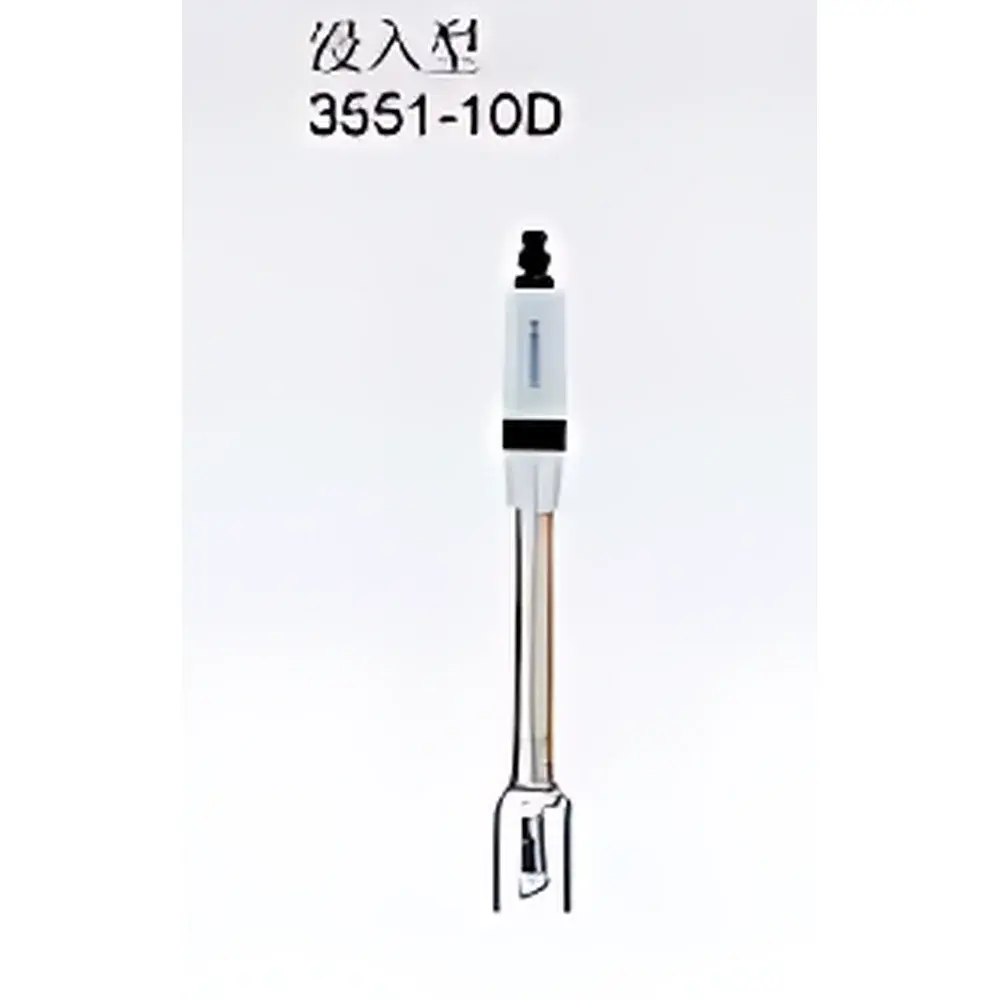
HORIBA 3551-10D Immersion-Type Conductivity Electrode
| Brand | HORIBA |
|---|---|
| Origin | Japan |
| Model | 3551-10D |
| Cell Constant | 10 m⁻¹ (0.1 cm⁻¹) |
| Conductivity Range | 10 µS/cm to 1 S/cm (0.1 µS/cm to 10 mS/cm) |
| Minimum Sample Volume | 50 mL |
| Operating Temperature Range | 0–60 °C |
| Part Number | 3014081712 (9056000800) |
Overview
The HORIBA 3551-10D is a precision-engineered immersion-type conductivity electrode designed for high-accuracy, stable measurement of aqueous and low-viscosity electrolyte solutions in laboratory, quality control, and process monitoring environments. Based on the principle of two-electrode AC conductance measurement, this sensor operates at a fixed frequency (typically 1 kHz) to minimize polarization effects and electrode fouling—ensuring reliable performance across a broad dynamic range. With a nominal cell constant of 10 m⁻¹ (0.1 cm⁻¹), the 3551-10D is optimized for medium-to-high conductivity applications, including industrial wastewater analysis, boiler feedwater monitoring, pharmaceutical buffer verification, and electroplating bath control. Its robust stainless-steel body and platinum black-plated electrodes provide long-term stability, chemical resistance, and reproducible calibration traceability per ISO 7888 and ASTM D1125 standards.
Key Features
- Immersion-type design with integrated temperature sensor (Pt1000 or thermistor, depending on configuration) enabling automatic temperature compensation (ATC) in real time
- Pt-black platinized electrodes for enhanced surface area, reduced polarization error, and improved signal-to-noise ratio
- Stainless-steel 316L housing rated IP67 for splash resistance and mechanical durability in routine lab handling
- Fixed cell constant (10 m⁻¹ / 0.1 cm⁻¹) certified via KCl standard solution calibration; traceable to NIST-traceable reference materials
- Optimized geometry for minimal flow dependency and consistent immersion depth sensitivity
- Compatible with HORIBA’s LAQUA twin series (e.g., LAQUA Twin B-771, LAQUA twin Compact) and modular benchtop meters (e.g., LAQUAact ES-300, D-74)
Sample Compatibility & Compliance
The 3551-10D supports aqueous samples with conductivity values from 10 µS/cm up to 1 S/cm—including tap water, saline solutions, acid/base titrants, nutrient media, and mild industrial effluents. It is not recommended for highly viscous, suspended-solid-laden, or strongly oxidizing media (e.g., concentrated HNO₃, hot chromic acid) without prior validation. The electrode complies with IEC 60746-3 for electrochemical analyzers and meets essential requirements under EU Directive 2014/30/EU (EMC) and 2011/65/EU (RoHS). When used in regulated environments (e.g., pharmaceutical QC labs), its calibration and usage records support GLP/GMP documentation workflows, and data integrity is maintained when paired with HORIBA’s FDA 21 CFR Part 11-compliant software platforms (e.g., LAQUA Studio v3.x).
Software & Data Management
When connected to compatible HORIBA meters equipped with USB or Bluetooth connectivity, the 3551-10D enables timestamped, audit-trail-enabled data logging. LAQUA Studio software provides instrument configuration management, multi-point calibration curve generation (linear or non-linear), uncertainty estimation per ISO/IEC 17025 guidelines, and export to CSV/PDF for QA review. All calibration events—including date, operator ID, standard lot number, and measured deviation—are automatically archived with digital signatures where enabled. Raw conductivity and temperature readings are stored with 0.1 µS/cm resolution and ±0.3% full-scale accuracy (typical), supporting trend analysis and statistical process control (SPC) charting.
Applications
- Monitoring conductivity of purified water (PW) and water-for-injection (WFI) per USP and EP 2.2.38
- Verification of cleaning-in-place (CIP) rinse endpoints in biopharmaceutical manufacturing
- Real-time tracking of ion exchange resin exhaustion in demineralization systems
- Concentration control of etchants and passivation baths in semiconductor and metal finishing lines
- Educational use in physical chemistry laboratories for Kohlrausch’s law validation and molar conductivity studies
FAQ
What is the recommended calibration frequency for the 3551-10D in routine QC use?
Calibration should be performed before each analytical session or at least once per shift when used continuously; daily verification with a mid-range standard (e.g., 1413 µS/cm KCl) is advised.
Can this electrode be used in pressurized or flowing systems?
No—it is strictly an immersion-type electrode and must be used in static or gently stirred vessels. For inline or flow-through applications, consider the 3561-10D or 3562-10D series.
Is the 3551-10D compatible with non-HORIBA meters?
Yes, provided the meter supports analog (mV) or digital (RS-232/USB) input for two-electrode conductivity sensors with 10 m⁻¹ cell constant and offers manual cell constant entry.
How should the electrode be cleaned after measuring high-salt or protein-containing samples?
Rinse thoroughly with deionized water, then soak for 5–10 minutes in 0.1 M HNO₃ (for inorganic deposits) or 0.1% SDS solution (for organic fouling), followed by triple DI water rinse and air drying.
Does the electrode include temperature compensation capability?
Yes—the integrated temperature sensor enables automatic temperature compensation (ATC) when connected to a compatible HORIBA meter; the default algorithm applies the linear temperature coefficient (α = 2.0%/°C) unless user-defined polynomial correction is configured.




