
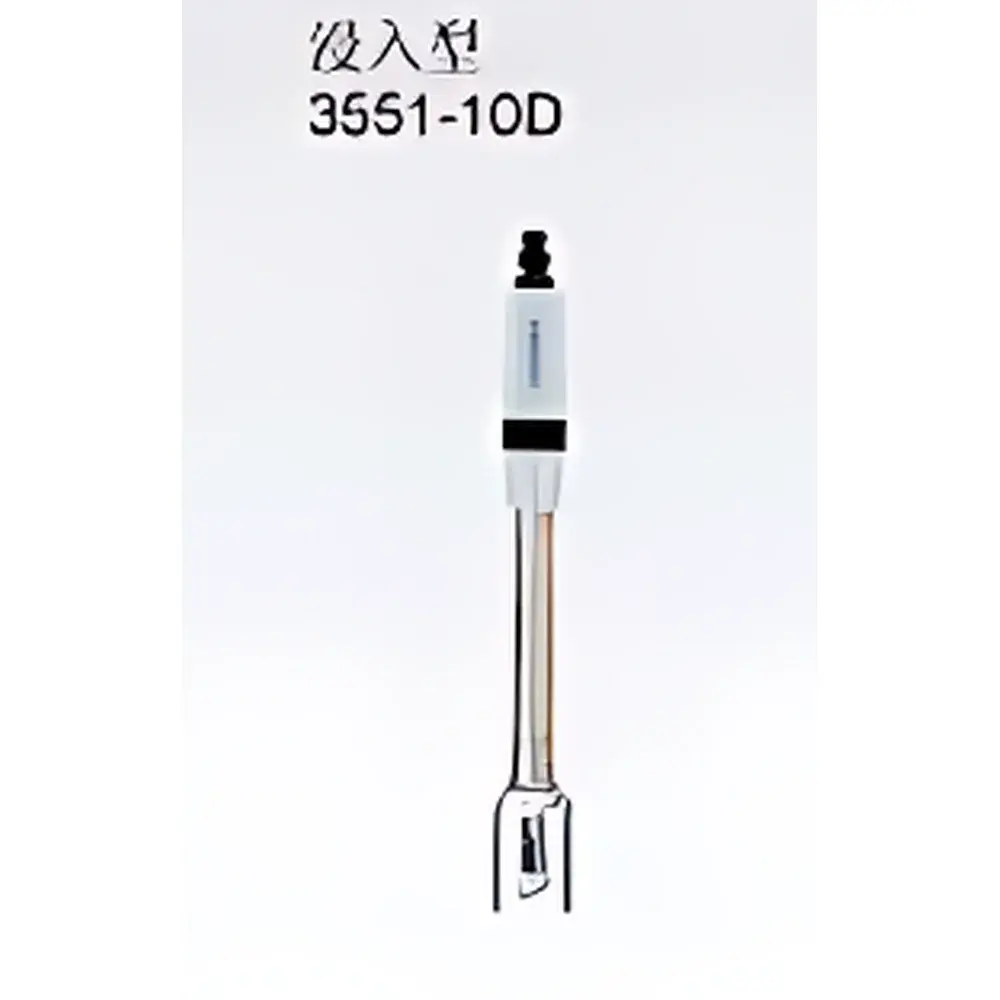
HORIBA 3551-10D Immersion-Type Conductivity Electrode
| Brand | HORIBA |
|---|---|
| Origin | Japan |
| Model | 3551-10D |
| Cell Constant | 10 m⁻¹ (0.1 cm⁻¹) |
| Conductivity Range | 10 µS/cm to 1 S/cm (0.1 µS/cm to 10 mS/cm) |
| Minimum Sample Volume | 50 mL |
| Operating Temperature Range | 0–60 °C |
| Part Number | 3014081712 (9056000800) |
Overview
The HORIBA 3551-10D is a precision-engineered immersion-type conductivity electrode designed for reliable, high-reproducibility measurements in laboratory and quality control environments. Based on the fundamental principle of two-electrode AC conductometry—where an alternating current minimizes polarization effects and electrode fouling—the 3551-10D delivers stable readings across a broad dynamic range. Its cell constant of 10 m⁻¹ (0.1 cm⁻¹) is optimized for low-to-moderate conductivity samples, including ultrapure water, pharmaceutical buffers, process rinse solutions, and environmental aqueous matrices. Constructed with platinum electrodes and PEEK (polyether ether ketone) housing, the probe exhibits excellent chemical resistance to acids, bases, and organic solvents, ensuring long-term stability under routine calibration and measurement cycles. The electrode is fully compatible with HORIBA’s LAQUA series benchtop and portable conductivity meters (e.g., LAQUA twin, LAQUA TR, and LAQUA DO-300), as well as third-party instruments supporting analog or digital (RS-232/USB) conductivity input protocols.
Key Features
- Immersion-type configuration with fixed geometry and defined electrode surface area for consistent cell constant (10 m⁻¹ / 0.1 cm⁻¹)
- Platinum black-plated electrodes for enhanced surface area, reduced impedance, and improved signal-to-noise ratio
- PEEK body material offering superior mechanical strength, thermal stability, and resistance to hydrolysis and aggressive reagents
- Integrated temperature sensor (NTC thermistor) enabling automatic temperature compensation (ATC) per ASTM D1125 and ISO 7888 standards
- No internal reference electrolyte required—eliminates maintenance, leakage risk, and contamination concerns associated with four-electrode or reference-based systems
- Calibration traceable to NIST-certified KCl standard solutions (e.g., 0.01 mol/kg, 0.1 mol/kg); supports single-point or multi-point verification
Sample Compatibility & Compliance
The 3551-10D is validated for use with aqueous solutions exhibiting conductivity between 10 µS/cm and 1 S/cm. It accommodates minimum sample volumes of 50 mL—ideal for batch testing of purified water (PW), water-for-injection (WFI), cleaning validation swab extracts, and effluent monitoring. The electrode meets key regulatory expectations for data integrity: its design supports GLP-compliant workflows when paired with HORIBA’s LAQUA software, which provides audit-trail-enabled calibration logs, user authentication, and electronic signatures compliant with FDA 21 CFR Part 11 requirements. Performance aligns with ISO 17025 accreditation criteria for conductivity measurement uncertainty, and its temperature-compensated output conforms to IEC 60746-3 for electrochemical analyzers.
Software & Data Management
When connected to HORIBA’s LAQUA TR or LAQUA twin platforms, the 3551-10D leverages embedded firmware that auto-detects cell constant and applies configurable linear or non-linear (e.g., NaCl curve) temperature compensation algorithms. Data export is supported via CSV or Excel-compatible formats through USB or Bluetooth interfaces. The optional LAQUA PC Software (v3.0+) enables real-time graphing, statistical trend analysis (e.g., moving average, RSD calculation), and automated report generation—including instrument ID, operator ID, timestamp, calibration history, and raw conductivity/temperature pairs. All measurement records are time-stamped with millisecond precision and stored with immutable metadata—critical for QA/QC documentation in regulated pharmaceutical and semiconductor manufacturing settings.
Applications
- Pharmaceutical water system monitoring (USP , EP 2.2.38, JP 2.05)
- Conductivity verification during cleaning-in-place (CIP) and sterilization-in-place (SIP) validation
- Electrolyte concentration tracking in battery electrolyte formulation and recycling processes
- Environmental water quality assessment (surface water, wastewater influent/effluent)
- Quality assurance of buffer solutions, diluents, and excipients in biologics manufacturing
- Research applications requiring reproducible low-conductivity measurements (e.g., deionized water aging studies)
FAQ
What is the recommended calibration frequency for the 3551-10D in GMP environments?
Calibration should be performed before each analytical session or at least once per shift, using two NIST-traceable KCl standards bracketing the expected sample range. A full system suitability test—including drift check and repeatability assessment—is required prior to release testing.
Can the 3551-10D be used for high-salinity seawater samples?
No. Its upper limit of 1 S/cm makes it unsuitable for undiluted seawater (~5 S/cm). For such matrices, the 3553-10D (1000 m⁻¹) or 3562-10D (100 m⁻¹) is recommended.
Is sterilization or autoclaving supported?
The 3551-10D is not autoclavable due to thermal limits of the PEEK housing and embedded electronics. It may be sanitized using 70% ethanol or 0.5% sodium hypochlorite followed by thorough rinsing with purified water.
Does the electrode require periodic platinization renewal?
Platinum black coating is factory-applied and stable under normal use. Degradation is indicated only by rising zero-point drift (>±2% FS) or nonlinear response—typically after >2 years of continuous operation in aggressive media.
How is cell constant verification performed?
Using certified KCl solutions at 25 °C, measure conductivity and calculate actual cell constant as K = L/A = R × σ, where R is measured resistance and σ is certified conductivity. Deviation >±2% from nominal 10 m⁻¹ warrants recalibration or replacement.





