
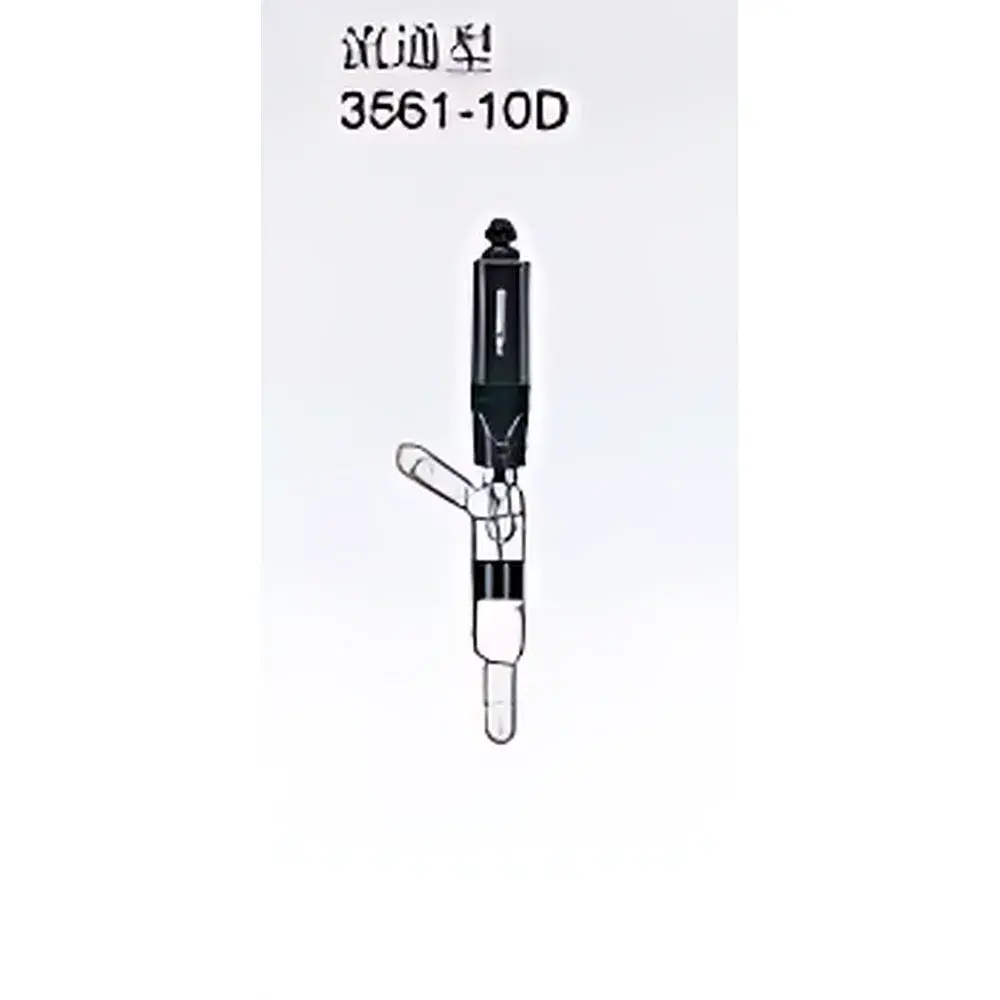
HORIBA 3561-10D Flow-Through Conductivity Electrode
| Brand | HORIBA |
|---|---|
| Origin | Japan |
| Model | 3561-10D |
| Cell Constant | 10 m⁻¹ (0.1 cm⁻¹) |
| Conductivity Range | 10 μS/cm to 1 S/cm (0.1 μS/cm to 10 mS/cm) |
| Minimum Sample Volume | 10 mL |
| Operating Temperature Range | 0–60 °C |
| Part Number | 3014082350 (Legacy: 9056001100) |
Overview
The HORIBA 3561-10D is a precision-engineered flow-through conductivity electrode designed for continuous, real-time monitoring of aqueous electrolyte solutions in process control, environmental monitoring, and laboratory-based quality assurance workflows. Based on the four-electrode (tetrapolar) AC conductometric principle, this electrode eliminates polarization errors and contact resistance effects common in two-electrode systems—ensuring high reproducibility and long-term stability across varying ionic strengths. Its cell constant of 10 m⁻¹ (0.1 cm⁻¹) optimizes sensitivity for low-to-moderate conductivity samples, covering a calibrated range from 10 μS/cm to 1 S/cm (equivalent to 0.1 μS/cm to 10 mS/cm when referenced to standard calibration protocols). The electrode is constructed with inert platinum electrodes and chemically resistant PEEK and ETFE housing, enabling reliable operation in aggressive media including mild acids, bases, and saline solutions.
Key Features
- Tetrapolar AC measurement architecture minimizes electrode polarization and eliminates cable capacitance interference, critical for stable readings in dynamic flow streams.
- Optimized flow cell geometry ensures laminar flow profile and uniform current distribution—reducing residence time variability and improving response time (< 3 s typical T₉₀).
- Integrated temperature sensor (Pt1000) enables automatic temperature compensation per ASTM D1125 and ISO 7888 standards, supporting linear and non-linear (e.g., natural logarithm) compensation algorithms.
- PEEK body and platinum sensing elements provide exceptional chemical compatibility with pH 2–12 solutions and resistance to biofouling in municipal wastewater or fermentation broths.
- Compact 10 mL minimum sample volume requirement allows integration into microfluidic manifolds, inline bioreactor loops, and low-volume analytical skids without compromising measurement integrity.
- IP67-rated connector interface and silicone-free sealing ensure robustness in humid or washdown environments compliant with IEC 60529 specifications.
Sample Compatibility & Compliance
The 3561-10D is validated for use with deionized water, boiler feedwater, pharmaceutical rinse solutions, nutrient media, and industrial cooling circuits. It meets material compatibility requirements outlined in USP for purified water conductivity testing and supports GLP/GMP documentation workflows through traceable calibration certificates (NIST-traceable KCl standards). When paired with HORIBA’s LAQUA twin series or standalone conductivity transmitters (e.g., LAQUA Twin B-771), the system satisfies FDA 21 CFR Part 11 data integrity criteria—including electronic signatures, audit trails, and user-access controls—when configured with appropriate firmware and network authentication.
Software & Data Management
The electrode interfaces seamlessly with HORIBA’s LAQUA Connect software (v3.2+) and third-party SCADA/DCS platforms via analog 4–20 mA output or digital RS-485 Modbus RTU protocol. Raw conductivity and temperature values are timestamped at configurable intervals (100 ms to 5 min), with internal memory buffering up to 10,000 records during communication outages. Calibration history—including date, operator ID, standard used (e.g., 1413 μS/cm KCl), and deviation metrics—is automatically archived and exportable as CSV or PDF for regulatory review. Software-assisted multi-point calibration routines support up to five standard points, with residual error reporting aligned with ISO/IEC 17025 uncertainty budgeting practices.
Applications
- In-line monitoring of reverse osmosis (RO) permeate and ultrapure water (UPW) loops in semiconductor fabrication facilities.
- Real-time conductivity feedback control in biopharmaceutical buffer preparation systems (ISO 13485-compliant).
- Continuous effluent screening in municipal wastewater treatment plants per EPA Method 120.1.
- Concentration tracking of cleaning-in-place (CIP) solutions in food & beverage processing lines.
- Lab-scale validation of ion exchange resin breakthrough in column chromatography setups.
- Environmental field deployment with portable meters for surface water quality assessment (ASTM D5391-compliant).
FAQ
What is the recommended calibration frequency for the 3561-10D in continuous operation?
Calibration should be performed prior to initial use, after maintenance, and at least once per 24-hour operational cycle in GMP environments; daily verification using a single-point check standard is acceptable if full calibration history demonstrates ≤ ±1.5% deviation over 7 days.
Can this electrode be sterilized in place (SIP) using steam?
No—steam sterilization exceeds the 60 °C upper temperature limit and may compromise epoxy seals and Pt electrode adhesion. Autoclaving is not supported; use chemical sanitants such as 0.5% peracetic acid or 70% ethanol instead.
Is the 3561-10D compatible with non-aqueous solvents?
It is not designed for organic solvents (e.g., methanol, acetone) due to potential swelling of PEEK components and inaccurate dielectric response; conductivity measurements are valid only for aqueous or highly polar solvent systems with ≥ 50% water content.
How is cell constant verified post-installation?
Cell constant verification requires measurement of a certified reference solution (e.g., 1413 μS/cm KCl at 25 °C) and calculation of observed vs. certified value ratio; deviation > ±2% warrants re-calibration or physical inspection for fouling or damage.
Does HORIBA supply NIST-traceable calibration certificates with each unit?
Yes—each 3561-10D ships with a factory-issued certificate listing serial-number-specific cell constant, temperature coefficient, and verification data against NIST SRM 3194 (KCl solutions), valid for 12 months from date of manufacture.
Related Products






