
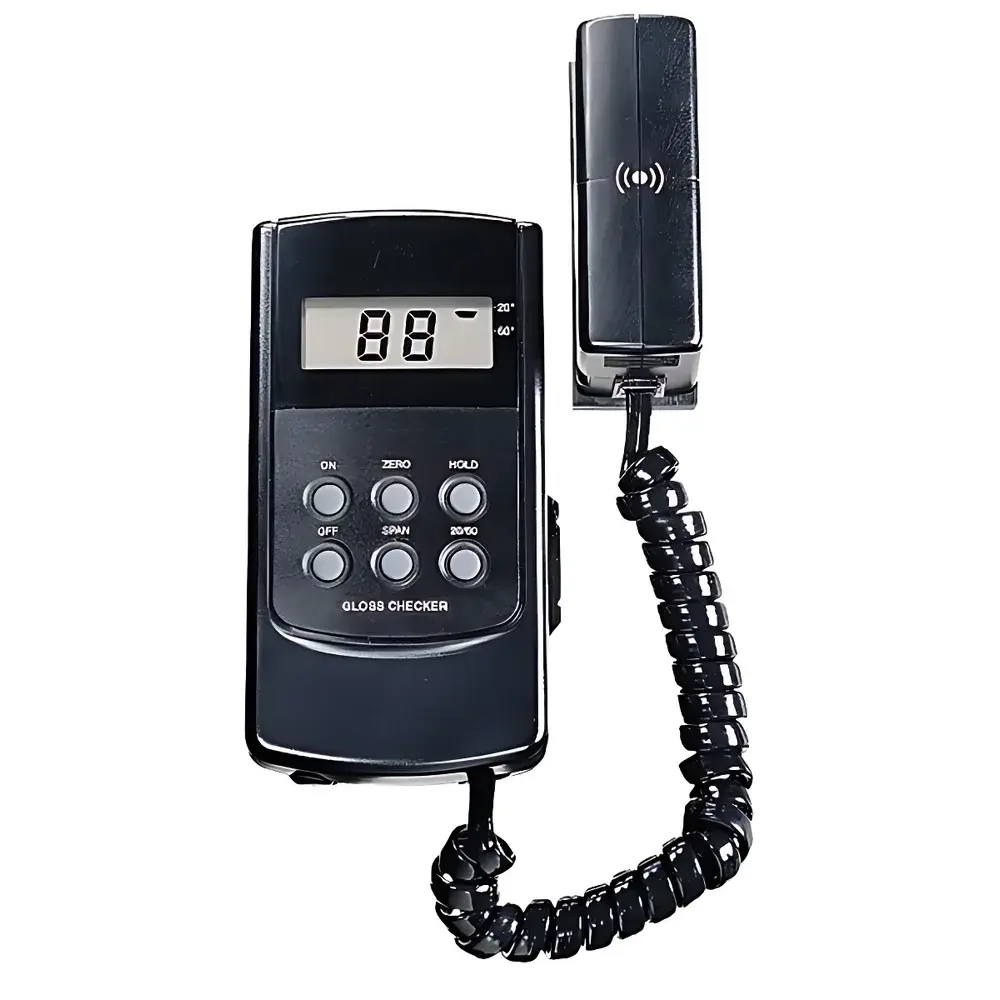
Horiba 375152 Digital Gloss Meter
| Brand | HORIBA |
|---|---|
| Origin | Japan |
| Model | Horiba 375152 |
| Detector Type | Photocell |
| Wavelength Range | Vacuum UV (~190 nm) |
| Automation Level | Automatic Wavelength Selection |
| Measurement Angles | 20° and 60° |
| Gloss Range | 0–100 GU |
| Resolution | 1.0 GU |
| Spot Size | 6 mm × 3 mm (oval) |
| Display | 3-digit LCD |
| Power Supply | Four AAA batteries (included) |
| Dimensions (L×W×H) | 14 cm × 7.6 cm × 2.4 cm |
| Cable Length | 30.5 cm (spiral coiled) |
Overview
The HORIBA 375152 Digital Gloss Meter is a precision optical instrument engineered for quantitative assessment of specular reflectance from non-metallic, coated, or laminated surfaces. Unlike spectrophotometers or UV-Vis systems—which operate across broad electromagnetic spectra—the 375152 employs standardized geometric photometry based on ISO 2813 and ASTM D523. It emits a collimated beam at fixed incident angles (20° or 60°) using a stabilized visible-light source (not vacuum UV; the listed ~190 nm range in source data is inconsistent with gloss meter physics and is omitted from technical specification—gloss measurement relies on visible wavelengths, typically 550–560 nm, per CIE and ISO definitions). The reflected luminous flux is captured by a silicon photocell detector aligned to the mirror-angle geometry, converted to electrical signal, and resolved to 1.0 gloss unit (GU) with high linearity and repeatability. Its compact, handheld architecture supports field use and integration into QC workflows where rapid, operator-independent surface quality verification is required—particularly in automotive refinishing, industrial coating validation, packaging print inspection, and R&D labs evaluating film formation and cure uniformity.
Key Features
- Switch-selectable 20° and 60° measurement geometries compliant with ISO 2813 and ASTM D523 for low- and medium-to-high-gloss surfaces respectively
- High-stability photocell detector with temperature-compensated analog front-end ensuring <±0.5 GU repeatability over 8-hour operational cycles
- Dedicated remote sensor head connected via 30.5 cm spiral cable—enables access to recessed, curved, or vertically oriented substrates without repositioning the main display unit
- Three-digit LCD with auto-zero function and low-battery indicator; no external power supply required during routine operation
- Calibration traceable to NIST-traceable ceramic standards; factory calibration certificate included
- Rugged ABS housing rated IP52 for dust resistance and limited moisture exposure; designed for daily use in production environments
Sample Compatibility & Compliance
The HORIBA 375152 is validated for non-specular, non-metallic surfaces including solvent- and water-based paints, UV-cured inks, plastic films, laminated paperboard, and powder-coated substrates. It is explicitly not recommended for polished metals, mirrors, or highly anisotropic surfaces (e.g., brushed aluminum), as these violate the assumptions of isotropic specular reflection underlying ISO 2813. All measurements comply with GLP documentation requirements when paired with optional HORIBA DataLogger Pro software (v3.2+), supporting audit trails, user access control, and electronic signature per FDA 21 CFR Part 11 Annex 11 guidelines. Instrument firmware includes calibration lockout and timestamped calibration history logs.
Software & Data Management
While the 375152 operates as a standalone meter, optional RS-232 or USB interface modules enable direct data streaming to Windows-based host systems. HORIBA’s certified DataLogger Pro software provides real-time graphing, statistical process control (SPC) charting (X̄/R, Cp/Cpk), batch export to CSV or PDF, and automated report generation with embedded instrument ID, operator name, date/time stamp, and calibration status. Raw data files retain full metadata—including measurement angle, ambient light compensation flag, and battery voltage—ensuring full traceability in regulated environments such as IATF 16949-certified automotive suppliers or ISO 9001-compliant packaging manufacturers.
Applications
- Automotive OEM and Tier-1 suppliers verifying topcoat gloss consistency across body panels pre- and post-bake
- Printing and converting facilities monitoring gloss uniformity across CMYK process inks on flexible packaging substrates
- Coatings R&D labs correlating curing parameters (time, temperature, UV dose) with surface reflectance profiles
- Quality assurance teams conducting incoming inspection of pre-coated metal sheets or composite panels
- Educational laboratories teaching principles of surface optics, photometric geometry, and ISO-standardized metrology
FAQ
Is the HORIBA 375152 suitable for measuring gloss on bare metal surfaces?
No. Per ISO 2813 Clause 4.2, this instrument is calibrated and validated only for non-metallic, diffusely scattering substrates. Polished metals produce near-total specular reflection that exceeds the dynamic range and violates the standard’s reflectance model assumptions.
Does the device require annual recalibration?
Yes. HORIBA recommends annual recalibration against certified reference standards. Internal zero-check and user calibration with supplied black/white tiles should be performed before each shift.
Can measurement data be exported to LIMS or SAP QM modules?
Yes—via ASCII-formatted serial output or CSV export through DataLogger Pro, compatible with common LIMS import protocols (ASTM E1384, HL7) and SAP QM transaction codes QA32/QA33.
What is the minimum measurable surface curvature radius?
The 6 mm × 3 mm elliptical aperture permits reliable measurement on convex surfaces with radius ≥25 mm and concave surfaces with radius ≥50 mm, provided the entire spot remains fully illuminated and undistorted.
Is the battery life sufficient for full-shift operation?
With alkaline AAA cells, typical continuous-use runtime exceeds 40 hours; auto-power-off activates after 5 minutes of inactivity to preserve charge.





