
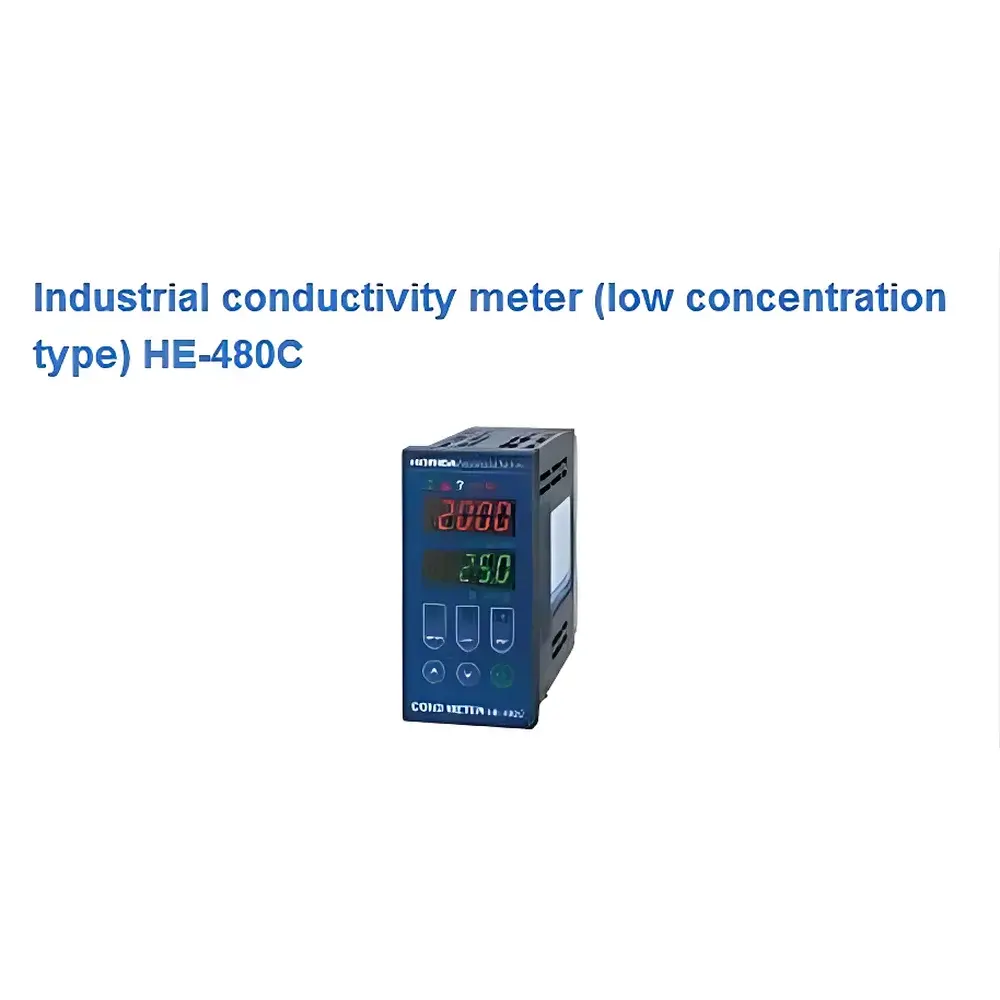
HORIBA HE-480C Industrial Online Conductivity Monitor
| Brand | HORIBA |
|---|---|
| Origin | Japan |
| Model | HE-480C |
| Enclosure | Aluminum, IP65-rated |
| Compliance | CE, FCC, RoHS, WEEE |
| Input Channels | 1-channel conductivity sensor interface |
| Electrode Constants Supported | 0.01 cm⁻¹, 0.1 cm⁻¹, 1.0 cm⁻¹ |
| Conductivity Range (selectable per electrode constant) | 2.000–20.00 µS/cm (0.01 cm⁻¹), 20.00–200.0 µS/cm (0.1 cm⁻¹), 200.0–2000 µS/cm / 0.2000–2.000 mS/cm / 2.000–20.00 mS/cm / 20.00–200.0 mS/cm (1.0 cm⁻¹) |
| TDS Range | 2.00–20.0 mg/L, 20.0–200 mg/L, 200–2000 mg/L (user-defined conversion factor 0.30–1.00) |
| Temperature Range | 0–100 °C (adjustable decimal places: 0/1/2) |
| Repeatability | ±0.5% of full scale (conductivity), ±1.5% FS (TDS) |
| Analog Output | 4–20 mA DC, isolated, max. load 900 Ω |
| Relay Outputs | 2 × SPDT (240 V AC / 30 V DC, 3 A resistive) |
| Temp. Compensation Options | Ultra-pure water mode (ref. 25 °C), user-defined reference temp. (5–95 °C) & temp. coefficient (±5 %/°C), NaCl curve, or none |
| Sensor Compatibility | HORIBA ESH-series and FS-series conductivity sensors |
| Power Supply | 90–264 V AC, 50/60 Hz, ≤10 VA |
| Operating Ambient | −5 to +45 °C |
| Weight | ~4.5 kg |
Overview
The HORIBA HE-480C is a rugged, outdoor-rated industrial online conductivity monitor engineered for continuous, high-reliability measurement in demanding water quality monitoring applications. Based on two-electrode or four-electrode conductometric principles—depending on the connected ESH or FS series sensor—the instrument delivers stable, temperature-compensated conductivity data across a wide dynamic range. Its design prioritizes operational continuity in wastewater treatment plants, industrial effluent discharge points, cooling water circuits, boiler feedwater systems, and process water loops where real-time ionic strength assessment is critical for regulatory compliance and process control. Unlike benchtop or portable meters, the HE-480C integrates directly into plant infrastructure via DIN-rail mounting or wall installation, featuring a sealed aluminum housing rated IP65 for protection against dust ingress and water jets. The unit operates autonomously without PC dependency, supporting unattended long-term deployment under ambient conditions from −5 °C to +45 °C.
Key Features
- IP65-rated aluminum enclosure with corrosion-resistant finish, certified to CE and FCC electromagnetic compatibility standards
- Large, high-contrast LCD display with adjustable backlight—enables at-a-glance verification of conductivity, TDS, temperature, and system status even in low-light or outdoor environments
- Dual relay outputs (R1/R2) configurable for alarm thresholds (high/low), maintenance alerts, USP General Chapter <645> deviation flags, or pump interlock logic
- Isolated 4–20 mA analog output with scalable full-scale assignment—compatible with DCS, SCADA, and PLC systems for centralized data acquisition and trending
- Comprehensive self-diagnostic capability including sensor open-circuit detection, cable resistance monitoring, and calibration history logging (date/time-stamped)
- Flexible temperature compensation: selectable ultra-pure water algorithm (IEC 60746-3 compliant), NaCl-based linearization, user-defined reference temperature (5–95 °C), and temperature coefficient (±5 %/°C)
- Screw-terminal wiring with captive hardware—eliminates risk of loose connections in vibration-prone industrial settings
Sample Compatibility & Compliance
The HE-480C interfaces exclusively with HORIBA’s ESH (electrochemical shielded) and FS (flow-through stainless steel) conductivity sensors, supporting electrode constants of 0.01 cm⁻¹ (for ultrapure water), 0.1 cm⁻¹ (for potable and surface waters), and 1.0 cm⁻¹ (for high-conductivity industrial effluents or brines). It meets essential requirements for environmental monitoring under ISO 5667-22 (water quality — sampling — guidance on field instrumentation) and supports audit-ready operation in regulated facilities. While not intrinsically safe, its construction satisfies EN 61326-1 (industrial EMC) and EN 61000-6-2/-4. For pharmaceutical or biotech applications requiring electronic record integrity, the device supports manual calibration logs traceable to NIST-traceable standards—but does not include FDA 21 CFR Part 11-compliant electronic signatures or audit trails, as it lacks network connectivity or user authentication.
Software & Data Management
The HE-480C operates as a standalone analyzer with no embedded firmware-upgrade path or cloud connectivity. All configuration—including electrode constant entry, TDS conversion factor (0.30–1.00), relay hysteresis, display units, and temperature compensation mode—is performed locally via membrane keypad navigation. Calibration data (date, operator ID if manually entered, sensor ID, and offset/gain values) is retained in non-volatile memory for ≥100 cycles. No proprietary software is required; however, the 4–20 mA output permits integration with third-party historian platforms (e.g., Siemens Desigo, Honeywell Experion, or Ignition SCADA) for long-term trend analysis, alarm correlation, and report generation aligned with ISO 17025 or GLP documentation frameworks.
Applications
- Continuous monitoring of influent and effluent conductivity in municipal and industrial wastewater treatment plants per EPA Method 120.1 and ISO 7888
- Boiler feedwater purity assurance in power generation and steam-cycle facilities (ASTM D4582, ASTM D511)
- Reverse osmosis (RO) and deionization (DI) system performance validation—detecting membrane breach or resin exhaustion via conductivity spike detection
- Process water quality control in semiconductor fab ultrapure water (UPW) loops (SEMI F57, IEC 60746-3)
- Chemical dosing feedback control in cooling towers and closed-loop HVAC systems
- Environmental compliance reporting for NPDES permits and local discharge consent limits
FAQ
Does the HE-480C support digital communication protocols such as Modbus RTU or HART?
No. The HE-480C provides only analog (4–20 mA) and discrete (relay) I/O. It does not feature serial or fieldbus interfaces.
Can it measure resistivity directly, or is it derived from conductivity?
Resistivity is calculated in real time as the reciprocal of conductivity (ρ = 1/σ) and displayed alongside conductivity and TDS values.
Is temperature measurement performed by the sensor or the transmitter?
Temperature is measured by an integrated Pt1000 RTD within the HE-480C housing—no external probe is required unless using a remote sensor with built-in temperature compensation.
What calibration standards are recommended for routine verification?
NIST-traceable KCl solutions (e.g., 84 μS/cm, 1413 μS/cm, 12.88 mS/cm) appropriate to the selected electrode constant and expected sample range.
How often should calibration be performed in continuous operation?
Calibration frequency depends on application severity: weekly for aggressive industrial effluents; monthly for treated drinking water; quarterly for stable UPW loops—always validated against documented SOPs.







