
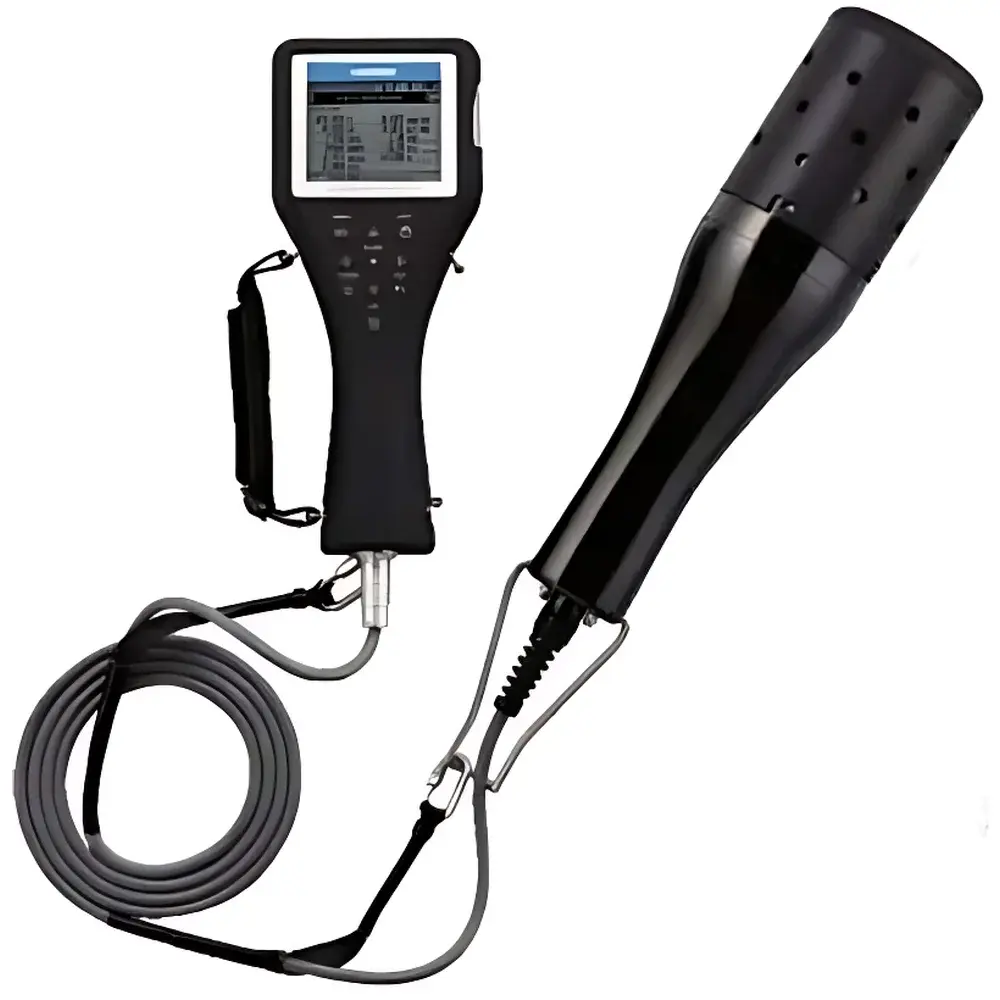
HORIBA U-50 Series Multi-Parameter Portable Water Quality Analyzer
| Brand | HORIBA |
|---|---|
| Origin | Japan |
| Model | U-50 Series |
| Instrument Type | Portable / Handheld Water Quality Analyzer |
| Measurable Parameters | pH, ORP, Dissolved Oxygen (DO), Electrical Conductivity (EC), Salinity, TDS, Specific Gravity (Seawater), Temperature, Turbidity (NTU), Water Depth (m), GPS Positioning |
| Turbidity Standards | U-53 — US EPA Method |
| Operating Temperature Range | −10 to 55 °C |
| Depth Measurement Range | up to 30 m |
| IP Rating | IP67 (instrument), IP68 (probe) |
| Battery Life | up to 70 h (alkaline AA × 4, backlight off) |
| Data Storage | 10,000 measurement sets |
| Communication | USB |
| Display | 320 × 240 monochrome LCD with backlight |
Overview
The HORIBA U-50 Series is a field-deployable, multi-parameter water quality analyzer engineered for high-reliability in situ monitoring of freshwater, groundwater, estuarine, and wastewater environments. Built on electrochemical, optical, and pressure-based sensing principles, the U-50 platform integrates calibrated glass electrode (pH), platinum redox (ORP), Clark-type polarographic (DO), four-electrode AC conductivity (EC), and dual-wavelength (LED/tungsten) nephelometric turbidity detection into a single ruggedized probe assembly. Its modular architecture supports seven configurable probe variants (U-51 through U-54G), enabling mission-specific sensor loading—whether for regulatory compliance sampling per US EPA or EU water framework directives, long-term ecological monitoring, or rapid response assessment during environmental incidents. The instrument’s sealed housing meets JIS C 0920 IP67 (main unit) and IP68 (probe submersion to 30 m), with wetted materials selected for chemical resistance—including PEEK, titanium, SUS316L stainless steel, FKM elastomers, and FEP membranes—to ensure stability across aggressive matrices (e.g., high-chloride seawater, acidic mine drainage, or organic-laden effluents).
Key Features
- Rugged field-portable design: 1.8 kg total system weight (probe + console), ergonomic handheld form factor, and shock-absorbing polymer casing rated to JIS IP67/IP68.
- Simultaneous real-time display of up to 11 parameters: pH, mV (ORP), DO (mg/L), EC (S/m), salinity (ppt), TDS (g/L), seawater specific gravity (δt), temperature (°C), turbidity (NTU), depth (m), and GPS coordinates (12-channel, U-52G/U-53G/U-54G models).
- Dual-standard turbidity measurement: U-53 probes comply with US EPA Method 180.1 (forward-scatter LED, 30°), while U-54 probes conform to EN ISO 7027 (90° tungsten-light scatter), both offering 0.01 NTU resolution and integrated self-cleaning brush mechanisms to mitigate biofouling.
- Enhanced DO sensor kinetics: Optimized membrane diffusion path and cathode geometry reduce response time (t90) by >30% versus prior-generation polarographic cells; simplified cap replacement and electrolyte refill protocol minimizes field maintenance downtime.
- Intelligent calibration management: Auto-recognition of pH 4.01 buffer; two-point pH/DO/EC calibration routines with traceable reference point storage; built-in temperature compensation algorithms compliant with ASTM D1129 (conductivity) and ISO 5814 (DO).
- Extended operational endurance: Four AA alkaline batteries deliver ≥70 hours continuous operation (backlight off, 20 °C ambient); optional 10 m or 30 m probe cables support deep-profile profiling without tether constraints.
Sample Compatibility & Compliance
The U-50 Series is validated for direct immersion in natural waters (rivers, lakes, springs), municipal and industrial effluents, brackish estuaries (0–70 ppt salinity), and seawater. Probe materials resist corrosion from chloride, sulfide, hydrogen sulfide, and low-pH conditions (pH 0–14). Regulatory alignment includes: US EPA-approved turbidity methodology (U-53), EN ISO 7027 certification (U-54), ASTM D1293 (pH), ASTM D3693 (ORP), ASTM D5391 (conductivity), and ISO 5814 (dissolved oxygen). Data integrity complies with GLP requirements via timestamped, non-editable internal logging (10,000 records), USB export in CSV format, and optional audit-trail-enabled software for 21 CFR Part 11–governed laboratories.
Software & Data Management
Instrument data are transferred via USB to HORIBA’s proprietary U-50 Data Manager software (Windows-compatible), supporting batch calibration verification, statistical summary reports (mean, SD, min/max), spatial mapping (GPS-tagged profiles), and export to LIMS-ready formats (CSV, Excel). The software enforces electronic signature workflows, version-controlled method templates, and automatic metadata embedding (operator ID, location, calibration history). Raw sensor outputs—including analog voltage traces for troubleshooting—are retained alongside processed values, facilitating root-cause analysis of drift or outlier events.
Applications
- Regulatory compliance monitoring: Routine discharge verification per NPDES permits, WFD Article 5 reporting, and drinking water source surveillance (WHO/EPA guideline parameter sets).
- Environmental impact assessment: Pre-/post-construction baseline studies, sediment porewater profiling, and acid mine drainage characterization.
- Aquatic ecosystem health evaluation: Diurnal DO saturation tracking, thermal stratification mapping, and turbidity-driven light attenuation modeling.
- Wastewater treatment optimization: Aeration basin DO control, influent/effluent conductivity trending, and sludge blanket interface detection via turbidity gradients.
- Emergency response: Rapid deployment for spill delineation (e.g., saltwater intrusion, chemical leachate), floodwater contamination screening, and post-hurricane infrastructure damage assessment.
FAQ
What turbidity standards does the U-50 Series support?
The U-53 probe implements US EPA Method 180.1 (forward-scatter LED), while the U-54 probe adheres to EN ISO 7027 (90° tungsten-light nephelometry). Both provide 0.01 NTU resolution and include motorized cleaning brushes.
Does the U-50 Series meet GLP or 21 CFR Part 11 requirements?
While the instrument itself lacks built-in electronic signatures, its data export structure (timestamped, immutable CSV logs) and companion U-50 Data Manager software support implementation of ALCOA+ principles and 21 CFR Part 11-compliant audit trails when deployed within validated laboratory workflows.
How is temperature compensation handled across parameters?
Automatic temperature compensation is applied per parameter-specific algorithms: NIST-based polynomial for pH, linear correction per ASTM D1129 for conductivity, and Henry’s law–derived solubility adjustment for DO—all referenced to the integrated Pt1000 sensor (JIS Class B accuracy: ±0.3 + 0.005|t| °C).
Can the U-50 be used in seawater applications?
Yes. All wetted components (titanium housing, PEEK shaft, FEP membrane) are seawater-resistant. Salinity is derived from conductivity using PSS-78 equations; specific gravity (δt) is calculated per UNESCO 1983 algorithms, validated to 50 δt units.
What is the maximum certified depth rating?
The probe assembly is rated IP68 to 30 meters static water column (3 bar), verified per IEC 60529. Depth measurement uses piezoresistive pressure transduction with ±0.3 m absolute accuracy and 0.05 m resolution.
Related Products







