
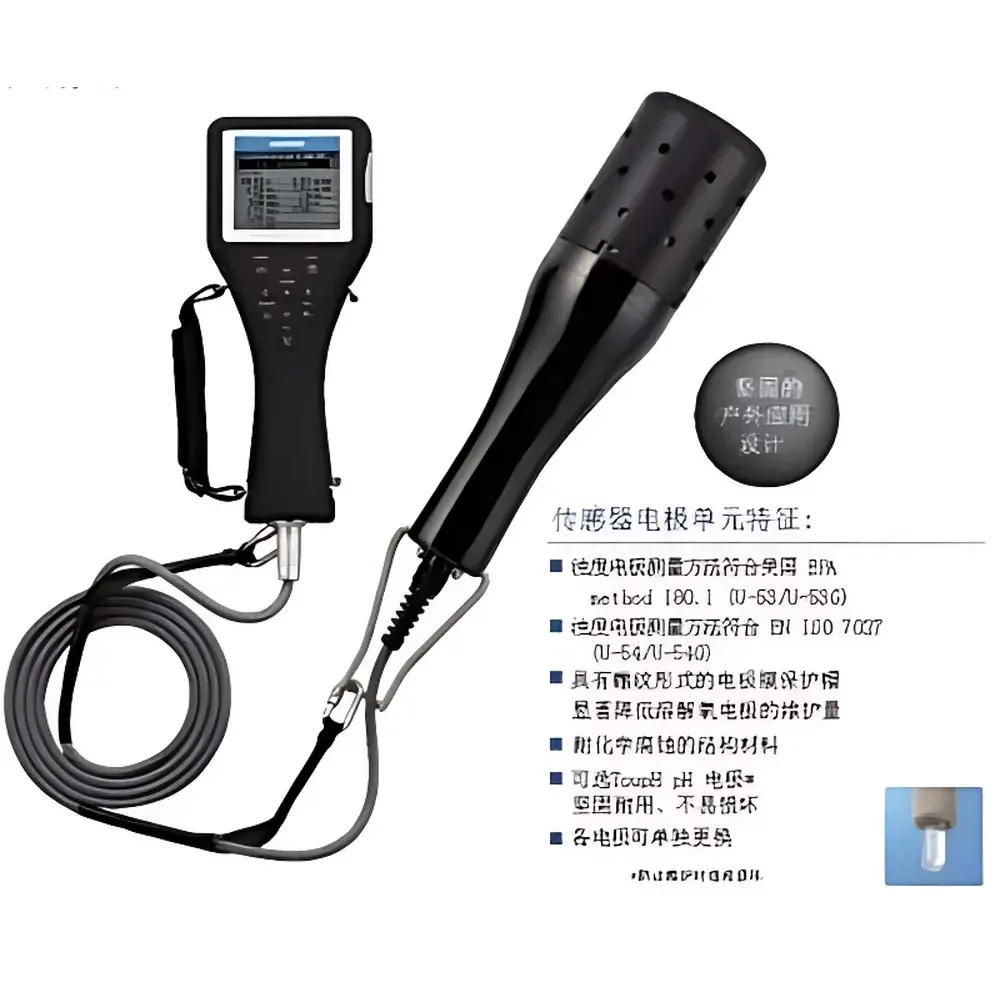
HORIBA U-50 Series Multi-Parameter Portable Water Quality Analyzer
| Brand | HORIBA |
|---|---|
| Origin | Japan |
| Model | U-50 Series (U-51/U-52/U-52G/U-53/U-53G/U-54/U-54G) |
| Instrument Type | Portable/HANDHELD Water Quality Analyzer |
| Measured Parameters | pH, ORP, Dissolved Oxygen (DO), Conductivity, Salinity, TDS, Specific Gravity (Seawater), Temperature, Turbidity (LED or Tungsten Lamp), Water Depth (select models), GPS (select models) |
| Turbidity Compliance | U-53 — US EPA Method 180.1 |
| Turbidity Resolution | 0.01 NTU |
| Operating Temperature Range | −10 to +55 °C |
| IP Rating | IP67 (instrument), IP68 (probe) |
| Battery Life | Up to 70 hours (alkaline AA × 4, backlight off) |
| Data Storage | 10,000 measurement sets |
| Communication | USB |
| Display | 320 × 240 monochrome LCD with backlight |
Overview
The HORIBA U-50 Series is a rugged, field-deployable multi-parameter water quality analyzer engineered for high-reliability environmental monitoring in diverse aquatic environments—including rivers, lakes, groundwater wells, wastewater treatment plants, and coastal zones. Built upon HORIBA’s decades of electrochemical and optical sensor expertise, the U-50 platform integrates seven core electrochemical and optical sensing modalities into a single handheld unit: pH (glass electrode), ORP (platinum electrode), dissolved oxygen (Clark-type polarographic sensor), conductivity (AC four-electrode method), temperature (Pt1000 RTD), turbidity (LED or tungsten-based 90°/30° light scattering), and optional water depth (pressure transducer) and GPS (12-channel). Its modular probe architecture allows configuration-specific deployment—U-51 through U-54 variants differ in turbidity excitation source (LED vs. tungsten lamp), compliance standard (US EPA vs. EN ISO 7027), and integrated functionalities such as GPS and depth sensing—enabling precise alignment with regional regulatory reporting requirements and application-specific metrological needs.
Key Features
- Ruggedized IP67-rated handheld instrument and IP68-rated probe assembly, constructed from chemically resistant materials including PPS, SUS316L stainless steel, titanium, FKM elastomers, PEEK, and FEP membranes—suitable for prolonged immersion and abrasive field conditions.
- Simultaneous real-time display of up to 11 parameters: pH, pH(mV), ORP, DO (mg/L & % saturation), conductivity, salinity (ppt), TDS (g/L), seawater specific gravity (δt), temperature (°C), turbidity (NTU), and optionally water depth (m) and GPS coordinates.
- Dual turbidity measurement options: U-53 probe conforms to US EPA Method 180.1 using LED-based forward-scatter detection (0–800 NTU); U-54 probe complies with EN ISO 7027 using tungsten-lamp 90° scatter geometry (0–1000 NTU), both offering 0.01 NTU resolution and integrated automatic cleaning brushes to mitigate biofouling.
- Optimized polarographic DO sensor with enhanced response time (<60 s T90) and simplified membrane/electrolyte maintenance—reducing field calibration frequency and operational downtime.
- Multi-language interface supporting English, Japanese, Russian, Spanish, and Portuguese—facilitating international deployment and cross-border collaborative monitoring programs.
- Auto-ranging conductivity measurement with automatic temperature compensation to 25 °C, full-scale accuracy ±1% F.S. (at two-point calibration midpoint), and selectable TDS conversion factors.
- Integrated GPS (U-52G/U-53G/U-54G models) enables georeferenced data logging compliant with spatial metadata standards used in EPA WQX, ISO 14001, and EU Water Framework Directive reporting frameworks.
Sample Compatibility & Compliance
The U-50 Series is validated for use across freshwater, brackish, seawater, and wastewater matrices. Its sensor suite meets internationally recognized performance benchmarks: pH and ORP measurements adhere to ASTM D1293 and ISO 10523; conductivity and salinity follow ASTM D1125 and ISO 7888; dissolved oxygen conforms to ISO 5814 and APHA 4500-O; turbidity measurements satisfy either US EPA Method 180.1 (U-53) or EN ISO 7027 (U-54)—ensuring regulatory acceptability in North America, Europe, and APAC jurisdictions. The instrument’s design supports GLP-compliant workflows: all calibrations (pH two-point, DO zero/span, conductivity two-point) are timestamped and stored with operator ID fields; data export via USB preserves audit trails required under 21 CFR Part 11 when paired with validated laboratory information management systems (LIMS).
Software & Data Management
Data acquisition, visualization, and export are managed via HORIBA’s proprietary U-50 PC Software (Windows-compatible), which supports batch download of up to 10,000 measurement records—including raw sensor outputs, GPS coordinates, timestamps, and calibration history. The software enables post-processing with configurable unit conversions (e.g., DO mg/L ↔ % saturation), linear/nonlinear trend analysis, and customizable report generation aligned with ISO/IEC 17025 technical record templates. All stored datasets include embedded metadata (probe serial number, firmware version, ambient temperature, battery voltage), ensuring traceability throughout the data lifecycle. Export formats include CSV, Excel (.xlsx), and PDF—compatible with third-party platforms such as ArcGIS, LabArchives, and cloud-based environmental data portals.
Applications
The U-50 Series serves mission-critical roles in environmental compliance monitoring (e.g., NPDES permit verification, drinking water source assessment), ecological research (eutrophication studies, benthic zone profiling), industrial effluent characterization (pharmaceutical, food & beverage, pulp & paper), and emergency response (spill delineation, post-flood water safety screening). Its portability and rapid startup (<30 s) make it ideal for transect-based surveys, well-head sampling, and mobile lab integration. Municipal utilities deploy U-53/U-54 configurations for turbidity-critical applications—such as filter performance validation per US EPA LT2ESWTR—and coastal agencies utilize U-52G/U-53G units for salinity-driven habitat mapping under NOAA NOS protocols.
FAQ
What turbidity standards does the U-50 comply with?
The U-53 probe complies with US EPA Method 180.1 (LED forward-scatter); the U-54 probe complies with EN ISO 7027 (tungsten-lamp 90° scatter). Both achieve 0.01 NTU resolution.
Can the U-50 perform automatic temperature compensation for all parameters?
Yes—temperature compensation is applied automatically to pH, ORP, DO, conductivity, salinity, TDS, and specific gravity calculations using the integrated Pt1000 RTD sensor (JIS Class B accuracy: ±0.3 °C + 0.005|t|).
Is GPS data synchronized with each measurement?
GPS coordinates are logged simultaneously with each measurement on U-52G, U-53G, and U-54G models—supporting geospatial QA/QC and GIS-integrated reporting.
How often does the DO probe require membrane replacement?
Under typical field use, the polarographic DO membrane should be replaced every 3–6 months; electrolyte replenishment is recommended prior to each daily use or after extended storage.
Does the U-50 support GLP/GMP data integrity requirements?
Yes—the instrument logs calibration events with date/time stamps, operator IDs, and reference standard values; exported data retains full metadata, enabling compliance with 21 CFR Part 11 when used within a validated procedural framework.







