
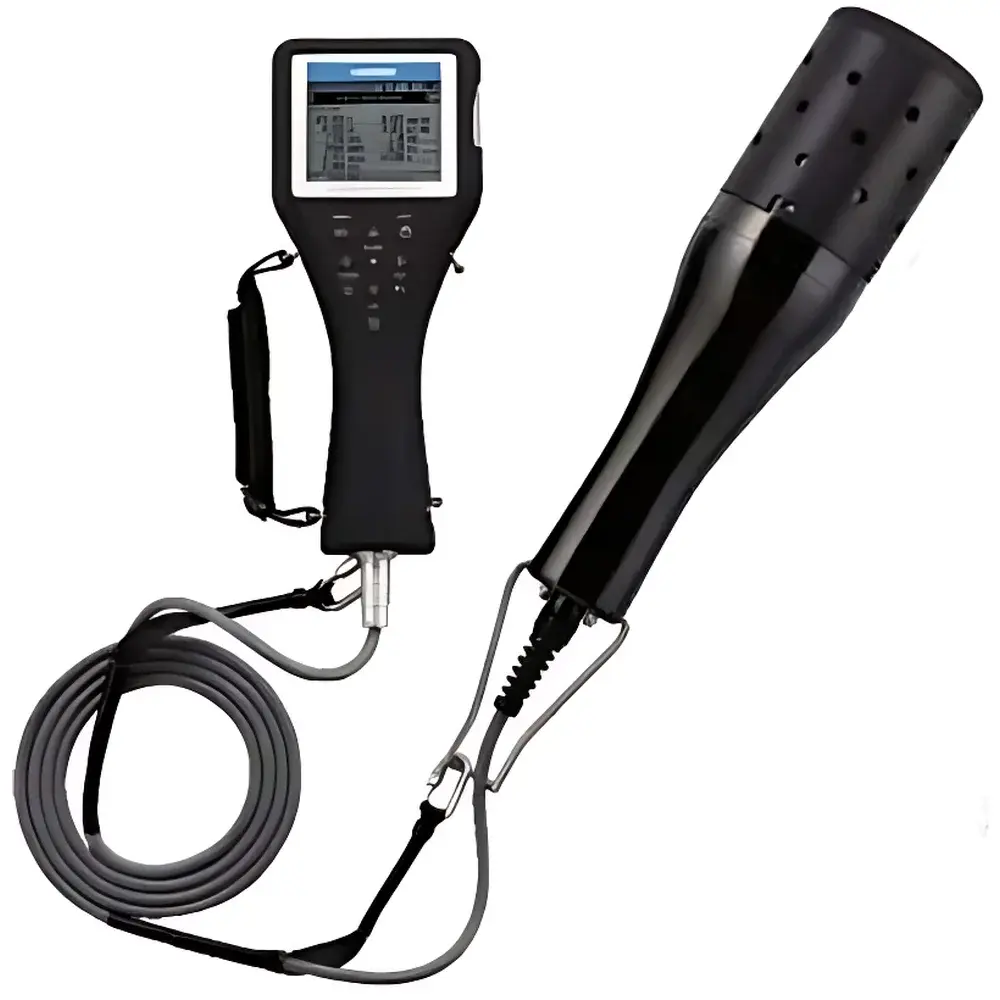
HORIBA U-50 Series Portable Multi-Parameter Water Quality Analyzer
| Brand | HORIBA |
|---|---|
| Origin | Japan |
| Model | U-50 Series |
| Instrument Type | Portable |
| Measurement Principles | Glass Electrode (pH), Platinum Electrode (ORP), Polarographic Membrane (DO), AC 4-Electrode (Conductivity), LED/Tungsten Light Scattering (Turbidity), Pressure Transducer (Depth), Pt100 RTD (Temperature) |
| pH Range | 0–14 |
| pH Resolution | 0.01 |
| pH Accuracy | ±0.1 |
| pH Repeatability | ±0.05 |
| ORP Range | −2000 to +2000 mV |
| ORP Resolution | 1 mV |
| ORP Accuracy | ±15 mV |
| DO Range | 0–50.0 mg/L |
| DO Resolution | 0.01 mg/L |
| DO Accuracy | ±0.2 mg/L (0–20 mg/L), ±0.5 mg/L (20–50 mg/L) |
| Conductivity Range | 0–10 S/m (0–100 mS/cm) |
| Conductivity Accuracy | ±1% F.S. (midpoint of dual-point calibration) |
| Turbidity Range | 0–1000 NTU (model-dependent) |
| Turbidity Resolution | 0.01 NTU (0–9.99 NTU) |
| Turbidity Accuracy | ±3% reading or ±0.1 NTU (whichever greater, per ISO 7027 or EPA Method 180.1) |
| Depth Range | 0–30 m |
| Depth Resolution | 0.05 m |
| Depth Accuracy | ±0.3 m |
| Temperature Range | −10 to +55 °C |
| Temperature Accuracy | JIS B-class Pt100 (±0.3 + 0.005 |
| Detection Limit (pH/DO/Cond) | 0.1 unit or mg/L or mS/cm (context-dependent) |
| Measurement Time | <10 seconds per parameter set |
| Data Storage | 10,000 measurement groups |
| Battery Life | ~70 hours (alkaline AA ×4, backlight off) |
| IP Rating | IP67 (instrument), IP68 (probe, JIS Class 8) |
| Operating Temp | −5 to +45 °C |
| Storage Temp | −10 to +60 °C |
| Probe Cable Length | Standard 2 m (optional 10 m / 30 m) |
| Probe Material | PPS, SUS316L, SUS304, FKM, PEEK, Ti, FEP, POM |
| Weight (Probe) | ~1800 g |
| Weight (Instrument) | ~800 g |
| Display | 320 × 240 monochrome LCD with backlight |
| Communication | USB |
| GPS | 12-channel (U-52G/U-53G/U-54G models only) |
| Language Support | English, Japanese, Russian, Spanish, Portuguese |
Overview
The HORIBA U-50 Series is a rugged, field-deployable multi-parameter water quality analyzer engineered for high-reliability environmental monitoring in diverse aquatic settings—including rivers, lakes, groundwater wells, wastewater outfalls, and coastal zones. Unlike single-parameter handheld meters, the U-50 integrates seven core electrochemical and optical sensing modalities into a unified platform: pH (glass electrode), oxidation-reduction potential (ORP, platinum electrode), dissolved oxygen (DO, polarographic membrane), conductivity (AC four-electrode method), salinity (calculated from conductivity), total dissolved solids (TDS), seawater specific gravity (δt), temperature (Pt100 RTD), turbidity (LED or tungsten-based 90°/30° light scattering), and depth (piezoresistive pressure transducer). Each sensor is housed within a corrosion-resistant probe assembly constructed from PEEK, titanium, SUS316L stainless steel, and FEP membranes—ensuring long-term stability in aggressive matrices such as brackish estuaries or industrial effluents. The instrument operates on standardized calibration protocols aligned with ISO 7027 (turbidity), US EPA Method 180.1 (turbidity), ASTM D1293 (pH), and ASTM D888 (DO), enabling traceable data acquisition under GLP-compliant workflows.
Key Features
- Simultaneous real-time display of up to 11 parameters: pH, mV (ORP), DO (mg/L), conductivity (S/m), salinity (ppt), TDS (g/L), seawater specific gravity (δt), temperature (°C), turbidity (NTU), depth (m), and GPS coordinates (on G-series models)
- Modular probe architecture supporting six configuration variants (U-51 through U-54G) — enabling user-selectable combinations of turbidity detection (LED forward-scatter, tungsten 90° scatter, or LED 90° scatter per EN ISO 7027), integrated depth sensing, and GPS geotagging
- U-53 and U-54 series probes feature motorized self-cleaning turbidity windows compliant with US EPA and EN ISO 7027 standards respectively, minimizing biofouling-induced drift during extended deployments
- Polarographic DO sensor optimized for rapid response (<60 s T90) and simplified membrane/electrolyte maintenance—reducing field service intervals without compromising accuracy
- IP67-rated handheld console and IP68-rated probe (JIS Class 8) certified for submersion up to 30 m; probe body materials selected for chemical resistance across pH 0–14 and salinities up to 70 ppt
- Internal storage capacity of 10,000 measurement records with timestamp, GPS metadata (G-models), and operator-defined site IDs—exportable via USB to CSV or proprietary .u5d format
Sample Compatibility & Compliance
The U-50 Series is validated for use in natural surface waters (freshwater and marine), groundwater, treated and untreated wastewater, and process streams in municipal and industrial applications. Its multi-sensor architecture eliminates cross-contamination risks associated with sequential single-parameter sampling, while automatic temperature compensation (ATC) and salinity correction algorithms ensure consistent performance across thermal gradients (−10 to +55 °C) and ionic strengths (0–10 S/m). All electrochemical measurements adhere to internationally recognized standard methods: pH per ASTM D1293 and ISO 10523; DO per ASTM D888 and ISO 5814; conductivity per ASTM D1125 and ISO 7888; turbidity per ISO 7027 (U-54) and US EPA Method 180.1 (U-53). The system supports dual-point calibration for pH/ORP/DO and four-point calibration for conductivity/turbidity—meeting documentation requirements for regulatory submissions under EPA NPDES, EU WFD, and ISO/IEC 17025-accredited laboratories.
Software & Data Management
Data acquisition and post-processing are managed through HORIBA’s U-50 PC Utility software (Windows-compatible), which enables batch download, spectral visualization of temporal trends, QA/QC flagging (e.g., calibration expiration, sensor saturation), and report generation compliant with ISO/IEC 17025 audit trails. Raw datasets include embedded metadata: measurement time (UTC), GPS coordinates (latitude/longitude/altitude), probe serial numbers, calibration history timestamps, and operator ID fields. While the U-50 does not implement FDA 21 CFR Part 11 electronic signature functionality, its immutable local storage and USB export protocol support ALCOA+ principles (Attributable, Legible, Contemporaneous, Original, Accurate) required for GLP and GMP-aligned environmental monitoring programs. Firmware updates are delivered via secure HORIBA portal downloads and applied offline using the same USB interface.
Applications
- Regulatory compliance monitoring for NPDES permits, EU Urban Wastewater Treatment Directive (UWWTD), and national ambient water quality criteria
- Rapid assessment of eutrophication indicators (DO depletion, pH shifts, conductivity anomalies) in watershed health surveys
- Pre- and post-treatment verification in decentralized wastewater systems and stormwater retention basins
- Groundwater plume delineation using redox-sensitive parameters (ORP, DO, conductivity) coupled with GPS-referenced spatial mapping
- Marine and estuarine studies requiring simultaneous salinity, δt, turbidity, and DO profiling across tidal cycles
- Educational fieldwork and citizen science initiatives leveraging multilingual UI (English, Japanese, Russian, Spanish, Portuguese) and intuitive icon-driven navigation
FAQ
What turbidity standards does the U-50 Series comply with?
The U-53 probe conforms to US EPA Method 180.1 (tungsten lamp, 90° scatter); the U-54 probe complies with EN ISO 7027 (LED, 90° scatter). Both achieve resolution down to 0.01 NTU in low-range modes.
Can the U-50 perform automatic temperature compensation across all parameters?
Yes—temperature is measured continuously via integrated Pt100 RTD and applied automatically to pH, ORP, DO, conductivity, salinity, TDS, and specific gravity calculations per IUPAC and ASTM guidelines.
Is GPS data synchronized with each measurement record?
GPS position, altitude, and UTC timestamp are embedded in every stored record on U-52G, U-53G, and U-54G models—enabling GIS-integrated spatial analysis without post-hoc georeferencing.
How often must calibration be performed for regulatory reporting?
For EPA or ISO-compliant reporting, pH/ORP/DO require two-point calibration before each sampling day; conductivity and turbidity require four-point calibration at least daily or per 10 measurements—documented in the instrument’s internal log.
What is the maximum recommended deployment duration for continuous profiling?
With optional 30-m cable and alkaline batteries, the U-54 probe supports unattended vertical profiling for up to 72 hours in temperate freshwater; saltwater deployments require more frequent cleaning due to accelerated biofouling kinetics.
Related Products







