
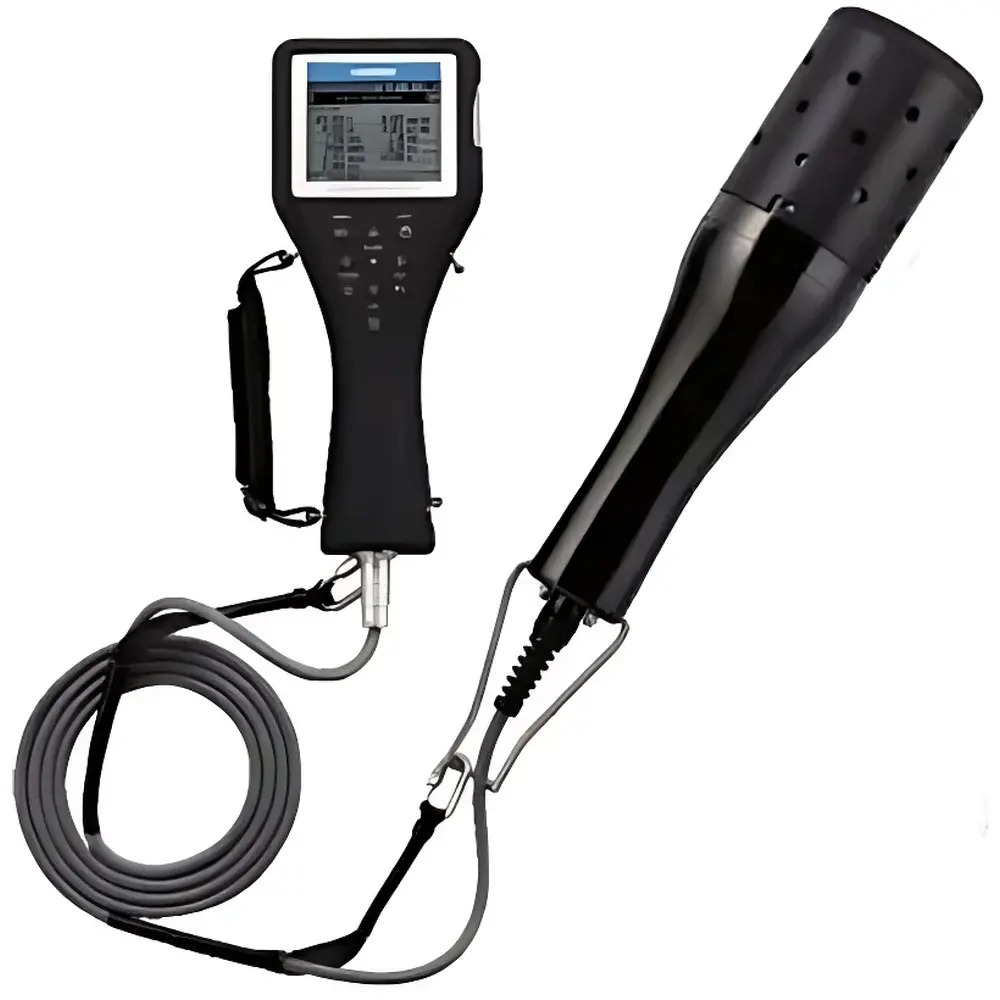
HORIBA U-50 Series Portable Multiparameter Water Quality Analyzer
| Brand | HORIBA |
|---|---|
| Origin | Japan |
| Model | U-50 Series |
| Instrument Type | Portable / Handheld Water Quality Analyzer |
| Measured Parameters | pH, ORP, Dissolved Oxygen (DO), Electrical Conductivity (EC), Salinity, TDS, Specific Gravity (Seawater), Temperature, Turbidity (NTU), Depth (m), GPS Positioning |
| Turbidity Standards | U-53 — US EPA Method 180.1 |
| Turbidity Resolution | 0.01 NTU |
| Operating Temperature Range | −10 to 55 °C |
| Depth Measurement Range | up to 30 m |
| IP Rating | IP67 (instrument), IP68 (probe) |
| Battery Life | up to 70 h (alkaline AA × 4, backlight off) |
| Data Storage | 10,000 measurement sets |
| Communication | USB |
| Display | 320 × 240 monochrome LCD with backlight |
Overview
The HORIBA U-50 Series Portable Multiparameter Water Quality Analyzer is an engineered field-deployable instrument designed for high-reliability in situ monitoring of freshwater, groundwater, estuarine, and wastewater systems. Built upon HORIBA’s legacy in electrochemical and optical sensing, the U-50 platform integrates multiple independent sensor modules—glass electrode (pH), platinum redox electrode (ORP), polarographic dissolved oxygen (DO), four-electrode conductivity cell, LED- or tungsten-based turbidimetric optics, and pressure-based depth transduction—into a single ruggedized probe assembly. All measurements are temperature-compensated in real time using a JIS Class B platinum resistance thermometer (Pt1000). The system operates on standardized electrochemical principles (e.g., Nernst equation for pH/ORP, Clark-type diffusion-limited current for DO, AC four-pole method for conductivity) and adheres to internationally recognized measurement protocols—including US EPA Method 180.1 for turbidity (U-53 variants) and EN ISO 7027 (U-54 variants)—ensuring data traceability and regulatory acceptability across environmental compliance frameworks.
Key Features
- Ruggedized dual-body architecture: IP67-rated handheld console and IP68-rated probe (depth-rated to 30 m), constructed from PPS, SUS316L stainless steel, titanium, FKM elastomers, PEEK, and FEP membranes for chemical and abrasion resistance in harsh field environments.
- Simultaneous real-time display of up to 11 parameters: pH, mV (ORP), DO (mg/L), conductivity (S/m), salinity (ppt), TDS (g/L), seawater specific gravity (δt), temperature (°C), turbidity (NTU), depth (m), and GPS coordinates (on G-series models).
- Dual turbidity optical configurations: U-53 employs LED-based forward-scatter (30°) per US EPA 180.1; U-54 utilizes tungsten-lamp 90° scatter compliant with EN ISO 7027—both delivering 0.01 NTU resolution and integrated auto-cleaning brush (U-53G/U-54G) to mitigate biofouling drift.
- Enhanced polarographic DO sensor with accelerated response time (t₉₀ < 30 s) and simplified membrane/electrolyte maintenance protocol—reducing field calibration frequency without compromising accuracy.
- Intuitive multilingual interface supporting English, Japanese, Russian, Spanish, and Portuguese—optimized for international field teams and cross-border regulatory reporting.
- Onboard automatic two-point pH calibration (using standard pH 4 and 7 buffers), automatic conductivity cell constant verification, and configurable TDS conversion factors (0.4–1.0) for site-specific water matrices.
Sample Compatibility & Compliance
The U-50 Series is validated for direct immersion in natural waters—including rivers, lakes, aquifers, wetlands, stormwater outfalls, and secondary-treated effluents—with no sample preservation or filtration required for routine profiling. Probe materials comply with NSF/ANSI Standard 61 for drinking water contact safety. Turbidity modules meet statutory requirements for regulatory submissions under US Clean Water Act (CWA) Section 402 NPDES permits (U-53) and EU Water Framework Directive (WFD) monitoring (U-54). Depth and GPS functions satisfy ASTM D5124-20 (Standard Guide for Field Logging of Subsurface Investigations) and ISO 14001 environmental management system documentation requirements. All firmware and data logging routines support audit-ready timestamping and user ID tagging—facilitating GLP-compliant field data capture.
Software & Data Management
Measurements are stored internally in non-volatile memory (10,000 records) with UTC-synchronized timestamps, GPS metadata (latitude/longitude/altitude), and sensor status flags (e.g., “cleaning brush actuated”, “calibration due”). Data export occurs via USB 2.0 to HORIBA’s proprietary LabSTATION software (Windows-compatible), which supports batch export to CSV, Excel, and GIS-ready shapefiles (.shp). The software enforces electronic signature workflows, generates calibration certificates with uncertainty budgets per ISO/IEC 17025, and maintains full audit trails—including operator logins, parameter edits, and data deletion events—to satisfy FDA 21 CFR Part 11 and EU Annex 11 requirements where applicable. Firmware updates are delivered via signed .hex packages with SHA-256 verification.
Applications
- Regulatory surface water quality surveys (EPA Region-wide monitoring, WFD Article 8 reporting)
- Wastewater treatment plant influent/effluent compliance tracking (BOD/COD surrogate via DO & conductivity trends)
- Groundwater plume delineation and redox zonation mapping (pH/ORP/DO cross-correlation)
- Coastal and estuarine salinity intrusion studies (conductivity–temperature–depth profiling)
- Stormwater BMP performance verification (turbidity decay kinetics, TSS load estimation)
- Drinking water distribution system integrity assessment (residual chlorine proxy via ORP, pipe corrosion index via pH/conductivity)
FAQ
What turbidity standards does the U-50 Series comply with?
U-53 models conform to US EPA Method 180.1 (LED forward-scatter); U-54 models comply with EN ISO 7027 (tungsten 90° scatter). Both deliver 0.01 NTU resolution and include optional auto-cleaning brushes.
Can the U-50 perform depth profiling in marine environments?
Yes—pressure-based depth sensors (U-52G/U-53G/U-54G) operate reliably to 30 m in seawater (max. 3 bar), with ±0.3 m absolute accuracy and 0.05 m resolution, compensated for local gravity and seawater density.
Is GPS positioning available on all U-50 models?
GPS functionality is exclusive to G-series instruments (U-52G, U-53G, U-54G), featuring 12-channel reception with sub-5 m horizontal accuracy (SA-free) and automatic geotagging of every measurement record.
How often must the DO sensor be calibrated in field use?
Polarographic DO probes require zero-point calibration in nitrogen-saturated water and span calibration in air-saturated water before each deployment; membrane replacement is recommended every 6 months under continuous use.
Does the instrument support GLP/GMP-compliant data handling?
Yes—LabSTATION software provides electronic signatures, immutable audit logs, calibration traceability to NIST-traceable standards, and export formats compatible with LIMS integration and regulatory submission portals.
Related Products







