
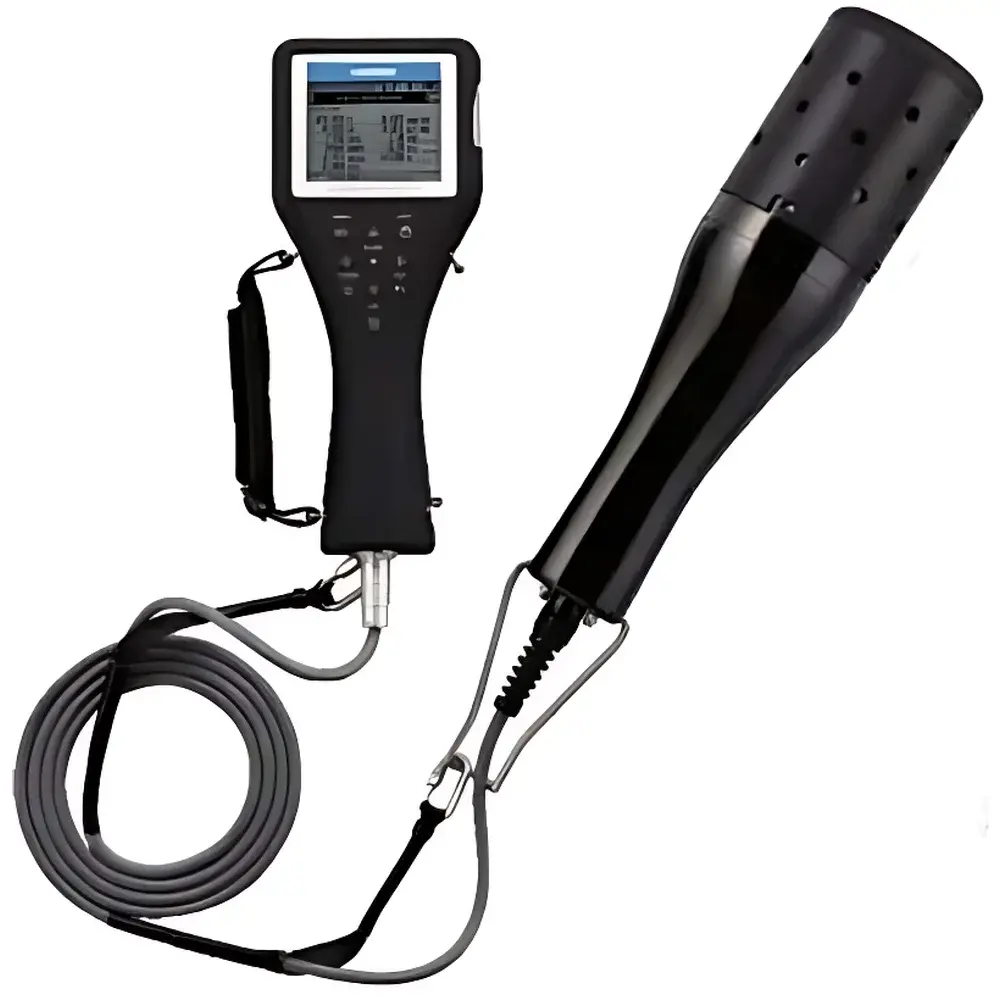
HORIBA U-50 Series Portable Multiparameter Water Quality Analyzer
| Brand | HORIBA |
|---|---|
| Origin | Japan |
| Model | U-50 Series (U-51/U-52/U-52G/U-53/U-53G/U-54/U-54G) |
| Instrument Type | Portable/HANDHELD Water Quality Analyzer |
| Measured Parameters | pH, ORP, Dissolved Oxygen (DO), Conductivity, Salinity, TDS, Specific Gravity (Seawater), Temperature, Turbidity (LED or Tungsten Lamp), Depth (pressure-based, up to 30 m), GPS (U-52G/U-53G/U-54G models) |
| Turbidity Standards | U-53 complies with US EPA Method 180.1 |
| Turbidity Resolution | 0.01 NTU (0–10 NTU range) |
| DO Measurement Principle | Clark-type polarographic sensor with enhanced response time and simplified maintenance |
| pH Measurement Principle | Glass electrode method (two-point calibration, auto-temperature compensation) |
| Conductivity Measurement Principle | AC four-electrode method with automatic range switching and 25 °C temperature compensation |
| Depth Measurement Principle | Piezoresistive pressure transducer |
| IP Rating | IP68 (electrode), IP67 (host unit with cable connected) |
| Operating Temperature | –5 °C to 45 °C |
| Storage Temperature | –10 °C to 60 °C |
| Battery Life | Up to 70 hours (alkaline AA × 4, backlight off) |
| Data Storage | 10,000 measurement sets |
| Communication Interface | USB |
| Display | 320 × 240 monochrome LCD with backlight |
| Weight | Host ~800 g |
| Probe Cable Length | Standard 2 m (optional 10 m or 30 m) |
Overview
The HORIBA U-50 Series is a rugged, field-deployable multiparameter water quality analyzer engineered for high-reliability environmental monitoring in diverse aquatic settings—including rivers, lakes, groundwater wells, estuaries, wastewater treatment outfalls, and coastal zones. Designed and manufactured in Japan, the U-50 platform integrates seven interchangeable probe configurations (U-51 through U-54G) to support mission-specific parameter combinations while maintaining consistent core metrology, mechanical integrity, and operational workflow. Its measurement architecture is grounded in internationally validated electrochemical and optical principles: pH and ORP are determined via glass and platinum electrodes following JIS Z 8401 and ASTM D1293; dissolved oxygen employs a temperature-compensated polarographic (Clark-type) sensor with optimized membrane diffusion kinetics; conductivity utilizes an AC four-electrode configuration to minimize polarization errors and fouling effects—conforming to ASTM D1125 and ISO 7888; turbidity measurements adhere strictly to regulatory optical standards—U-53 probes implement LED-based forward-scatter detection per US EPA Method 180.1, while U-54 variants use tungsten-lamp 90° scatter geometry compliant with EN ISO 7027. The system operates without external power sources, enabling extended unattended surveys in remote locations.
Key Features
- Ruggedized IP68-rated probe housing constructed from PPS, PEEK, SUS316L stainless steel, titanium, and FEP membranes—certified for continuous submersion up to 30 meters depth.
- Modular probe design supporting seven configurations (U-51 to U-54G), each pre-calibrated and certified for traceable performance across pH (0–14, ±0.1 pH), ORP (–2000 to +2000 mV, ±15 mV), DO (0–50.0 mg/L, ±0.2 mg/L at 0–20 mg/L), and conductivity (0–10 S/m, ±1% FS).
- Dual turbidity options: U-53 (LED, EPA-compliant, 0–800 NTU) and U-54 (tungsten lamp, ISO-compliant, 0–1000 NTU), both featuring 0.01 NTU resolution in low-range mode and integrated self-cleaning brush mechanisms (U-53G/U-54G).
- Integrated GPS receiver (12-channel, U-52G/U-53G/U-54G models) enables georeferenced data logging compliant with ISO 14001 environmental audit requirements and EPA-approved field data capture protocols.
- Multi-language interface (English, Japanese, Russian, Spanish, Portuguese) and intuitive monochrome LCD (320 × 240 pixels) with adjustable backlight ensure operational consistency across international field teams.
- Internal storage capacity of 10,000 measurement records with timestamp, GPS coordinates (where equipped), and full parameter arrays—exportable via USB to comply with GLP documentation workflows.
Sample Compatibility & Compliance
The U-50 Series is validated for direct immersion in natural freshwaters, brackish systems, seawater (up to 70 ppt salinity), municipal and industrial effluents, and groundwater matrices. Probe materials—including titanium housings, FKM O-rings, and POM flow bodies—are chemically inert toward common contaminants (e.g., chlorine, hydrogen sulfide, heavy metals) and resistant to biofouling under typical field exposure durations. All electrical and optical measurements meet metrological traceability requirements outlined in ISO/IEC 17025-accredited calibration practices. Turbidity modules satisfy jurisdictional regulatory mandates: U-53 supports US EPA NPDES reporting under 40 CFR Part 136, while U-54 meets European Union Water Framework Directive (WFD) monitoring specifications via EN ISO 7027. Conductivity and salinity algorithms incorporate temperature compensation per ITS-90 and apply standard conversion factors (e.g., 0.64 for NaCl-based TDS estimation), ensuring alignment with ASTM D5391 and ISO 7888 reporting conventions.
Software & Data Management
Data acquisition and post-processing are supported by HORIBA’s proprietary U-50 PC Utility software (Windows-compatible), which facilitates firmware updates, calibration certificate generation, batch export to CSV/Excel, and graphical trend analysis with configurable axes and statistical overlays (mean, SD, min/max). The instrument logs metadata including probe serial number, calibration dates, operator ID (user-defined), and ambient conditions—enabling full audit trails required under FDA 21 CFR Part 11 for regulated environmental laboratories. Raw sensor outputs are stored unprocessed to preserve measurement integrity; derived parameters (e.g., specific gravity, δt values) are calculated in real time using NIST-traceable coefficients embedded in firmware. USB communication uses CDC ACM class drivers—no proprietary dongles or drivers required—and supports mass-storage mode for drag-and-drop file transfer.
Applications
- Regulatory compliance monitoring for NPDES permits, WFD status assessment, and ISO 14001 environmental management systems.
- Wastewater treatment plant influent/effluent characterization, including DO profiling across aeration basins and nitrification/denitrification zone mapping.
- Groundwater contamination plume delineation via multi-depth vertical profiling (pH, conductivity, redox potential) combined with GPS-tagged sampling coordinates.
- Coastal and estuarine salinity intrusion studies leveraging simultaneous TDS, conductivity, and specific gravity outputs with temperature compensation.
- Educational field hydrology programs requiring robust, student-safe instrumentation with standardized calibration procedures and curriculum-aligned parameter sets.
- Emergency response deployments for post-spill or post-flooding water safety screening—rapid deployment, battery autonomy, and multi-parameter cross-validation reduce false-positive risk.
FAQ
What turbidity standards does the U-50 Series comply with?
U-53 probes conform to US EPA Method 180.1 (LED forward-scatter); U-54 probes comply with EN ISO 7027 (tungsten lamp 90° scatter). Both achieve 0.01 NTU resolution in the 0–10 NTU range.
Is the U-50 suitable for seawater measurements?
Yes—the probe materials (titanium, SUS316L, FEP) resist chloride corrosion, and salinity, conductivity, and specific gravity algorithms are validated for seawater up to 70 ppt.
How is calibration traceability ensured?
Each probe ships with a NIST-traceable calibration certificate; two-point pH calibration uses certified buffers (pH 4.01/7.00 or 4.01/10.01); conductivity calibration employs KCl standards per ISO 7888.
Can data be exported for LIMS integration?
Yes—CSV exports include all raw and derived parameters, timestamps, GPS coordinates (if enabled), and calibration metadata, supporting direct ingestion into laboratory information management systems.
What is the warranty and service support structure outside Japan?
HORIBA provides a 24-month limited warranty; global service network includes authorized calibration centers in North America, EMEA, and APAC regions offering on-site verification and probe refurbishment per ISO/IEC 17025.
Related Products







