
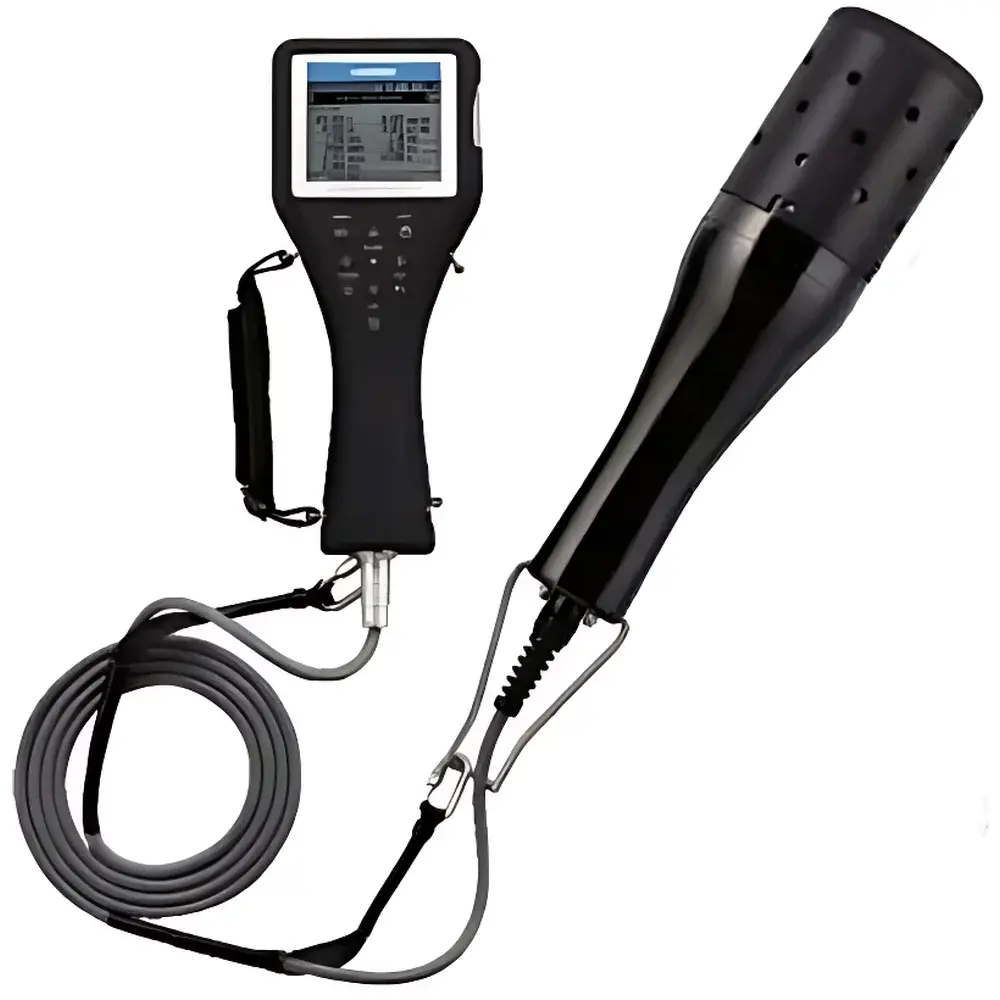
HORIBA U-50 Series Portable Multiparameter Water Quality Analyzer
| Brand | HORIBA |
|---|---|
| Origin | Japan |
| Model | U-50 Portable Series |
| Instrument Type | Portable / Handheld Water Quality Analyzer |
| Measured Parameters | pH, ORP, Dissolved Oxygen (DO), Conductivity, Salinity, TDS, Specific Gravity (Seawater), Temperature, Turbidity (LED or Tungsten Lamp), Depth (select models) |
| Turbidity Standards | U-53 complies with US EPA Method 180.1 |
| Turbidity Resolution | 0.01 NTU |
| DO Sensor Response Time | Enhanced for rapid stabilization |
| Electrode Material | PPS, Glass, SUS316L/SUS304, FKM, PEEK, Titanium, FEP Membrane, POM |
| IP Rating | IP68 (JIS Protection Class 8 for probe), IP67 (JIS Protection Class 7 for main unit with cable connected) |
| Operating Temperature | –5 to 45 °C |
| Storage Temperature | –10 to 60 °C |
| Battery Life | Up to 70 hours (alkaline AA × 4, backlight off) |
| Data Storage | 10,000 measurement sets |
| Communication | USB |
| Display | 320 × 240 monochrome LCD with backlight |
| Weight | Probe ~1.8 kg (3.97 lbs) |
| Probe Dimensions | Ø96 mm × 340 mm L |
| Cable Standard | 2 m (optional: 10 m or 30 m) |
Overview
The HORIBA U-50 Series Portable Multiparameter Water Quality Analyzer is an engineered field instrument designed for high-reliability in-situ monitoring of surface water, groundwater, wastewater, and marine environments. Built on a modular probe architecture and ruggedized industrial design, the U-50 platform integrates electrochemical, optical, and pressure-based sensing principles into a single handheld system. Its core measurement methodologies include glass electrode potentiometry (pH), platinum redox electrode detection (ORP), Clark-type polarographic dissolved oxygen sensing with temperature-compensated membrane diffusion kinetics, four-electrode AC conductivity measurement (enabling stable readings across high-ionic-strength matrices), and dual-wavelength light scattering photometry (LED forward-scatter for U-53; tungsten 90° scatter for U-54 per EN ISO 7027). The inclusion of GPS geotagging (on G-series models) and depth-pressure transduction (up to 30 m) enables spatially referenced, stratified profiling—critical for regulatory compliance sampling, watershed assessment, and environmental impact studies.
Key Features
- Simultaneous real-time display of up to 11 parameters: pH, mV (ORP), dissolved oxygen (mg/L and % saturation), conductivity, salinity (ppt), total dissolved solids (TDS), seawater specific gravity (δt), temperature, turbidity (NTU), water depth (m), and GPS coordinates (G-models).
- Multi-standard turbidity compliance: U-53 probe meets US EPA Method 180.1 for drinking water and wastewater applications; U-54 probe conforms to EN ISO 7027 for process and environmental monitoring—both delivering 0.01 NTU resolution and integrated cleaning brushes to mitigate biofouling.
- Optimized polarographic DO sensor with accelerated response time and simplified membrane/electrolyte maintenance—reducing downtime during extended field deployments.
- Ruggedized probe construction using corrosion-resistant materials: titanium housing, SUS316L electrodes, FEP membrane, PEEK insulators, and PPS structural components—validated to JIS Protection Class 8 (IP68) submersion rating.
- Intuitive multilingual interface supporting English, Japanese, Russian, Spanish, and Portuguese—facilitating international deployment and cross-border collaborative monitoring programs.
- Auto-ranging conductivity measurement with automatic temperature compensation to 25 °C, and configurable TDS conversion factors for site-specific calibration traceability.
Sample Compatibility & Compliance
The U-50 Series is validated for use across freshwater, brackish, estuarine, and full-strength seawater matrices (0–70 ppt salinity). Its four-electrode conductivity cell eliminates polarization errors in high-conductivity samples (up to 10 S/m), while the platinum ORP electrode maintains stability in sulfide-rich anaerobic zones. All electrochemical sensors support two-point calibration using NIST-traceable standards (e.g., pH 4.01/7.00 buffers, Zobell’s solution for ORP). Turbidity modules are certified per applicable regulatory frameworks: U-53 supports EPA-compliant reporting for NPDES permits and Clean Water Act assessments; U-54 satisfies ISO 7027 requirements for GLP-aligned laboratory and field validation. The system adheres to IEC 60529 (IP67/IP68), JIS C 0920, and ASTM D3370 (field sampling procedures). Data integrity is reinforced by timestamped logging, operator ID fields, and audit-ready export via USB.
Software & Data Management
Measurements are stored internally in non-volatile memory (10,000 datasets), each tagged with date/time, GPS coordinates (G-models), depth, and sensor status flags. Data export is performed via standard USB interface to Windows-compatible software (HORIBA Multi-Parameter Data Manager), which supports CSV and Excel formatting, statistical summaries (min/max/avg/std dev), trend plotting, and customizable report generation. The software enforces ALCOA+ principles: attributable, legible, contemporaneous, original, accurate, complete, consistent, enduring, and available—meeting baseline expectations for GLP and preliminary GMP-aligned environmental data handling. While not natively 21 CFR Part 11 compliant, the system supports external electronic lab notebook (ELN) integration for organizations requiring full audit trail functionality.
Applications
- Regulatory field monitoring: EPA Region-level ambient water quality surveys, TMDL assessments, and wastewater discharge verification.
- Drinking water source protection: Real-time detection of pH shifts, DO depletion, or conductivity anomalies indicating contamination events.
- Marine and coastal research: Stratified profiling of salinity gradients, hypoxic zone mapping, and turbidity plume tracking near dredging or outfall sites.
- Industrial pretreatment compliance: On-site verification of influent/effluent parameters prior to municipal sewer discharge.
- Educational and training use: Field-based hydrology labs emphasizing sensor physics, calibration rigor, and environmental data interpretation.
FAQ
What turbidity standards does the U-50 series comply with?
The U-53 probe complies with US EPA Method 180.1; the U-54 probe complies with EN ISO 7027. Both offer 0.01 NTU resolution and built-in cleaning brushes.
Does the U-50 require routine calibration in the field?
Yes—two-point calibration is recommended for pH, ORP, and DO before each sampling session; conductivity and turbidity benefit from multi-point verification using certified standards.
Can the U-50 operate in full seawater without sensor drift?
Yes—the titanium probe body, SUS316L electrodes, and FEP membrane resist chloride-induced corrosion; salinity compensation algorithms maintain accuracy across 0–70 ppt.
Is GPS data embedded directly into exported measurement files?
Yes—GPS coordinates (latitude/longitude), altitude, and satellite count are recorded with each dataset on U-52G, U-53G, and U-54G models.
What is the maximum operational depth for depth measurement?
The pressure-based depth sensor supports measurements up to 30 meters; resolution is 0.05 m with ±0.3 m accuracy.
Related Products







