
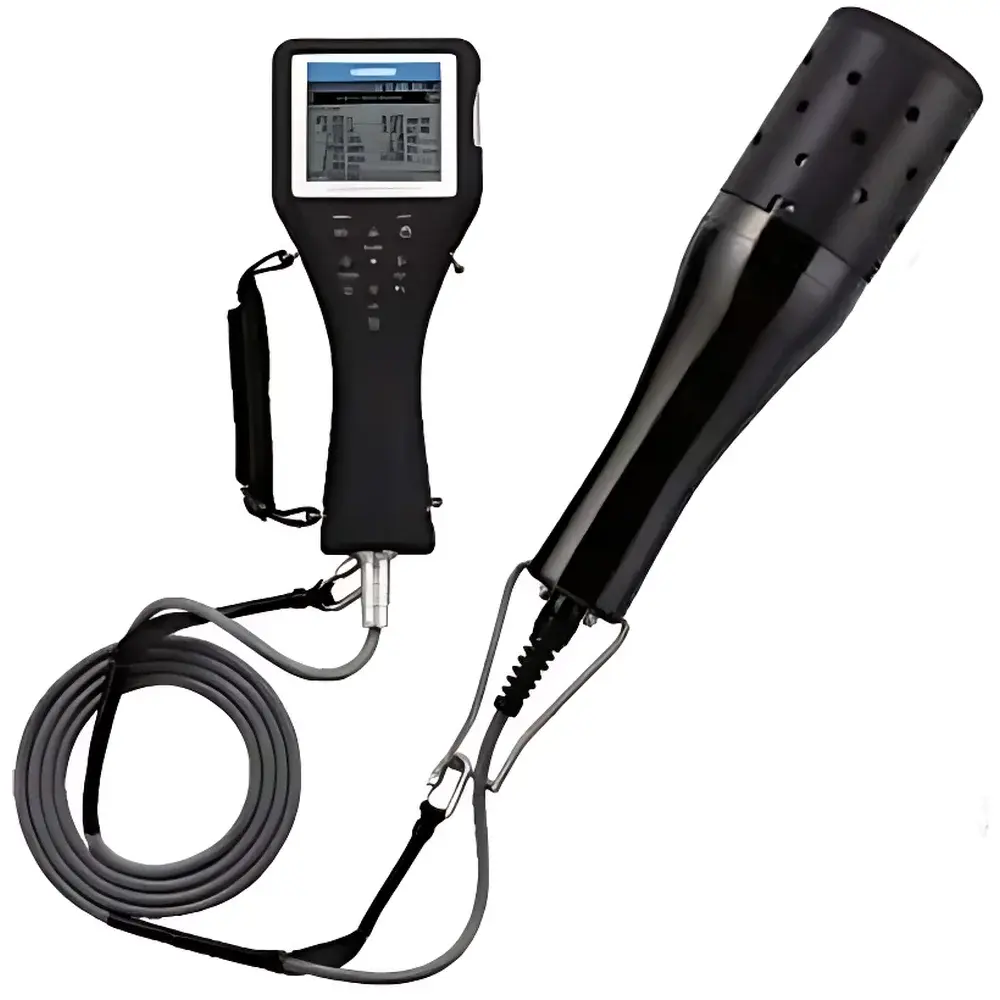
HORIBA U-50 Series Portable Multiparameter Water Quality Analyzer
| Brand | HORIBA |
|---|---|
| Origin | Japan |
| Model | U-50 Series |
| Instrument Type | Portable / Handheld Water Quality Analyzer |
| Measurable Parameters | pH, ORP, Dissolved Oxygen (DO), Conductivity, Salinity, TDS, Specific Gravity (Seawater), Temperature, Turbidity (LED or Tungsten Lamp), Depth (on select models) |
| Turbidity Standards | U-53 complies with US EPA Method 180.1 |
| Turbidity Resolution | 0.01 NTU |
| Depth Measurement Range | Up to 30 m (pressure-based) |
| Operating Temperature | −10 to +55 °C |
| Waterproof Rating | IP68 (JIS Protection Class 8 for probe |
| Data Storage Capacity | 10,000 measurement sets |
| Power Supply | Four AA alkaline batteries (≈70 h operation without backlight) |
| Communication Interface | USB |
| Display | 320 × 240 monochrome LCD with backlight |
| Weight | Probe ≈1800 g |
| Probe Dimensions | Ø96 mm × 340 mm |
| Standard Cable Length | 2 m (optional: 10 m or 30 m) |
| Housing Materials | PPS, SUS316L, SUS304, FKM, PEEK, Titanium, FEP membrane, POM |
| Language Support | English, Japanese, Russian, Spanish, Portuguese |
Overview
The HORIBA U-50 Series is a rugged, field-deployable multiparameter water quality analyzer engineered for high-reliability environmental monitoring in diverse aquatic settings—including rivers, lakes, groundwater wells, estuaries, wastewater treatment plants, and coastal zones. Built upon HORIBA’s decades of electrochemical and optical sensor expertise, the U-50 platform integrates seven core electrochemical and physical sensors into a single, pressure-rated probe assembly, enabling simultaneous real-time acquisition of up to 11 standardized water quality parameters. Its measurement architecture combines glass electrode potentiometry (pH/ORP), Clark-type polarographic dissolved oxygen sensing with accelerated response kinetics, four-electrode AC conductivity measurement with automatic temperature compensation to 25 °C, and dual-optical turbidity detection—either LED-based forward-scatter (U-52G/U-53/U-53G) or tungsten-lamp 90° scatter compliant with EN ISO 7027 (U-54/U-54G). Depth is measured via piezoresistive pressure transduction, calibrated for freshwater and seawater density profiles. Designed for regulatory-grade data collection, the U-50 series supports traceable calibration protocols aligned with ASTM D1293 (pH), ASTM D3693 (ORP), ASTM D888 (DO), and ISO 7888 (conductivity), ensuring metrological consistency across field deployments.
Key Features
- Simultaneous real-time measurement of up to 11 parameters: pH, mV (ORP), dissolved oxygen (mg/L and % saturation), conductivity (S/m or mS/cm), salinity (ppt), TDS (g/L), seawater specific gravity (δt), temperature (°C), turbidity (NTU), depth (m), and GPS position (on G-series models).
- Modular probe configuration: Select from U-51 (10-parameter base), U-52/U-52G (11-parameter + GPS), U-53/U-53G (11-parameter + EPA-compliant LED turbidity + cleaning brush), or U-54/U-54G (11-parameter + ISO 7027–compliant tungsten-lamp turbidity).
- High-stability sensor design: Platinum ORP electrode with low-drift reference system; temperature-compensated polarographic DO sensor featuring rapid stabilization (<60 s t₉₀) and simplified membrane/electrolyte maintenance.
- Optimized turbidity performance: U-53 probes incorporate an integrated motorized cleaning brush to mitigate biofouling in long-term deployments; both U-53 and U-54 achieve 0.01 NTU resolution and meet repeatability specifications per US EPA 180.1 (±0.1 NTU or ±3% of reading) and EN ISO 7027 (±0.1 NTU or ±5% of reading).
- Robust mechanical construction: Probe housing fabricated from corrosion-resistant materials including titanium, SUS316L stainless steel, PEEK, and FEP membranes; rated to JIS Protection Class 8 (IP68 equivalent) for submersion up to 30 m.
- Field-configurable operation: Five-language UI (English, Japanese, Russian, Spanish, Portuguese); on-device two-point pH calibration using standard buffer solutions (e.g., pH 4.01/7.00); automated conductivity cell constant verification.
Sample Compatibility & Compliance
The U-50 Series is validated for use across freshwater, brackish, and full-strength seawater matrices (salinity up to 70 ppt). Its sensor suite meets key international regulatory and methodological standards: pH and ORP measurements comply with ASTM D1293 and ASTM D3693; dissolved oxygen adheres to ASTM D888 (membrane electrode method); conductivity conforms to ISO 7888 and APHA 2510B; turbidity modes satisfy US EPA Method 180.1 (U-53) and EN ISO 7027 (U-54). All models support GLP-compliant data logging—including operator ID, timestamp, location (GPS-enabled G-models), sensor status flags, and calibration history—with USB export to CSV or proprietary .hor format. The system architecture facilitates audit readiness under FDA 21 CFR Part 11 when paired with HORIBA’s optional PC software (LAQUA Smart Studio), which provides electronic signature capability, user access control, and immutable audit trails.
Software & Data Management
Data acquisition and post-processing are managed via HORIBA’s LAQUA Smart Studio desktop application (Windows-compatible), which enables batch calibration curve generation, statistical summary reports (mean, SD, min/max), spatial mapping of GPS-tagged profiles, and export to LIMS-ready formats (CSV, Excel, PDF). The instrument stores up to 10,000 complete measurement records onboard—including raw sensor voltages, compensated values, temperature readings, and diagnostic flags—retaining full traceability even during extended offline surveys. USB communication supports firmware updates, configuration file import/export, and synchronized time calibration. No cloud dependency is required; all data remains under user control and resides locally unless explicitly exported. The software interface includes validation tools for linearity assessment, drift monitoring, and inter-sensor correlation analysis—critical for QA/QC workflows in accredited environmental laboratories.
Applications
- Regulatory surface water monitoring programs (EPA NPDES, EU WFD, national water framework directives)
- Wastewater influent/effluent characterization and process control in municipal and industrial treatment facilities
- Groundwater quality assessment during site remediation and landfill leachate tracking
- Marine and estuarine research requiring simultaneous salinity, DO, and turbidity profiling
- Educational field hydrology studies and student-led environmental science projects
- Emergency response deployment for post-spill or post-flooding water safety screening
FAQ
What turbidity standards does each U-50 model comply with?
U-53 models implement LED-based forward-scatter detection aligned with US EPA Method 180.1; U-54 models utilize tungsten-lamp 90° scatter optics certified to EN ISO 7027.
Does the U-50 require routine electrolyte refills for the DO sensor?
Yes—the polarographic DO probe uses a replaceable KCl electrolyte solution and Teflon membrane; HORIBA supplies maintenance kits with pre-filled cartridges and calibrated replacement membranes.
Can the U-50 perform automatic temperature compensation for all parameters?
Yes—temperature is measured continuously via a Pt1000 sensor (JIS Class B accuracy) and applied in real time to pH, ORP, DO, conductivity, salinity, TDS, and specific gravity calculations.
Is GPS functionality available on all U-50 models?
No—only U-52G, U-53G, and U-54G models integrate a 12-channel GPS receiver with positional logging synchronized to each measurement record.
How is data integrity ensured during extended field deployments?
Each stored record includes checksum validation, sensor health indicators, and calibration timestamps; LAQUA Smart Studio enforces digital signatures and role-based access controls to satisfy 21 CFR Part 11 requirements for regulated environments.
Related Products







