
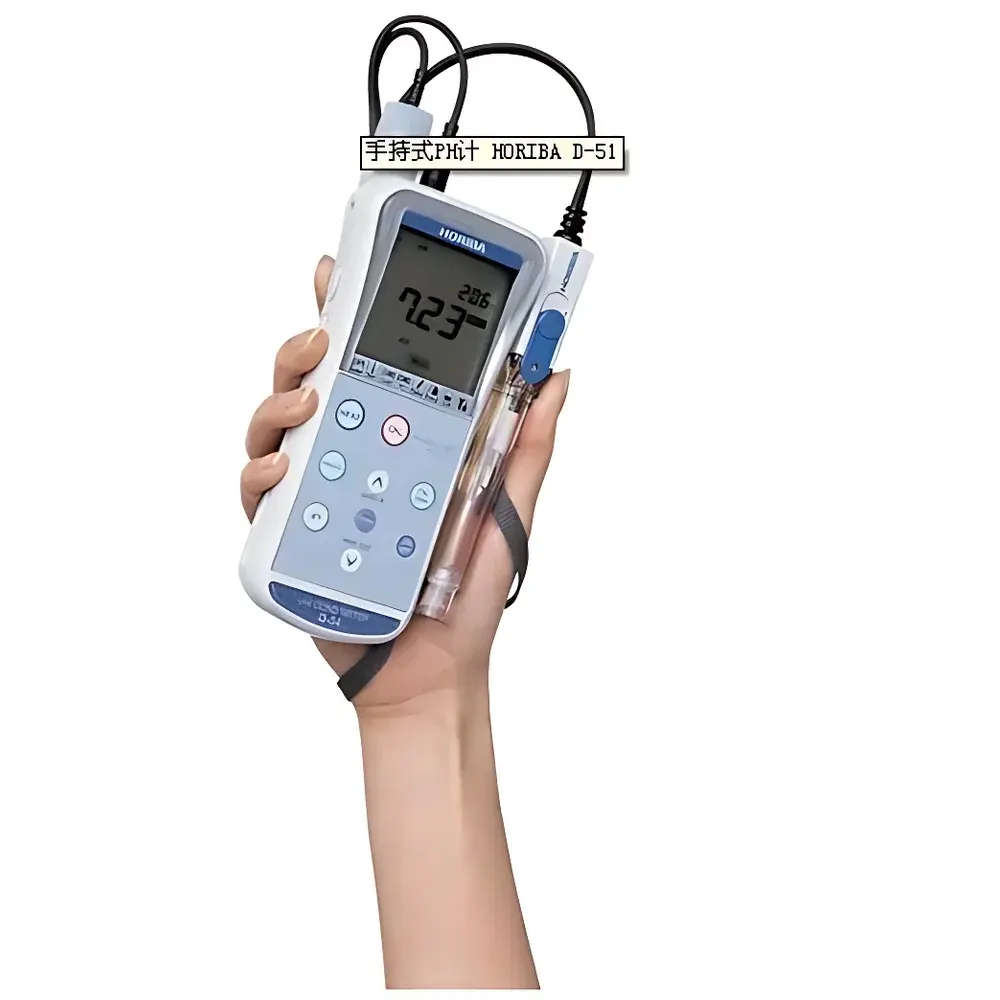
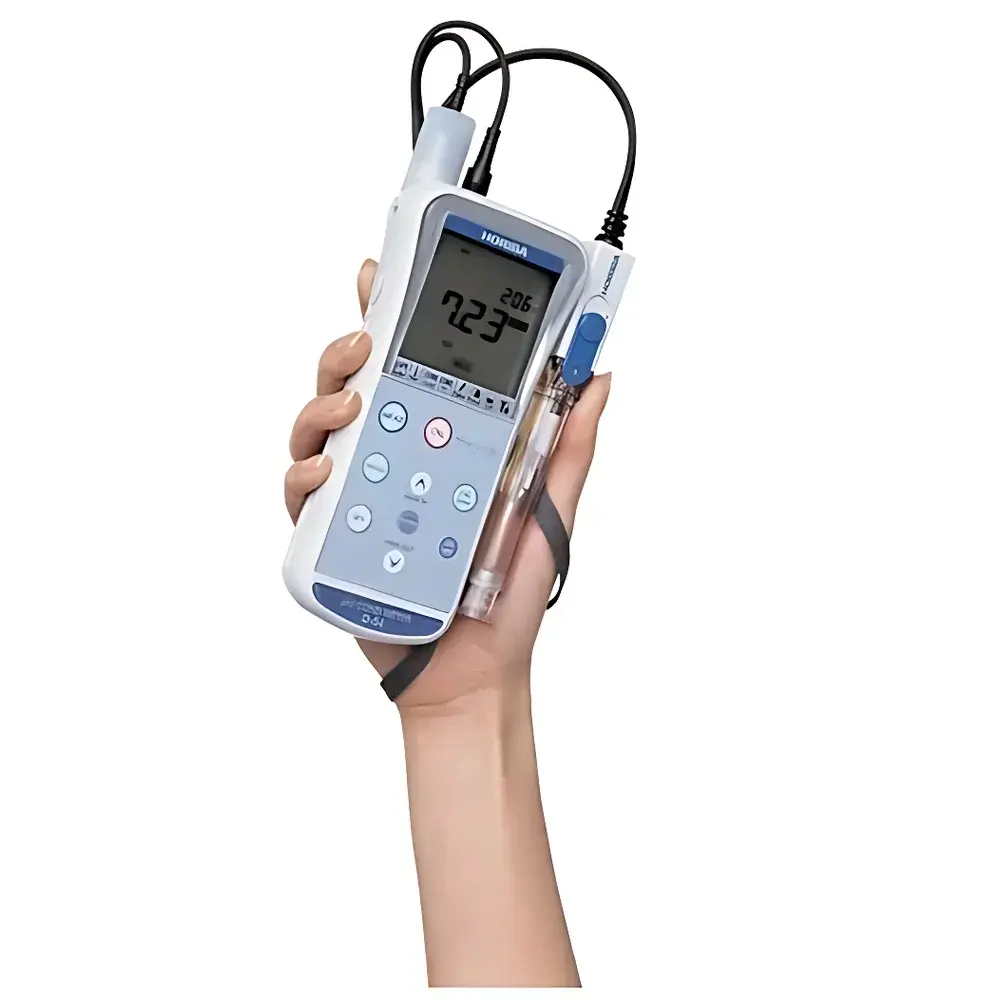
HORIBA D-51 Series Portable Multi-Parameter Water Quality Analyzer
| Brand | HORIBA |
|---|---|
| Origin | Japan |
| Model | D-51 Series |
| Instrument Type | Portable / Handheld Water Quality Analyzer |
| Measurement Parameters | pH, Temperature |
| pH Range | 0.00–14.00 (glass electrode method) |
| pH Resolution | 0.01 pH |
| Temperature Range | 0.0–100.0 °C |
| Temperature Resolution | 0.1 °C |
| pH Repeatability | ±0.01 pH ±1 digit |
| Temperature Repeatability | ±0.1 °C ±1 digit |
| Power Supply | DC 3 V (two AA/LR6 batteries) |
| Weight | Approx. 300 g |
| IP Rating | IP67 (waterproof housing) |
| Data Interface | USB (PC connectivity for data transfer and tabular export) |
| Display | Large backlit LCD screen |
| Features | Auto-data storage, self-diagnostic function, dual-channel measurement capability |
Overview
The HORIBA D-51 Series Portable Multi-Parameter Water Quality Analyzer is an engineered field instrument designed for reliable, on-site measurement of critical water quality parameters—specifically pH and temperature—under variable environmental conditions. Built upon proven potentiometric measurement principles using a high-stability glass electrode for pH and a precision thermistor or RTD-based sensor for temperature, the D-51 delivers laboratory-grade accuracy in a rugged, handheld platform. Its compact architecture and IP67-rated waterproof enclosure enable consistent operation in rain, dust, submerged splashing, or high-humidity environments—making it suitable for wastewater treatment plant inspections, river and lake monitoring campaigns, drinking water distribution audits, and educational fieldwork. Unlike benchtop analyzers requiring stable power and climate control, the D-51 operates independently on standard AA batteries, supporting extended deployment without external infrastructure.
Key Features
- IP67-certified waterproof and dustproof housing ensures operational integrity during outdoor sampling, including immersion up to 1 m for 30 minutes.
- Dual-channel capability allows simultaneous acquisition and display of pH and temperature readings, with real-time thermal compensation applied automatically per NIST-traceable algorithms.
- Large backlit LCD screen provides high-contrast, glare-resistant visualization—even under direct sunlight—with intuitive icon-driven menu navigation.
- Integrated auto-data storage logs up to 500 measurement records with timestamp, channel ID, and environmental metadata—accessible via USB interface.
- Self-diagnostic system continuously monitors electrode impedance, battery voltage, sensor response time, and calibration status, flagging anomalies before measurement errors occur.
- Low-power design enables >200 hours of continuous operation on two LR6 alkaline batteries; optional AC adapter supports desk-based calibration and data download workflows.
Sample Compatibility & Compliance
The D-51 is optimized for aqueous samples across natural, municipal, and industrial matrices—including freshwater, seawater (with appropriate electrode conditioning), effluent, and process water. It complies with fundamental electrochemical measurement standards referenced in ISO 7888 (water quality — determination of electrical conductivity), ASTM D1293 (Standard Test Methods for pH of Water), and EPA Method 150.1 (pH measurement in environmental waters). While not certified for GLP/GMP-regulated release testing, its traceable calibration protocols, audit-ready data export, and built-in diagnostic logging support adherence to internal QA/QC procedures and field data integrity requirements under ISO/IEC 17025-accredited laboratories.
Software & Data Management
Data transfer occurs via standard USB-B connection to Windows or macOS systems using HORIBA’s free PC Utility Software (v2.1+), which supports CSV and XLSX export, customizable report templates, and batch calibration file management. All stored measurements include embedded timestamps, unit identifiers, and instrument serial number—enabling full traceability. The software enforces read-only access to historical logs, preventing post-acquisition modification, and maintains local backup archives compliant with basic data integrity expectations outlined in FDA 21 CFR Part 11 Annex A (for non-GxP use cases). No cloud synchronization or remote telemetry is implemented—ensuring data sovereignty and network isolation where required.
Applications
- Routine field verification of pH stability in surface water bodies prior to regulatory sampling events.
- Quick-check diagnostics during pump station maintenance or pipe network leak investigations.
- Educational use in undergraduate environmental science labs for teaching electrode theory, calibration drift analysis, and temperature compensation effects.
- Pre-screening of influent/effluent streams at decentralized wastewater facilities lacking permanent instrumentation.
- Supporting ISO 5667-based sampling programs where portable verification of analytical conditions is mandated before sample preservation.
FAQ
What calibration buffers are recommended for routine pH verification?
Standard NIST-traceable buffers at pH 4.01, 7.00, and 10.01 (at 25 °C) are recommended. Single-point calibration suffices for relative trend analysis; two-point calibration is required for quantitative reporting.
Can the D-51 be used in seawater or high-ionic-strength samples?
Yes—provided the pH electrode is preconditioned in 3 M KCl and rinsed thoroughly after each measurement to minimize junction clogging and liquid junction potential error.
Is the temperature sensor independently calibrated?
The integrated temperature sensor is factory-calibrated against ITS-90 reference standards and does not require user recalibration; however, verification against a certified thermometer is advised annually.
Does the device support GLP-compliant electronic signatures or audit trails?
No—the D-51 lacks user authentication, electronic signature capability, or immutable audit trail generation; it meets basic field data capture needs but is not intended for regulated GxP environments.
How often should the pH electrode be replaced?
Under typical field use (≤5 measurements/day), electrode service life averages 12–18 months; performance degradation is indicated by slow response (>15 s to stabilize), reduced slope (±30 mV at pH 7.00).







