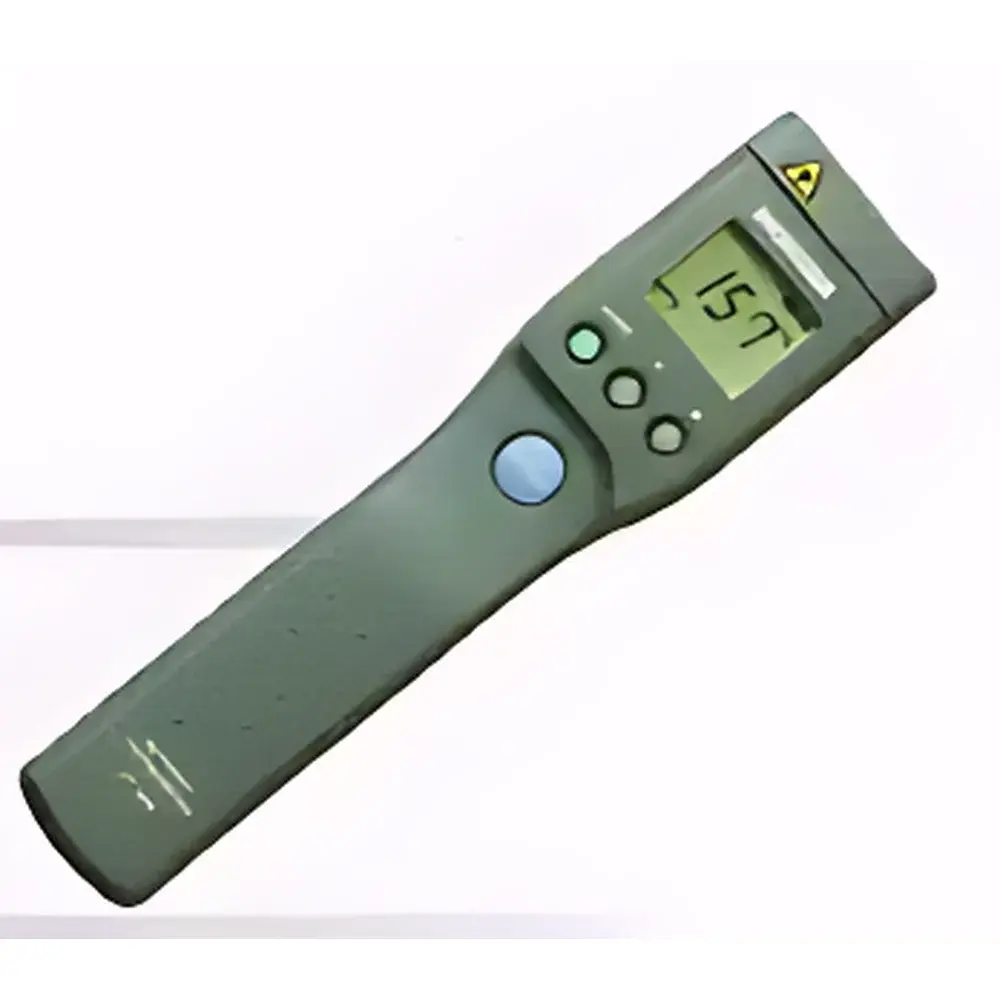
HORIBA IT-540 Non-Contact Infrared Radiometric Thermometer
| Brand | HORIBA |
|---|---|
| Origin | Japan |
| Model | IT-540 |
| Temperature Range | –50 °C to 1000 °C |
| Measurement Accuracy | ±1.5 °C or ±1.5% of reading (whichever is greater) |
| Response Time | ≤2 s |
| Spot Size | Φ25 mm at specified working distance (S-type optics) |
| Optical Resolution (D | S): 50:1 |
| Spectral Response | 8–14 µm |
| Emissivity Adjustment | 0.10–1.00 (0.01 step) |
| Display Resolution | 0.1 °C/°F |
| Power Supply | 2 × AA batteries |
| Operating Environment | –10 °C to 50 °C, <85% RH non-condensing |
| Weight | 220 g |
| Dimensions | 170 × 110 × 45 mm |
Overview
The HORIBA IT-540 is a compact, handheld non-contact infrared radiometric thermometer engineered for rapid, reliable surface temperature measurement across industrial, utility, and manufacturing environments. Based on Planck’s law of thermal radiation, the IT-540 detects emitted infrared energy in the 8–14 µm atmospheric transmission window—optimized for high accuracy on common industrial materials including oxidized metals, ceramics, plastics, and painted surfaces. Its fixed-focus S-type optical system delivers a precise Φ25 mm spot size at standard working distances, enabling targeted assessment of localized thermal anomalies without physical contact. With a broad operational range from –50 °C to 1000 °C and typical accuracy of ±1.5 °C or ±1.5% of reading (whichever is greater), the IT-540 supports routine thermographic screening of high-voltage substation components, furnace linings, conveyor-belt products, and process-critical machinery—where safety, speed, and repeatability are essential.
Key Features
- High-contrast dual-beam laser sighting system for unambiguous targeting—visually confirming the exact measurement location prior to acquisition.
- S-type optical configuration with 50:1 distance-to-spot ratio, optimized for small-area measurements (Φ25 mm) at practical working distances (e.g., 1.25 m).
- Real-time emissivity compensation (adjustable from 0.10 to 1.00 in 0.01 increments), allowing calibration to material-specific emissivity values per ASTM E1933 and ISO 18434-1 guidelines.
- Fast response time of ≤2 seconds enables efficient scanning of multiple points during preventive maintenance or line-side quality checks.
- Rugged, ergonomic housing (170 × 110 × 45 mm; 220 g) designed for one-handed operation in confined or elevated spaces—compatible with standard AA batteries for extended field deployment.
- Backlit LCD display with 0.1 °C/°F resolution and intuitive button interface—no software installation required for basic operation.
Sample Compatibility & Compliance
The IT-540 is suitable for measuring the surface temperature of electrically energized equipment (e.g., busbars, insulators, transformer bushings), rotating machinery, moving production parts, and heat-sensitive materials where contact probes pose risk of damage, contamination, or thermal loading. It complies with IEC 61557-10 for electrical safety during live-panel inspection and meets CE marking requirements for electromagnetic compatibility (EMC Directive 2014/30/EU) and low-voltage safety (LVD Directive 2014/35/EU). While not certified for hazardous area use (ATEX/IECEx), its non-intrusive design supports adherence to NFPA 70E arc-flash safety protocols by eliminating the need for proximity beyond safe approach boundaries. The device does not require recalibration under normal operating conditions but should be verified annually against traceable blackbody sources per ISO/IEC 17025-accredited procedures.
Software & Data Management
The IT-540 operates as a standalone instrument with no embedded data logging or PC connectivity. All measurements are displayed in real time and retained only on-screen until overwritten. For traceable recordkeeping, users may manually log readings—including timestamp, location ID, emissivity setting, and observed anomaly notes—in external QA/QC spreadsheets or CMMS platforms. When integrated into structured thermography programs, the IT-540 serves as a complementary tool to full-featured thermal imagers, providing quantitative point verification aligned with ISO 18434-1 Annex A recommendations for condition monitoring of electrical and mechanical assets. Its simplicity ensures compliance with GLP/GMP documentation principles when paired with standardized observation forms and reviewer sign-offs.
Applications
- Preventive maintenance of power distribution infrastructure: detecting hot spots on disconnect switches, cable terminations, and capacitor banks.
- In-line temperature verification during metal stamping, plastic extrusion, and glass tempering—ensuring thermal consistency within process windows.
- Quality assurance of solder joints, battery cell surfaces, and PCB assemblies where micro-scale thermal gradients affect reliability.
- Research and development labs requiring rapid, repeatable baseline temperature checks on prototype enclosures or heat sinks.
- Facility management audits for HVAC duct surface temperatures, steam trap functionality, and insulation integrity assessment.
FAQ
What is the minimum measurable spot size?
The IT-540 S-type optics resolve a circular measurement area of Φ25 mm at its designated focus distance—typically 1.25 m. Smaller targets require proportionally shorter working distances to maintain spatial resolution.
Can the IT-540 measure through glass or plastic covers?
No. Standard silica-based windows transmit poorly in the 8–14 µm band. Measurements must be taken directly on the target surface; transparent barriers will reflect or absorb IR energy and invalidate readings.
Is emissivity preset for common materials?
No factory presets exist. Users must manually input emissivity values based on reference tables (e.g., ASTM C1055, ISO 18434-1 Annex B) or empirical validation using contact probes on representative samples.
Does the device support data export or Bluetooth connectivity?
No. The IT-540 is a dedicated field-read instrument without memory storage, USB ports, or wireless interfaces. It prioritizes operational simplicity and battery longevity over digital integration.
How often does it require calibration verification?
Annual verification against an accredited blackbody source is recommended. Field checks using ice-water slurry (0 °C) or boiling water (at local atmospheric pressure) provide quick functional validation but do not replace formal calibration.