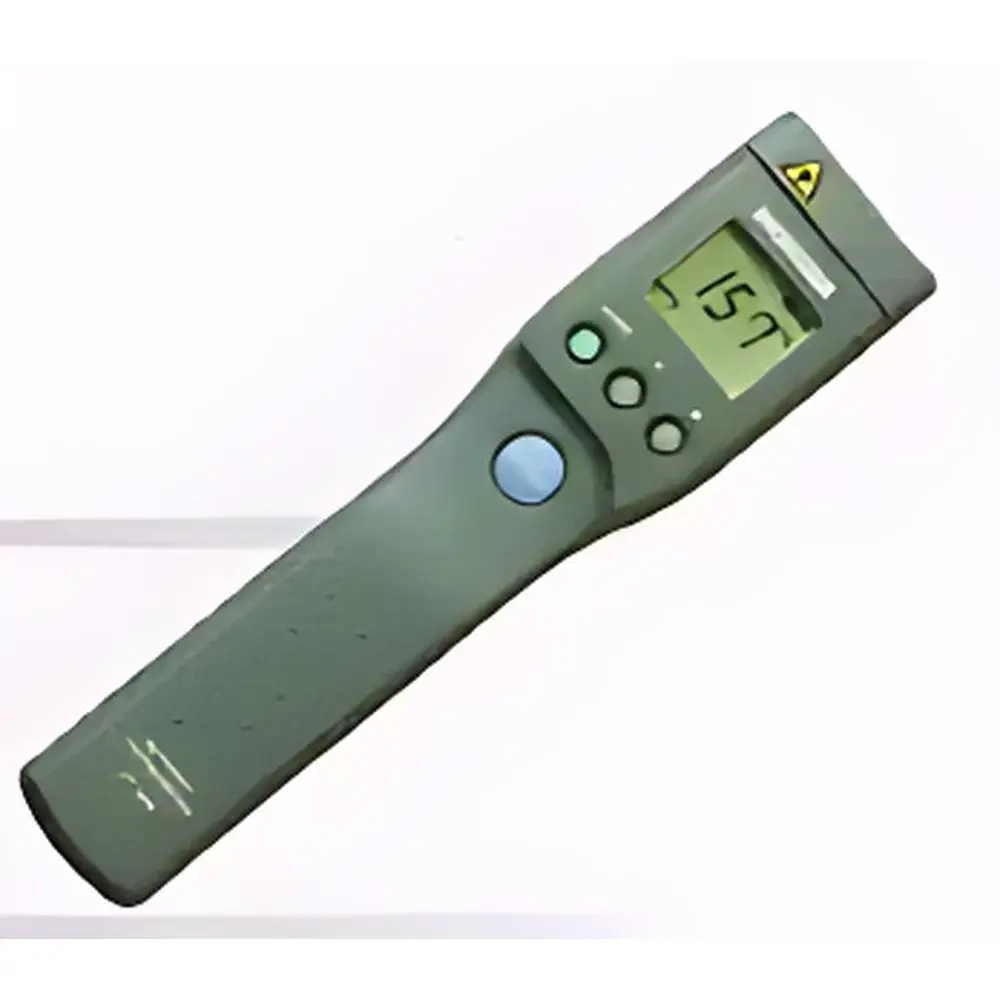
HORIBA IT-540 Non-Contact Infrared Radiometric Thermometer
| Brand | HORIBA |
|---|---|
| Origin | Japan |
| Model | IT-540 |
| Temperature Range | –50 to 1000 °C |
| Measurement Principle | Dual-wavelength infrared radiometry |
| Response Time | ≤2 s |
| Spot Size (S-type) | Ø25 mm at specified working distance |
| Optical Resolution | High spatial resolution for small-area targeting |
| Indication Method | Dual-beam laser pointer system |
| Compliance | Designed per IEC 61215-2 (industrial thermometry), meets ISO 18434-1 guidelines for condition monitoring |
Overview
The HORIBA IT-540 is a precision-engineered non-contact infrared radiometric thermometer designed for industrial condition monitoring and process temperature verification where physical contact is impractical, hazardous, or thermally disruptive. Utilizing dual-wavelength (ratio) infrared detection technology, the IT-540 compensates for partial emissivity variation and atmospheric attenuation—enabling stable, repeatable measurements across oxidized metals, ceramics, and composite surfaces commonly encountered in power transmission infrastructure, metallurgical furnaces, and semiconductor fabrication environments. Its calibrated spectral response operates within the 8–14 µm atmospheric window, minimizing interference from water vapor and CO₂ absorption bands. The instrument delivers traceable temperature readings from –50 °C to 1000 °C with inherent stability under ambient fluctuations between 0 °C and 50 °C, making it suitable for both preventive maintenance of high-voltage switchgear and real-time thermal profiling in continuous manufacturing lines.
Key Features
- Dual-beam visible laser targeting system: Precisely identifies measurement location without parallax error; beams converge at the designated focal point, ensuring unambiguous alignment on targets as small as Ø25 mm (S-type configuration).
- Rapid thermal response: Full-scale reading achieved in ≤2 seconds—optimized for scanning moving components (e.g., conveyor-borne castings) or time-sensitive diagnostics during live equipment operation.
- Narrow field-of-view optics: Engineered for high spatial resolution; maintains measurement integrity even when targeting discrete hotspots on busbars, transformer bushings, or weld seams amid complex thermal backgrounds.
- Robust industrial housing: IP54-rated enclosure resists dust ingress and incidental water splashing; operating temperature range supports deployment in unconditioned substations, foundry peripheries, and outdoor utility corridors.
- User-configurable emissivity compensation: Adjustable from 0.10 to 1.00 in 0.01 increments, enabling accurate readings on low-emissivity surfaces such as polished aluminum bus ducts or stainless steel reactor vessels.
Sample Compatibility & Compliance
The IT-540 is validated for use on electrically energized assets, refractory-lined vessels, rotating machinery bearings, and thin-film substrates—provided minimum spot size requirements are met per operational distance. It complies with ISO 18434-1:2008 for thermographic condition monitoring of electrical systems and aligns with ASTM E1933-19 for infrared temperature measurement methodology. While not certified for intrinsically safe (ATEX/IECEx) zones, its non-contact design eliminates arc-flash risk during live inspections. Data outputs conform to NIST-traceable calibration protocols, supporting GLP-aligned audit trails when integrated into enterprise CMMS platforms.
Software & Data Management
The IT-540 operates as a standalone field instrument with no embedded data logging; however, its analog output (4–20 mA) and optional RS-485 interface enable seamless integration with SCADA, PLC, or centralized thermal analytics software (e.g., Siemens Desigo CC, Honeywell Experion PKS). When paired with HORIBA’s optional PC-based configuration utility, users can store up to 10 user-defined emissivity profiles, set alarm thresholds (high/low), and export timestamped measurement sequences in CSV format. All firmware updates adhere to IEC 62443-3-3 cybersecurity principles, ensuring secure configuration transfer over isolated industrial networks.
Applications
- Electrical infrastructure: Detection of abnormal heating in circuit breakers, isolators, cable terminations, and capacitor banks—supporting IEEE 141 and IEEE 242 thermographic inspection protocols.
- Manufacturing QA/QC: In-line verification of annealing, tempering, and curing temperatures for automotive brake discs, aerospace fasteners, and polymer composites.
- Preventive maintenance: Baseline thermal mapping of HVAC chillers, steam traps, and boiler tube banks per ISO 18436-7 vibration and thermography competency standards.
- Research & development: Rapid screening of prototype thermal interfaces, heat sink efficiency, and microelectronic packaging under transient load conditions.
FAQ
Does the IT-540 require periodic recalibration?
Yes. HORIBA recommends annual calibration against NIST-traceable blackbody sources per ISO/IEC 17025-accredited laboratories to maintain measurement uncertainty within ±1.5 °C or ±1.5% of reading (whichever is greater) across its full span.
Can the IT-540 measure through glass or quartz windows?
No. Standard optical windows absorb or reflect infrared radiation in the 8–14 µm band. For enclosed applications, use dedicated IR-transparent materials (e.g., germanium or zinc selenide) with appropriate transmittance correction factors.
What is the minimum target size for reliable measurement?
For the S-type configuration, the target diameter must be ≥Ø25 mm at the specified working distance (typically 300–500 mm); smaller features require higher-resolution optics or alternative imaging solutions.
Is the dual-laser system Class 1 or Class 2?
The IT-540 employs two Class 2 visible lasers (635 nm, <1 mW each), compliant with IEC 60825-1:2014 and FDA 21 CFR 1040.10 regulations for general-purpose alignment devices.