
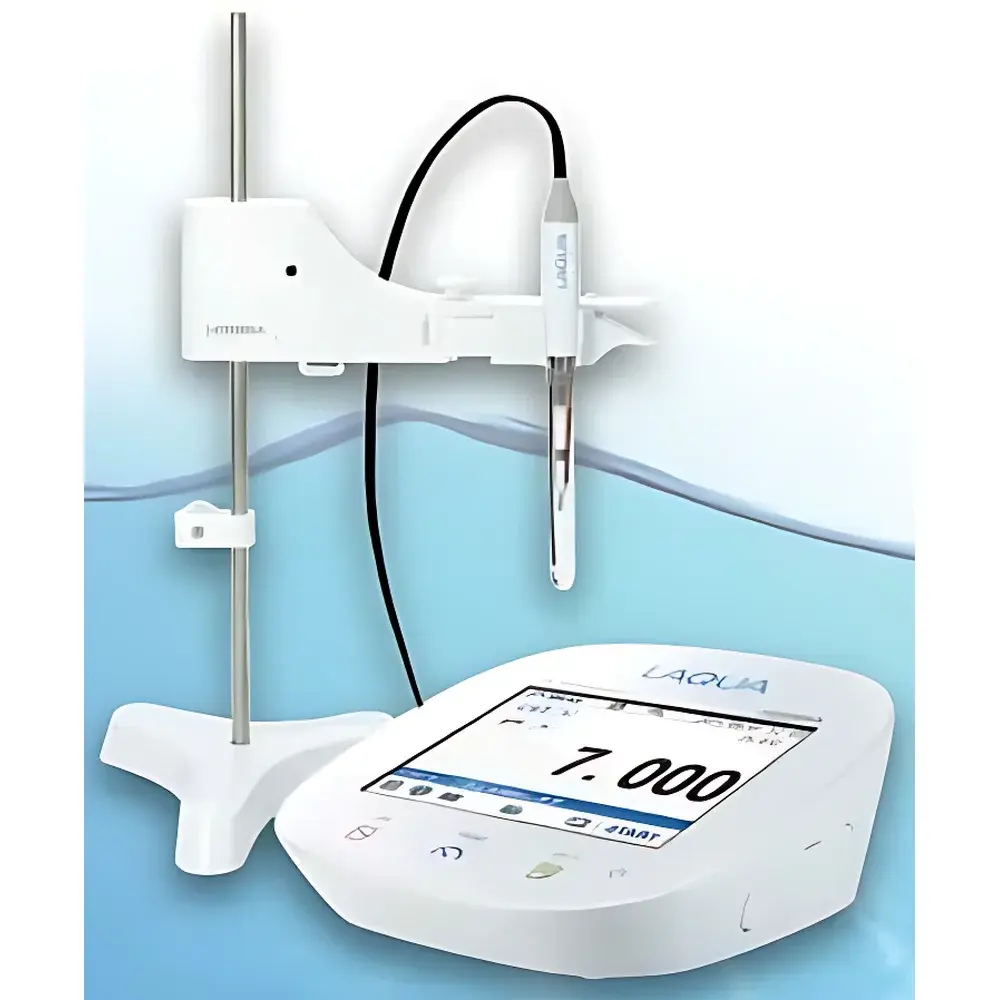
HORIBA F-71 Benchtop pH/ORP/Temperature Analyzer
| Brand | HORIBA |
|---|---|
| Origin | Japan |
| Model | F-71 |
| Instrument Type | Laboratory Water Quality Analyzer |
| Measurable Parameters | pH, ORP, Temperature |
| pH Range | 0.000–14.000 |
| pH Resolution | 0.001 |
| pH Repeatability | ±0.005 pH ±1 digit |
| ORP Range | ±1999.9 mV |
| ORP Resolution | 0.1 mV |
| ORP Repeatability | ±0.1 mV ±1 digit |
| Temperature Range | 0.0–100.0 °C (–30.0 to 130.0 °C) |
| Temperature Resolution | 0.1 °C |
| Temperature Repeatability | ±0.1 °C ±1 digit |
| Data Storage Capacity | 999 measurements |
| Power Supply | AC adapter, 100–240 V, 50/60 Hz |
| Power Consumption | ~0.7 VA |
| Weight | ~500 g |
| Compliance | JIS, USP, EP, JP, CP |
| Language Support | English, Japanese, Chinese, Korean |
| Interface | USB communication |
| Accessories Included | Electrode stand, operation manual, AC adapter |
Overview
The HORIBA F-71 is a precision-engineered benchtop analyzer designed for high-accuracy laboratory measurement of pH, oxidation-reduction potential (ORP), and temperature in aqueous samples. It employs a glass electrode-based potentiometric method compliant with ISO 3696, ASTM D1293, and IUPAC recommendations for pH determination, ensuring traceable metrology in regulated environments. Unlike portable or single-parameter meters, the F-71 integrates intelligent sensor diagnostics, real-time stability assessment, and automatic temperature compensation (ATC) using a built-in Pt1000 thermistor—enabling reliable measurements across diverse sample matrices including ultrapure water, pharmaceutical buffers, wastewater effluents, and process streams. Its compact form factor (~500 g) and low power draw (~0.7 VA) support continuous operation in QC labs, R&D facilities, and GLP-compliant testing suites without thermal drift or line noise interference.
Key Features
- Capacitive touch screen interface with intuitive icon-driven navigation—designed for glove-compatible operation and reduced contamination risk in cleanroom or aseptic workflows.
- Integrated self-diagnostic system: real-time electrode impedance monitoring, slope and offset validation during calibration, and automated alerting for out-of-specification sensor performance per USP and EP 2.2.3 guidelines.
- Compliance-ready calibration management: supports 1-, 2-, or 3-point pH calibration with NIST-traceable buffer recognition (4.01, 7.00, 10.01); stores calibration history with timestamp, operator ID, and buffer lot numbers.
- On-screen troubleshooting wizard: provides step-by-step resolution paths for common issues such as unstable readings, calibration failure, or electrode drying—aligned with JIS K 0211 and ISO/IEC 17025 root-cause analysis requirements.
- Robust mechanical design: splash-resistant housing (IP20), removable electrode holder compatible with standard BNC and DIN connectors, and modular electrode mounting for rapid swap between pH, ORP, and reference configurations.
Sample Compatibility & Compliance
The F-71 is validated for use with low-conductivity samples (≥10 µS/cm) and high-ionic-strength matrices up to 5 M NaCl equivalent. Its glass electrode architecture minimizes sodium error below pH 2 and alkali error above pH 12, maintaining accuracy per ISO 10523 specifications. Regulatory alignment includes full support for pharmacopeial water testing protocols: USP (Conductivity & TOC correlation), EP 2.2.38 (pH of purified water), JP XVI General Tests 2.07, and CP 2020 Appendix IX P. All measurement data—including raw mV values, calculated pH, temperature, and calibration metadata—are time-stamped and stored locally with immutable audit trails, satisfying FDA 21 CFR Part 11 requirements when paired with HORIBA’s optional secure software suite.
Software & Data Management
Data export is performed via USB 2.0 interface to Windows-based systems running HORIBA LabSolutions™ software (v3.2+), which enables CSV/Excel report generation, statistical process control (SPC) charting, and automated PDF certificate creation with digital signature fields. The instrument stores up to 999 measurement records with full parameter sets (pH, mV, °C, date/time, operator code), each tagged with unique identifiers for traceability. While the F-71 does not feature built-in Wi-Fi or Ethernet, its USB host capability allows direct connection to USB flash drives for offline backup—a configuration commonly deployed in air-gapped GMP laboratories where network isolation is mandated.
Applications
- Pharmaceutical QC: pH verification of Water for Injection (WFI), Purified Water (PW), and buffer solutions prior to sterilization or formulation.
- Environmental monitoring: field-deployable lab verification of surface water, groundwater, and treated effluent against EPA Method 150.1 and ISO 10523 compliance thresholds.
- Academic research: kinetic studies requiring high-resolution pH tracking during titration, enzymatic reactions, or corrosion inhibition assays.
- Food & beverage: shelf-life stability testing of acidic beverages, dairy products, and fermentation broths under controlled temperature conditions.
- Electroplating & semiconductor rinse baths: ORP monitoring for redox-controlled cleaning processes aligned with SEMI F57 standards.
FAQ
Does the F-71 support GLP/GMP-compliant data integrity?
Yes—when used with HORIBA LabSolutions™ software and configured with user access controls, electronic signatures, and audit trail logging, it meets ALCOA+ principles and 21 CFR Part 11 Subpart B requirements.
Can the F-71 measure ion concentration or conductivity?
No—the F-71 is a dedicated single-channel pH/ORP/temperature analyzer. Multi-parameter capabilities (e.g., conductivity, ion-selective measurement) require the F-72, F-73, or F-74 models.
What electrode types are compatible with the F-71?
Standard BNC or DIN-connected combination pH electrodes (e.g., HORIBA 9615S-10D, 9625S-10D), refillable double-junction reference electrodes, and platinum ORP electrodes meeting ISE/ASTM D1129 specifications.
Is firmware upgrade supported?
Yes—firmware updates are delivered via USB drive and applied through the instrument’s maintenance menu; version history and release notes comply with IEC 62304 Class B software lifecycle requirements.
How is temperature compensation implemented?
Automatic temperature compensation uses a built-in Pt1000 sensor with NIST-traceable calibration; users may select linear, non-linear (Nernstian), or custom compensation curves depending on application-specific needs.
Related Products







