
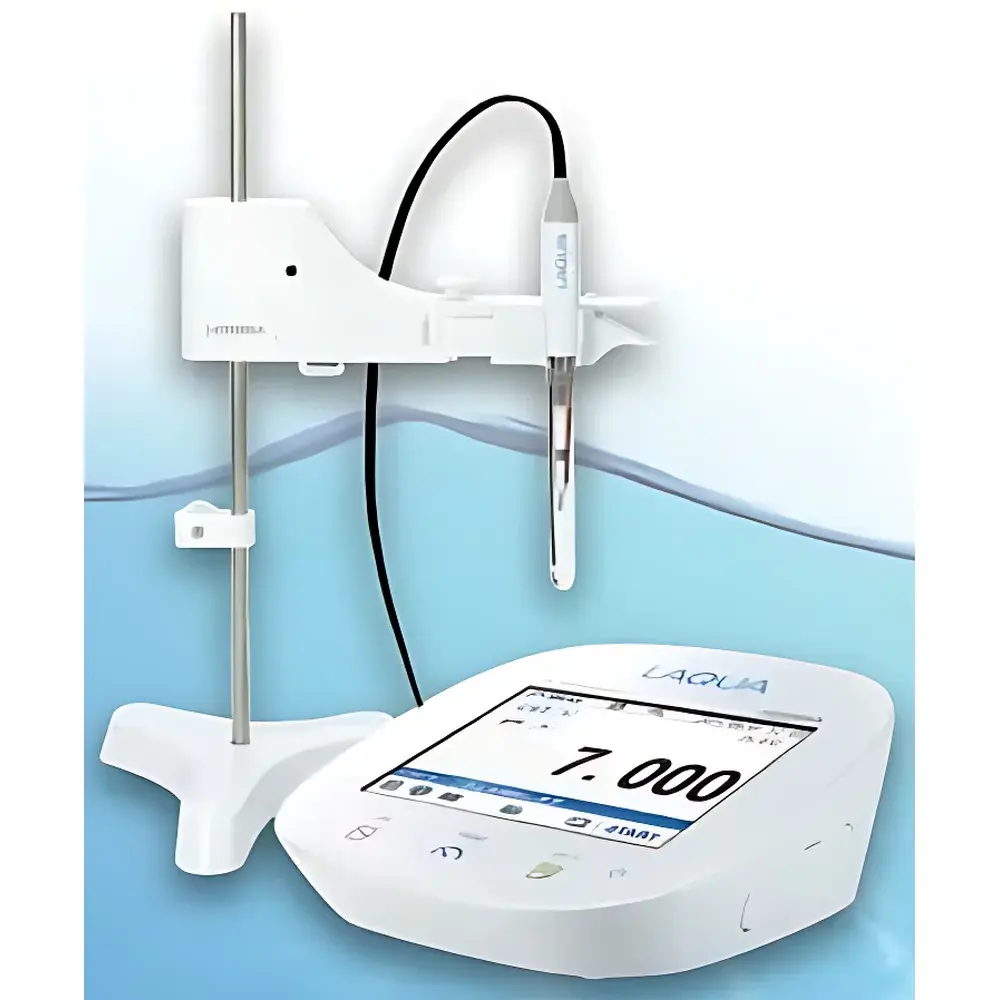
HORIBA F-72 Benchtop Water Quality Analyzer
| Brand | HORIBA |
|---|---|
| Origin | Japan |
| Model | F-72 |
| Instrument Type | Benchtop Laboratory Water Quality Analyzer |
| Measurable Parameters | pH, ORP, Ion Concentration, Temperature |
| Display | Single-channel capacitive touchscreen |
| Data Storage | 2000 measurements |
| Compliance | JIS, USP, EP, JP, CP |
| Language Support | English, Japanese, Korean, Chinese |
| Power Supply | AC adapter 100–240 V, 50/60 Hz |
| Power Consumption | ~9.8 VA |
| Weight | ~700 g |
| Included Accessories | Electrode stand, operation manual, AC adapter |
Overview
The HORIBA F-72 is a precision-engineered benchtop water quality analyzer designed for rigorous laboratory applications requiring high accuracy, traceable calibration, and regulatory compliance. Built upon HORIBA’s legacy in electrochemical sensing, the F-72 employs potentiometric measurement principles: pH and ORP are determined via glass and noble-metal reference electrodes following Nernstian response kinetics; ion concentration is quantified using selective ion electrodes (e.g., fluoride, nitrate, ammonium) with defined slope sensitivity and linear dynamic range; temperature is measured using a high-stability Pt1000 or thermistor sensor integrated into the electrode assembly or probe. Unlike portable or field meters, the F-72 is optimized for controlled lab environments—offering stable thermal management, minimized electrical noise coupling, and robust mechanical architecture to ensure long-term metrological integrity. Its single-channel architecture focuses on operational clarity and method reproducibility rather than multi-parameter parallel acquisition, making it ideal for QC labs validating purified water systems, pharmaceutical process streams, or environmental reference standards.
Key Features
- Capacitive touchscreen interface (7-inch diagonal) with intuitive, icon-driven navigation—designed for glove-compatible operation and minimal training overhead.
- Comprehensive electrode health diagnostics and guided calibration workflows compliant with JIS Z 8401, USP , EP 2.2.38, and JP XVIII Annexes for purified water testing.
- Real-time fault diagnosis engine: On-screen troubleshooting prompts activate during calibration drift, electrode aging, or signal instability—reducing downtime and supporting GLP audit readiness.
- Modular electrode compatibility: Supports interchangeable glass pH electrodes (e.g., HORIBA 9615S-10D), combination ORP electrodes, and solid-state or liquid-filled ion-selective electrodes with standardized BNC or mini-DIN connectors.
- Regulatory-grade data handling: Automatic timestamping, user ID logging, and editable measurement notes—configured to meet FDA 21 CFR Part 11 requirements when paired with validated software and access-controlled user accounts.
- Thermal compensation algorithms: Automatic temperature correction applied to pH, ORP, and ion readings based on simultaneous Pt1000 measurement—eliminating manual offset adjustments.
Sample Compatibility & Compliance
The F-72 is validated for aqueous matrices across pharmaceutical, academic, and municipal testing laboratories. It accommodates samples ranging from ultrapure water (resistivity >18.2 MΩ·cm) to high-ionic-strength industrial effluents (TDS up to 100 g/L). Its electrode interface design minimizes junction clogging and reference electrolyte contamination—critical for repeat analysis of viscous or particulate-laden samples. Regulatory alignment includes full support for pharmacopeial water specifications: USP Purified Water (PW) and Water for Injection (WFI) conductivity limits; EP Chapter 2.2.38 resistivity thresholds; JP General Tests for Water; and CP IV purified water monographs. All calibration protocols enforce dual-point (pH 4.01/7.00/10.01) and three-point (for ion mode) verification with certificate-traceable standard solutions (NIST SRM or equivalent).
Software & Data Management
Data export and instrument control are executed via USB 2.0 interface using HORIBA’s proprietary LabStation software (Windows-compatible, version 3.2+). The software enables secure data archiving in .csv and .xlsx formats with embedded metadata (operator, date/time, electrode serial number, calibration history). Audit trail functionality records all parameter changes, calibration events, and measurement deletions—fully compliant with GLP and GMP documentation requirements. Optional integration with LIMS platforms is supported through configurable ASCII output protocols. Internal memory retains 2000 measurement records with time/date stamps, electrode IDs, and raw mV/pH/ion values—retention persists through power cycles and firmware updates.
Applications
- Pharmaceutical water system validation: Continuous monitoring of PW/WFI loop resistivity and TOC-correlated conductivity per USP .
- Electrolyte formulation QC: Precise chloride, sodium, or potassium ion quantification in parenteral solutions and dialysate concentrates.
- Environmental reference lab accreditation: Certified pH and ORP measurements for inter-laboratory comparison studies under ISO/IEC 17025.
- Academic research: Kinetic studies of acid-base equilibria or redox reactions requiring sub-mV resolution and temperature-controlled sample cells.
- Calibration laboratory traceability: Primary standardization of secondary pH buffers and ion reference solutions against certified reference materials.
FAQ
Does the F-72 support GLP-compliant electronic signatures?
Yes—when used with LabStation software v3.2+ and configured with role-based user accounts, password policies, and audit trail activation, it satisfies FDA 21 CFR Part 11 requirements for electronic records and signatures.
Can the F-72 measure conductivity or TDS?
No—the F-72 is a single-channel analyzer dedicated to pH, ORP, ion concentration, and temperature. Conductivity, resistivity, salinity, and TDS are supported only on multi-channel models (e.g., F-74, F-74BW).
What ion types are supported out-of-the-box?
The F-72 accepts any commercially available ion-selective electrode with standard BNC or mini-DIN output. Common configurations include F⁻, Cl⁻, NO₃⁻, NH₄⁺, Ca²⁺, and K⁺—calibration is performed using ISE-specific slope and intercept parameters.
Is temperature compensation automatic during ion measurements?
Yes—temperature is continuously monitored via integrated Pt1000 sensor, and the Nernst equation correction is applied in real time to all ion concentration calculations.
How often does the instrument require recalibration?
Per USP , daily calibration is recommended for critical pharmaceutical water testing; for general lab use, calibration before each analytical session or at 8-hour intervals is advised—guided by the built-in calibration due-date tracker.
Related Products







