
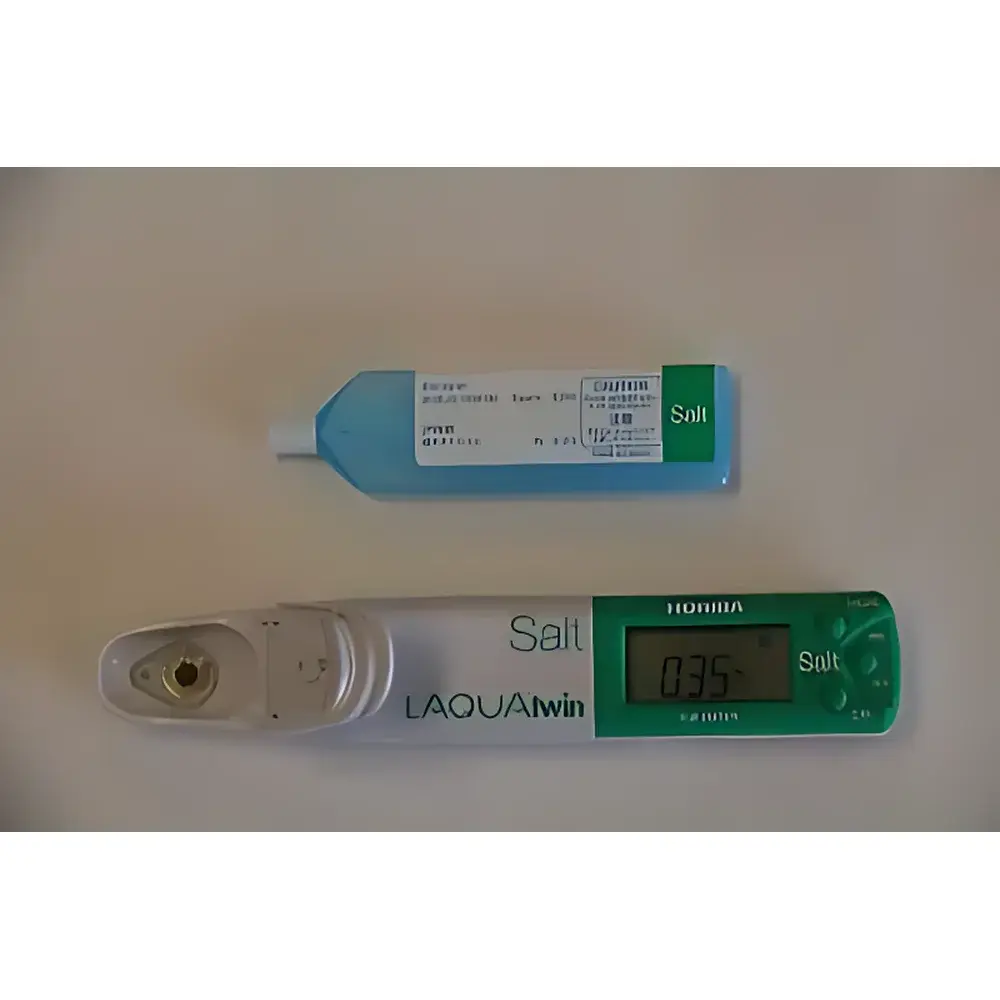
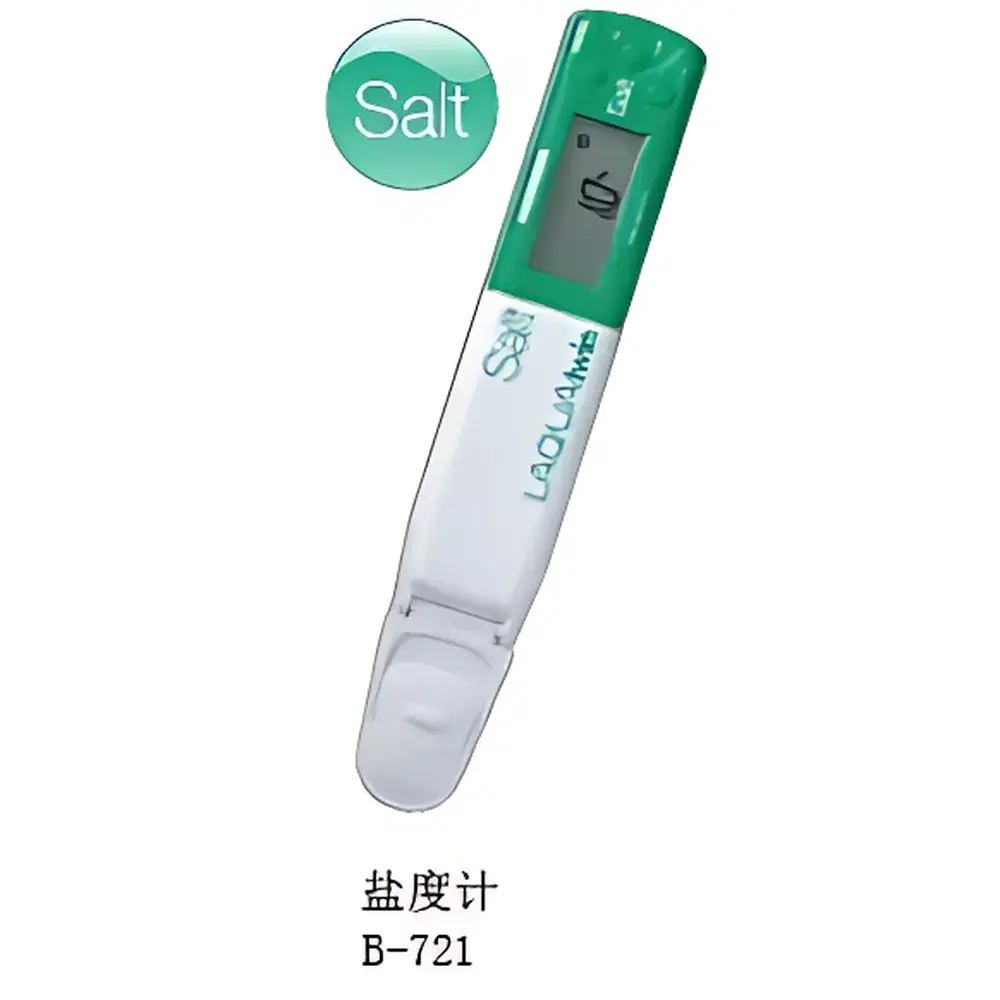
HORIBA B-721 Portable Salinity Meter
| Brand | HORIBA |
|---|---|
| Origin | Japan |
| Model | B-721 |
| Portability | Pen-type |
| Measurement Principle | Ion-selective electrode (NaCl-specific) |
| Salinity Range | 0.1–10% (w/w NaCl) |
| Temperature Range | 5–40 °C |
| Temperature Compensation | Automatic (2%/°C fixed coefficient) |
| Accuracy | ±10% of reading |
| Resolution | 0.1% |
| IP Rating | IP67 |
| Power Source | Two CR2032 batteries |
| Dimensions | 164 × 29 × 20 mm (excl. probe tip) |
| Weight | ~50 g (instrument only, no batteries) |
Overview
The HORIBA B-721 is a compact, pen-style salinity meter engineered for rapid, field-deployable quantification of sodium chloride concentration in aqueous solutions. Unlike traditional conductivity-based salinity estimators, the B-721 employs a dedicated NaCl-selective ion electrode — a solid-contact, potentiometric sensor optimized for direct, interference-minimized measurement of chloride and sodium activity under varying ionic strength conditions. This electrochemical architecture enables reliable salt determination without reliance on empirical TDS conversion factors or temperature-dependent conductivity-to-salinity algorithms. The instrument is calibrated using a two-point gravimetric standardization method traceable to NIST-certified reference materials, ensuring metrological consistency across environmental monitoring, aquaculture, food processing, and laboratory quality control applications. Its sealed, single-use electrode design eliminates maintenance requirements such as refilling electrolyte or replacing membranes — a critical advantage for unattended or high-turnover field use.
Key Features
- Pen-form factor with ergonomic grip and integrated LCD display for one-handed operation in humid or outdoor environments
- IP67-rated enclosure ensures full protection against dust ingress and immersion in water up to 1 m for 30 minutes
- Automatic temperature compensation (ATC) with fixed 2%/°C coefficient, referenced to 25 °C, compliant with ISO 7888 and ASTM D1125 guidelines for salinity reporting
- Auto-hold function freezes stable readings after signal stabilization (±0.05% over 3 s), reducing operator variability
- Low sample volume requirement: functional measurement from as little as 0.05 mL per test (dual-point sampling protocol supported)
- CR2032 battery power supply (2×) delivers >2,000 measurements per set under typical usage; low-battery indicator alerts prior to voltage drop below 2.4 V
- No firmware updates or PC connectivity required — fully self-contained operation with factory-set calibration constants
Sample Compatibility & Compliance
The B-721 is validated for use with natural waters (freshwater, brackish, seawater dilutions), process streams, nutrient solutions, and food-grade brines containing ≤10% NaCl. It exhibits minimal cross-sensitivity to common anions (e.g., SO₄²⁻, NO₃⁻) and cations (e.g., K⁺, Ca²⁺) at concentrations typical of agricultural runoff or recirculating aquaculture systems (RAS). The device complies with IEC 60529 for ingress protection and meets the electrical safety requirements of IEC 61010-1 for handheld portable measuring equipment. While not certified for GLP/GMP-regulated release testing, its two-point calibration procedure aligns with USP guidance for field instrumentation used in non-critical quality assessments. Data output conforms to ISO/IEC 17025 documentation expectations when paired with laboratory-controlled calibration records.
Software & Data Management
The B-721 operates without embedded software or digital data logging capability. All measurements are displayed in real time on a monochrome LCD with backlighting (activated manually). No Bluetooth, USB, or IR interface is included; therefore, no proprietary drivers, cloud synchronization, or FDA 21 CFR Part 11-compliant audit trails are provided. Users are expected to manually record results in bound logbooks or LIMS-integrated spreadsheets. Calibration history must be maintained externally per ISO/IEC 17025 Clause 7.7 — specifically, dates, standard lot numbers, ambient temperature, and observed deviations should be documented for each recalibration event.
Applications
- Aquaculture: Routine monitoring of hatchery tank salinity during larval rearing phases where ±0.5% deviation impacts osmoregulatory stress response
- Food & Beverage: Spot-checking brine concentration in pickle vats, soy sauce fermentation tanks, and cured meat marinades
- Environmental Fieldwork: Rapid assessment of estuarine mixing zones, road de-icing runoff impact, and coastal groundwater intrusion
- Educational Labs: Undergraduate electrochemistry demonstrations focusing on ion-selective electrode theory and Nernst equation validation
- Horticulture: Verification of nutrient solution salinity in hydroponic and aeroponic systems to prevent root zone EC drift
FAQ
What calibration standards are recommended for the B-721?
Use certified NaCl reference solutions at 1.0% and 5.0% w/w (traceable to NIST SRM 999b), prepared gravimetrically in Type I water (ASTM D1193). Avoid pre-mixed commercial “TDS” standards.
Can the B-721 measure seawater directly?
Yes, but only within its specified 0.1–10% range — undiluted seawater (~3.5%) falls well within operational limits. For hypersaline samples (>10%), dilution with deionized water and subsequent correction is required.
Is temperature compensation adjustable?
No. The B-721 applies a fixed 2%/°C coefficient per ISO 7888 Annex B. Manual temperature correction is not supported.
How often should calibration be performed?
Daily before first use in regulated environments; every 4 hours during continuous field deployment; or after exposure to temperatures outside 5–40 °C.
Does the electrode require storage solution?
No. The solid-contact sensor is designed for dry storage between measurements. Prolonged immersion in high-salinity solutions (>8%) may accelerate drift and necessitate recalibration.



