
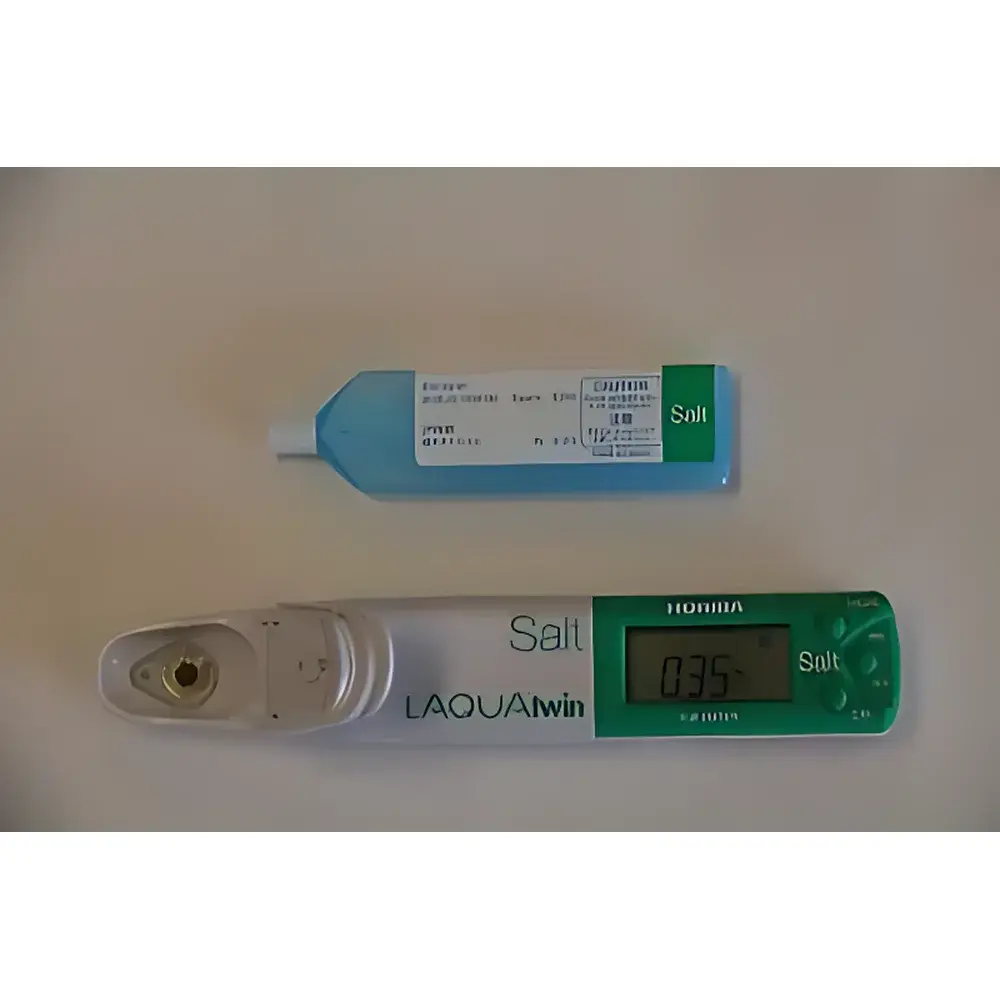
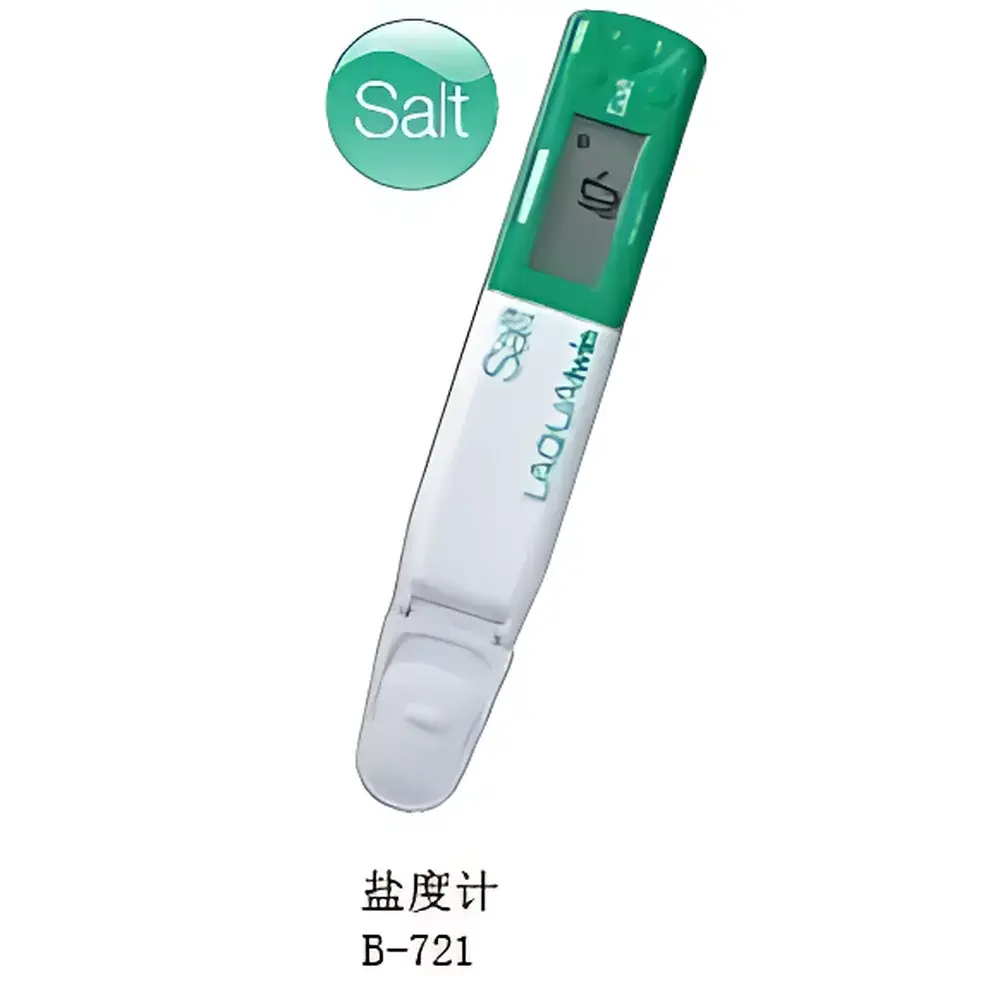
HORIBA B-721 Portable Salinity Meter
| Brand | HORIBA |
|---|---|
| Origin | Japan |
| Model | B-721 |
| Portability | Pen-type |
| Salinity Measurement Range | 0.1–10% (w/w NaCl) |
| Temperature Measurement Range | 5–40 °C |
| Accuracy | ±10% of reading |
| Minimum Resolution | 0.1% |
| Temperature Compensation | Automatic, fixed 2%/°C coefficient |
| Protection Rating | IP67 |
| Power Source | Two CR2032 batteries |
| Dimensions | 164 × 29 × 20 mm (excl. probe protrusion) |
| Weight | ~50 g (instrument only, excluding batteries) |
Overview
The HORIBA B-721 is a compact, pen-style salinity meter engineered for rapid, field-deployable quantification of sodium chloride (NaCl) concentration in aqueous solutions. Unlike traditional conductivity-based salinometers that infer salinity from electrical conductivity and require temperature-dependent conversion algorithms, the B-721 employs a dedicated ion-selective electrode (ISE) principle—specifically optimized for chloride ion activity in the presence of dominant Na⁺ counterions—enabling direct, chemistry-specific measurement of salinity as mass percent (w/w % NaCl). This approach eliminates ambiguity associated with multi-ion interference or TDS-to-salinity conversion assumptions, delivering improved specificity for applications where NaCl is the primary dissolved salt. The instrument operates within a validated range of 0.1 to 10.0% NaCl, making it suitable for monitoring brackish water, food processing brines, aquarium management, hydroponic nutrient solutions, and low-salinity industrial rinse baths. Its robust, single-parameter architecture prioritizes operational simplicity without compromising metrological traceability under routine environmental conditions.
Key Features
- Ion-selective electrode (ISE) detection system calibrated specifically for NaCl concentration, offering superior selectivity over generic conductivity-derived salinity estimates.
- Pen-form factor (164 × 29 × 20 mm, ~50 g) with ergonomic grip and integrated probe—designed for one-handed operation and minimal sample volume requirements (as low as 0.05 mL per measurement).
- IP67-rated enclosure ensures full protection against dust ingress and immersion in water up to 1 m for 30 minutes—validated for use in humid laboratories, outdoor field sites, aquaculture facilities, and food production floors.
- Automatic temperature compensation using a fixed 2%/°C coefficient, referenced to 25 °C—aligned with standard saline solution calibration conventions per ASTM D1125 and ISO 7888.
- Auto-hold function freezes stable readings on-screen, reducing operator-induced variability during manual sampling.
- Dual CR2032 coin-cell power supply provides >2,000 measurements per battery set, with low-battery indicator and automatic shutdown after 10 minutes of inactivity.
Sample Compatibility & Compliance
The B-721 is validated for use with clear, non-viscous, low-turbidity aqueous samples containing predominantly NaCl as the ionic solute. It is not recommended for high-salinity seawater (>10%), strongly acidic/alkaline media (pH 10), or samples containing elevated concentrations of interfering ions such as bromide (Br⁻), iodide (I⁻), or silver (Ag⁺), which may affect ISE response stability. Calibration is performed using two-point standardization with certified NaCl reference solutions (e.g., 1.0% and 5.0% w/w)—a procedure compliant with GLP documentation requirements when recorded manually or via external logbook. While the device itself does not generate electronic audit trails, its measurement protocol aligns with foundational principles of ISO/IEC 17025 for competence of testing and calibration laboratories, particularly regarding equipment verification, environmental control (5–40 °C ambient, RH < 85% non-condensing), and documented calibration frequency.
Software & Data Management
The B-721 operates as a standalone, embedded-system instrument with no onboard data logging, Bluetooth, or USB connectivity. All measurements are displayed in real time on a high-contrast LCD screen and must be manually transcribed for record retention. This design intentionally minimizes firmware complexity and maximizes long-term reliability in resource-constrained environments. For regulated workflows requiring electronic records, users may integrate the B-721 into broader data capture systems by pairing it with external barcode-scanned sample identifiers and timestamped entry into LIMS or ELN platforms. Though the instrument does not comply with FDA 21 CFR Part 11 out-of-the-box, its deterministic analog signal path and absence of configurable software parameters support straightforward validation protocols for GMP-relevant applications where salinity serves as a critical process parameter.
Applications
- Aquaculture and marine biology: Routine monitoring of hatchery tank salinity to maintain osmoregulatory stability in larval fish and crustaceans.
- Food & beverage quality control: Verification of brine concentration in pickling, curing, and fermentation processes (e.g., soy sauce, olives, cheese whey).
- Horticulture and hydroponics: Adjustment of nutrient solution salinity to prevent root zone osmotic stress in greenhouse crops.
- Environmental field screening: Rapid assessment of freshwater intrusion in coastal groundwater or runoff salinity near de-icing roadways.
- Educational laboratories: Hands-on instruction in ion-selective sensing principles, calibration methodology, and uncertainty propagation in single-parameter electrochemical analysis.
FAQ
What measurement principle does the B-721 use?
It utilizes a chloride-selective ion electrode (Cl⁻-ISE) with Na⁺ as the dominant cation, enabling direct potentiometric determination of NaCl concentration expressed as weight percent (w/w %).
Is the B-721 suitable for seawater analysis?
No—it is validated only up to 10% NaCl (≈100 g/L), whereas natural seawater averages ~3.5% (35 g/L); however, extended exposure to full-strength seawater may accelerate electrode drift and require more frequent recalibration.
Does the instrument support user-defined temperature compensation coefficients?
No—temperature compensation is fixed at 2%/°C, consistent with standard NaCl solution behavior near ambient temperatures and aligned with ASTM D1125 Annex A1.
Can the B-721 measure TDS or conductivity?
No—it is a dedicated salinity meter; models B-711, B-712, and B-771 offer pH, EC, or multi-ion capabilities, but the B-721 provides only NaCl-specific readout.
How often should calibration be performed?
Daily calibration is recommended for routine QC use; before each analytical session in regulated environments; and immediately following exposure to extreme temperatures, drying, or contamination events.






