
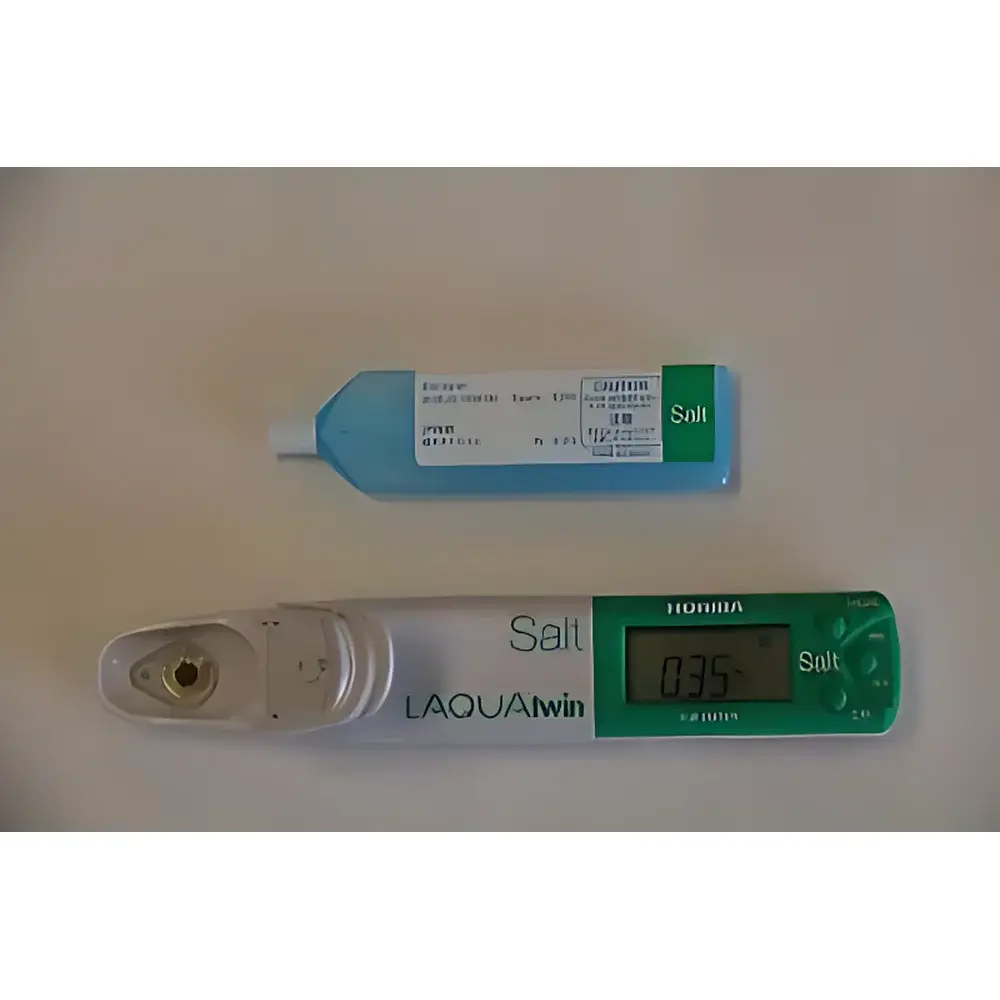
HORIBA B-721 Portable Salinity Meter
| Brand | HORIBA |
|---|---|
| Origin | Japan |
| Model | B-721 |
| Portability | Pen-type |
| Salinity Measurement Range | 0.1–10% (w/w NaCl) |
| Temperature Measurement Range | 5–40 °C |
| Accuracy | ±10% of reading |
| Minimum Resolution | 0.1% |
| Temperature Compensation | Automatic (2%/°C fixed coefficient) |
| IP Rating | IP67 |
| Power Source | Two CR2032 batteries |
| Dimensions | 164 × 29 × 20 mm (excl. protrusions) |
| Weight | ~50 g (instrument only, excluding batteries) |
Overview
The HORIBA B-721 is a compact, pen-style salinity meter engineered for rapid, field-deployable quantification of sodium chloride (NaCl) concentration in aqueous solutions. Unlike optical or refractive index-based instruments, the B-721 employs a robust ion-selective electrode (ISE) principle—specifically optimized for chloride ion activity—combined with integrated temperature sensing and automatic temperature compensation (ATC) at a fixed 2%/°C coefficient. This electrochemical approach ensures reliable performance across variable thermal conditions without requiring manual recalibration during routine use. Designed for operational simplicity and ruggedness, the B-721 delivers direct % (w/w) NaCl readouts without conversion factors or user-defined calibration curves. Its measurement range spans 0.1 to 10.0%, covering applications from food brine monitoring and aquaculture management to industrial process control and environmental water screening. The device operates exclusively on two standard CR2032 coin-cell batteries, enabling over 10,000 measurements per set under typical usage conditions.
Key Features
- Pen-form factor with IP67 ingress protection: Fully sealed against dust and immersion in water up to 1 m for 30 minutes—suitable for humid laboratories, outdoor sampling, and washdown environments.
- Ion-selective electrode architecture: Utilizes a stable, low-drift chloride-sensitive sensor element with minimal polarization effects, ensuring consistent response across repeated measurements.
- Two-point calibration protocol: Supports precise span adjustment using certified NaCl standards (e.g., 1.0% and 5.0% w/w), improving accuracy across the full operating range.
- Automatic data hold function: Freezes stable readings on-screen after signal stabilization—critical for handheld operation in non-laboratory settings.
- Integrated temperature measurement: Built-in thermistor provides real-time compensation, eliminating the need for external thermometers or manual correction tables.
- Low sample volume requirement: Validated for reliable operation with as little as 0.05 mL × 2 (dual-point sampling) or ≥0.3 mL single-volume measurements—ideal for limited or precious samples.
Sample Compatibility & Compliance
The B-721 is validated for use with clear, low-turbidity aqueous NaCl solutions containing minimal suspended solids or organic fouling agents. It is not intended for highly viscous, emulsified, or strongly oxidizing media (e.g., bleach solutions >500 ppm available chlorine). While not certified to ISO/IEC 17025 or ASTM D1125 for formal accreditation, its design aligns with general good laboratory practice (GLP) for non-regulated QC checks. The instrument meets IEC 60529 for IP67 classification and complies with RoHS Directive 2011/65/EU regarding hazardous substance restrictions. Battery compartment sealing satisfies UL 4200A requirements for consumer lithium battery safety.
Software & Data Management
The B-721 operates as a standalone, firmware-controlled instrument with no onboard memory or digital interface. All measurements are displayed in real time on a high-contrast LCD screen; no data logging, Bluetooth, or USB connectivity is provided. Users must manually record results or integrate with external documentation systems. For traceability in regulated environments, operators are advised to maintain handwritten or electronic logs including date/time, operator ID, calibration verification status, sample ID, and ambient temperature/humidity. Though lacking FDA 21 CFR Part 11-compliant audit trails, the device supports basic GLP workflows when paired with controlled procedural documentation.
Applications
- Quality assurance of food processing brines (e.g., pickling, curing, fermentation tanks)
- Routine salinity checks in marine aquariums, hatcheries, and recirculating aquaculture systems (RAS)
- Field verification of desalination plant reject stream concentrations
- Monitoring of de-icing solution strength prior to road application
- Education and student laboratories requiring low-cost, intuitive electrochemical instrumentation
- Pre-screening of wastewater influent/effluent for chloride load estimation
FAQ
What calibration standards are recommended for the B-721?
Use certified NaCl reference solutions traceable to NIST SRM 999 or equivalent—commonly 1.0% and 5.0% (w/w) NaCl in distilled water. Avoid tap water or unbuffered saline preparations.
Can the B-721 measure seawater salinity accurately?
It provides approximate % NaCl equivalents for natural seawater (~3.5%), but does not compensate for ionic strength differences among major seawater ions (e.g., Mg²⁺, SO₄²⁻). For oceanographic work, dedicated conductivity-based salinometers (e.g., following UNESCO TEOS-10) are preferred.
How often should the electrode be cleaned or conditioned?
Rinse thoroughly with deionized water after each use. Soak in 0.1 M HNO₃ for 2 minutes weekly if used in high-solids or protein-rich matrices; rinse again before storage in electrode storage solution.
Is temperature compensation adjustable?
No—the B-721 applies a fixed 2%/°C compensation coefficient per ISO 7888. Manual override or custom TC coefficients are not supported.
Does the B-721 require annual factory recalibration?
HORIBA recommends functional verification using reference standards before each daily use sequence. Full recalibration is advised every 6 months for critical applications or after physical impact/drop events.




