
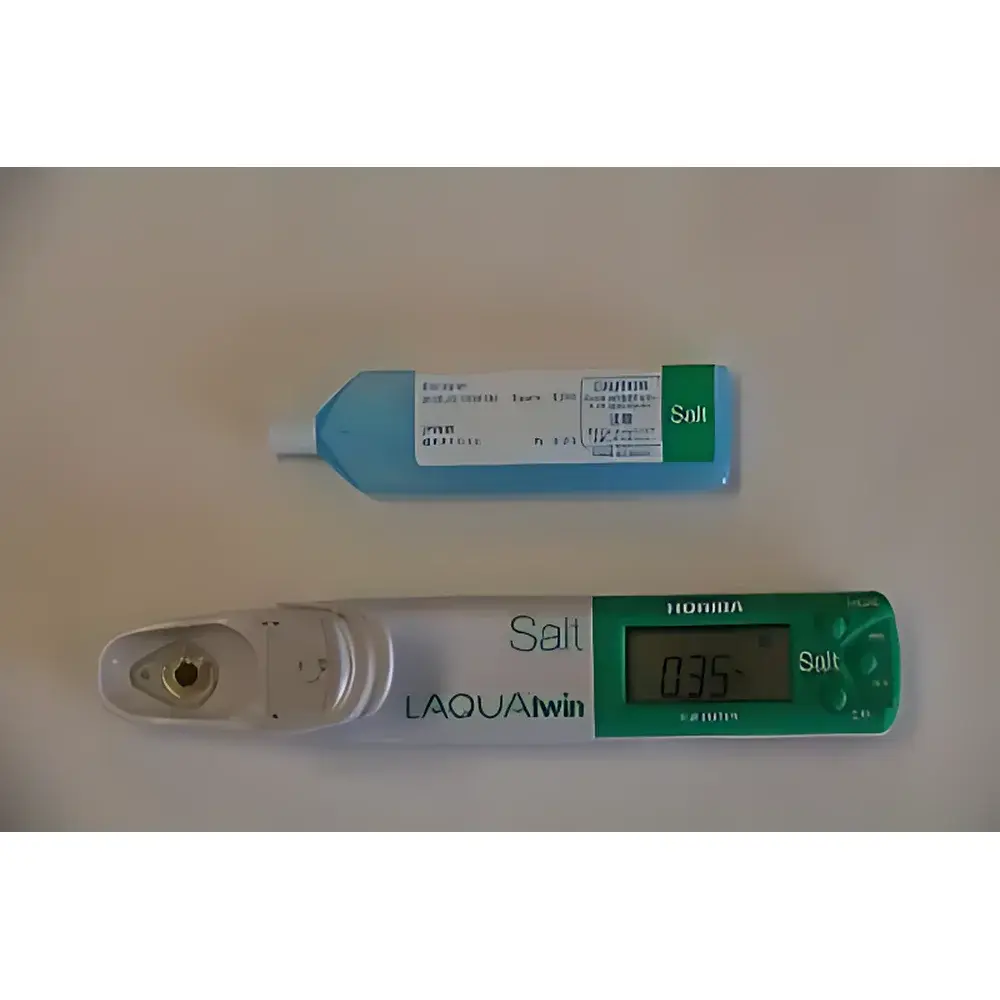
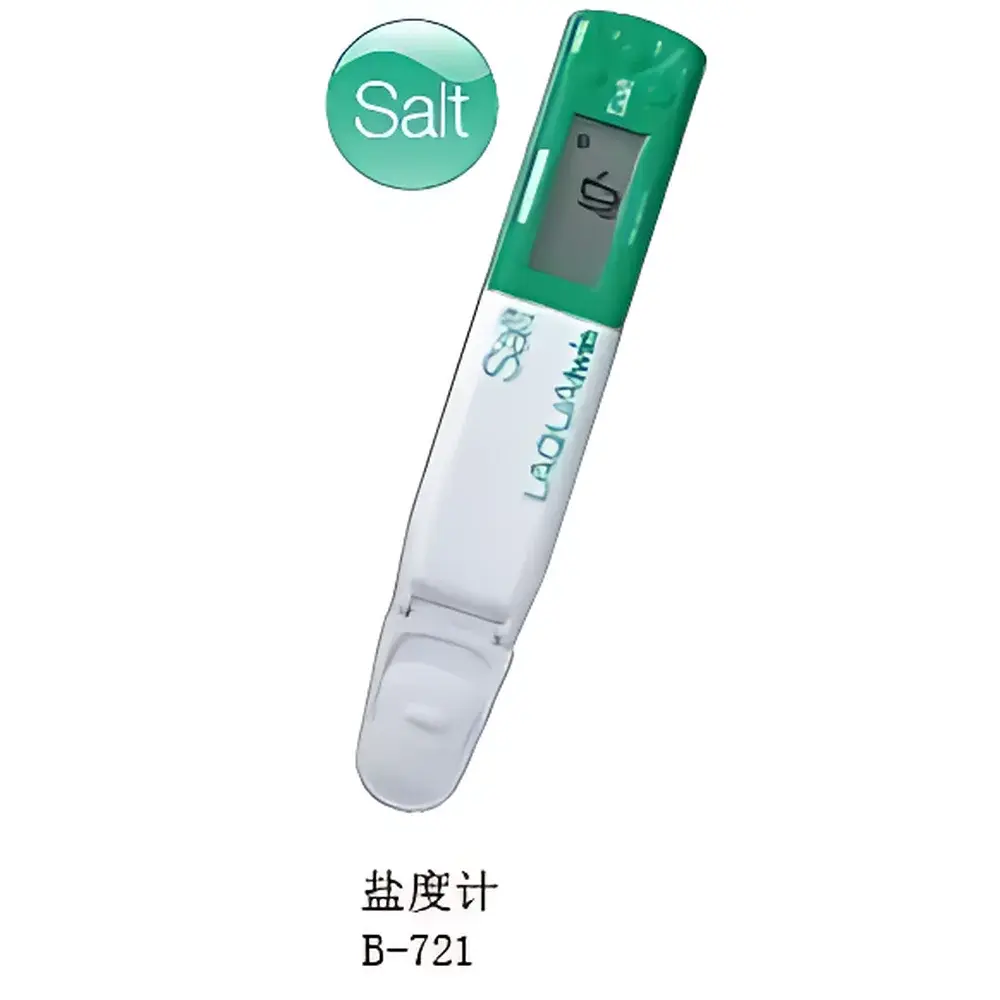
HORIBA B-721 Portable Salinity Meter
| Brand | HORIBA |
|---|---|
| Origin | Japan |
| Model | B-721 |
| Measurement Principle | Ion-selective Electrode Method |
| Salinity Range | 0.1–10% (NaCl, w/w) |
| Temperature Range | 5–40 °C |
| Accuracy | ±10% of reading |
| Resolution | 0.1% |
| Minimum Sample Volume | 0.05 mL × 2 or ≥0.3 mL |
| Temperature Compensation | Automatic (2%/°C fixed coefficient) |
| Auto-Hold Function | Yes |
| Ingress Protection | IP67 |
| Power Supply | Two CR2032 batteries |
| Dimensions | 164 × 29 × 20 mm (excl. probe protrusion) |
| Weight | ~50 g (instrument only, excl. batteries) |
Overview
The HORIBA B-721 Portable Salinity Meter is a compact, handheld electrochemical analyzer engineered for rapid, field-deployable quantification of sodium chloride concentration in aqueous solutions. It operates on the ion-selective electrode (ISE) principle—specifically utilizing a chloride-selective membrane electrode coupled with a built-in reference system—to generate a stable potentiometric response proportional to the activity of Cl⁻ ions in solution. This measurement is mathematically converted to % NaCl (w/w) using a pre-calibrated algorithm that incorporates density-based correction across the 0.1–10% range. Designed for simplicity and robustness, the B-721 eliminates the need for complex calibration routines or external data loggers, making it suitable for routine checks in aquaculture, food processing, desalination pre-screening, and environmental water monitoring where immediate, on-site salinity assessment is required.
Key Features
- True portable form factor: Pen-style design (164 × 29 × 20 mm, ~50 g) optimized for one-handed operation and pocket storage.
- IP67-rated enclosure ensures full protection against dust ingress and immersion in water up to 1 m for 30 minutes—validated for use in humid, outdoor, or splash-prone environments.
- Ion-selective electrode architecture delivers direct, interference-minimized response to chloride activity, minimizing cross-sensitivity from common cations (e.g., K⁺, Ca²⁺, Na⁺) under typical sample matrices.
- Automatic temperature compensation (ATC) applies a fixed 2%/°C correction coefficient, referenced to 25 °C, ensuring consistent output across the operational range (5–40 °C).
- Auto-hold function freezes the stabilized reading upon signal convergence, reducing operator-induced variability during manual sampling.
- Low sample volume requirement: Validated performance with as little as 0.05 mL × 2 replicate aliquots or ≥0.3 mL single-volume measurement—ideal for limited or precious samples.
- Two-CR2032 battery power provides >1,000 hours of standby life and supports continuous operation for >500 measurements per set under standard conditions.
Sample Compatibility & Compliance
The B-721 is validated for use with freshwater, brackish water, seawater dilutions, food brines, and industrial process rinses exhibiting conductivity < 20 mS/cm and total dissolved solids (TDS) < 10,000 ppm. It is not intended for highly viscous, suspended-solid-laden, or strongly oxidizing/reducing media without prior filtration or dilution. While not certified to ISO/IEC 17025 or ASTM D1125 (Standard Test Methods for Electrical Conductivity and Resistivity of Water), its measurement methodology aligns with the foundational principles outlined in ISO 7888 (Water quality — Determination of electrical conductivity) and supports GLP-aligned documentation when paired with traceable calibration standards. The device complies with IEC 60529 (IP67) and RoHS Directive 2011/65/EU for hazardous substance restrictions.
Software & Data Management
The B-721 operates as a standalone instrument with no embedded memory, Bluetooth, or USB interface. All measurement data must be manually recorded. This design prioritizes mechanical reliability, electromagnetic immunity, and extended service life over digital connectivity—making it suitable for regulated environments where uncontrolled data transmission or firmware updates are restricted (e.g., USDA-inspected facilities or ISO 9001-certified production lines). Calibration verification records (using certified 1.0% and 5.0% NaCl standards) should be maintained per internal QA protocols; no audit trail or electronic signature functionality is provided, consistent with its classification as a Class II general-purpose field meter under FDA 21 CFR Part 11 interpretation.
Applications
- Aquaculture: Real-time salinity verification in hatchery tanks, larval rearing units, and recirculating aquaculture systems (RAS) to maintain osmoregulatory stability.
- Food & Beverage: Spot-checking brine concentrations for vegetable fermentation, meat curing, and dairy whey processing.
- Environmental Monitoring: Rapid screening of estuarine mixing zones, coastal runoff, and groundwater intrusion indicators.
- Education & Training: Undergraduate laboratory instruction in electroanalytical chemistry, sensor fundamentals, and water quality parameter interrelationships.
- Maintenance & Field Service: Pre-commissioning verification of reverse osmosis (RO) reject streams and cooling tower blowdown consistency.
FAQ
What calibration standards are recommended for the B-721?
Use traceable NaCl solutions at 1.0% and 5.0% (w/w) for two-point calibration. HORIBA recommends NIST-traceable standards with uncertainty ≤ ±0.05%.
Can the B-721 measure seawater directly?
Yes, but only within its specified 0.1–10% range; undiluted natural seawater (~3.5%) falls well within this span. For hypersaline samples (>10%), dilute with deionized water and apply appropriate correction factors.
Is electrode replacement possible?
The sensor module is integrated and non-user-replaceable; HORIBA offers factory refurbishment or exchange under warranty or extended service agreement.
Does the device comply with FDA 21 CFR Part 11?
No—it lacks electronic record generation, audit trail, or user authentication capabilities. It is intended for non-GxP-critical applications or as a secondary verification tool.
How often should calibration be performed?
Before each daily use sequence, after exposure to extreme temperatures or contaminants, and following any physical impact to the probe tip—per standard operating procedure (SOP) requirements.
Related Products





