
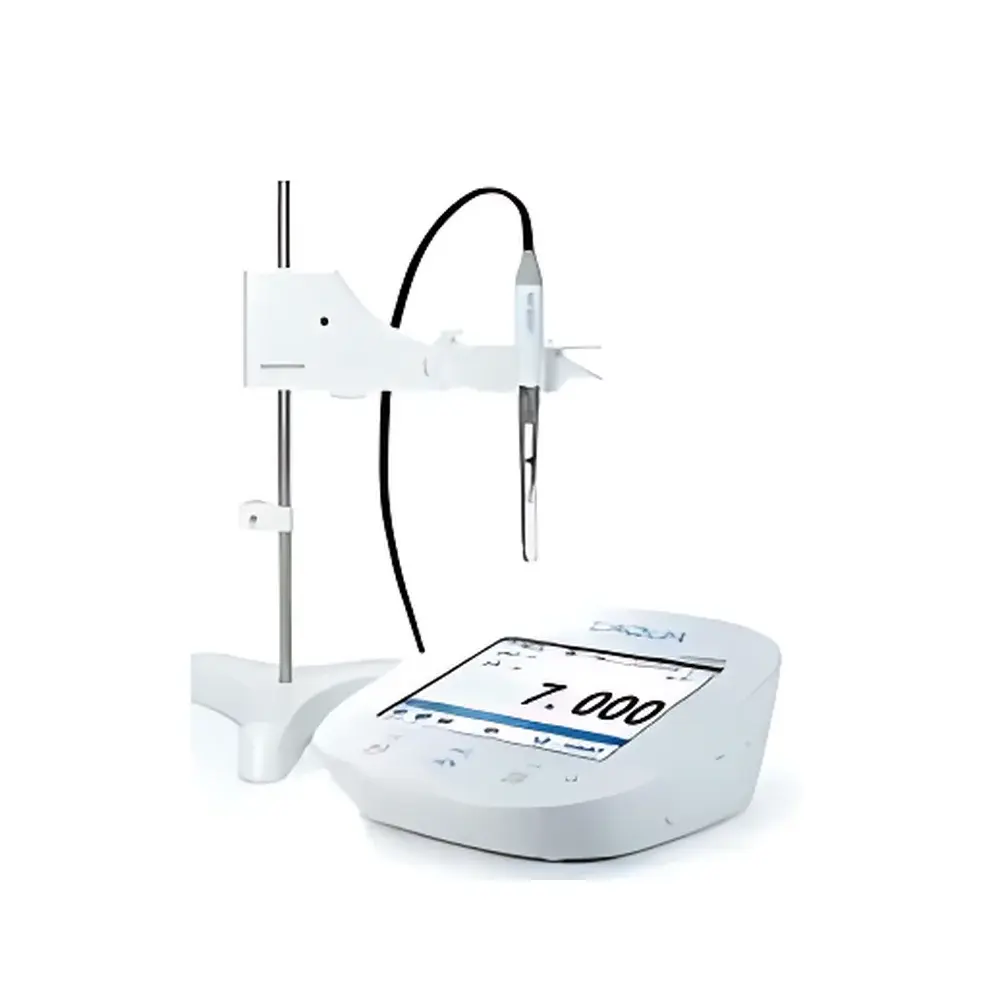
HORIBA F-73 Benchtop Multi-Parameter Water Quality Analyzer
| Brand | HORIBA |
|---|---|
| Origin | Japan |
| Model | F-73 Benchtop |
| Measurement Range | pH 0.000–14.000 |
| Accuracy | ±0.001 pH |
| Repeatability | ±0.001 pH ±1 digit |
| Resolution | 0.001 pH |
| ORP Range | ±1999.9 mV |
| ORP Resolution | 0.1 mV |
| ORP Repeatability | ±0.1 mV ±1 digit |
| Ion Concentration Range | 0.00 µg/L–999 g/L (mol/L) |
| Ion Repeatability | ±0.5% F.S. ±1 digit |
| Temperature Range | −30.0–130.0 °C |
| Temp Resolution | 0.1 °C |
| Temp Repeatability | ±0.1 °C ±1 digit |
| Data Storage Capacity | 2000 measurements |
| Compliance | JIS, USP <645>, EP 2.2.38, JP XVI, ChP |
| Power Supply | AC adapter 100–240 V, 50/60 Hz |
| Power Consumption | ~9.8 VA |
| Weight | 700 g |
Overview
The HORIBA F-73 Benchtop Multi-Parameter Water Quality Analyzer is a precision-engineered laboratory instrument designed for high-accuracy, traceable measurement of pH, oxidation-reduction potential (ORP), ion concentration, and temperature in aqueous samples. Built upon HORIBA’s legacy of electrochemical sensor design and Japanese manufacturing rigor, the F-73 implements standardized potentiometric principles: pH and ORP are measured via glass and noble-metal reference electrodes following Nernst equation-based calibration; ion concentration is determined using selective ion electrodes (e.g., fluoride, nitrate, ammonium) with slope-based quantification; and temperature is acquired via integrated Pt1000 or thermistor sensing with automatic temperature compensation (ATC). Its dual-channel architecture enables simultaneous display and independent configuration of two parameters—such as pH and ORP—without cross-interference. The instrument is explicitly engineered for compliance-driven environments, including pharmaceutical water systems (Purified Water, Water for Injection), environmental monitoring labs, and academic research facilities requiring audit-ready data integrity.
Key Features
- High-resolution 7-inch capacitive touchscreen interface with intuitive icon-driven navigation and real-time status feedback
- Dual-parameter concurrent measurement and display (e.g., pH + ORP, pH + temperature) with independent calibration and unit selection per channel
- Automated electrode diagnostics and guided calibration workflows compliant with JIS Z 8401, USP , and EP 2.2.3
- On-screen troubleshooting assistant providing context-sensitive resolution steps for common measurement anomalies (e.g., unstable reading, slope deviation, junction clogging)
- Removable, autoclavable glass pH electrode with easy-clean sleeve junction and quick-release bayonet mount
- GLP/GMP-ready operation: time-stamped measurements, user ID assignment, and password-protected method locking
- Integrated periodic verification mode supporting regulatory checklists per JIS T 0101 (medical devices), USP (water system qualification), and ISO/IEC 17025 internal audits
Sample Compatibility & Compliance
The F-73 accommodates standard 12-mm diameter pH and ion-selective electrodes, as well as ORP and temperature probes conforming to DIN 19263 and ASTM D1129. It supports aqueous matrices across conductivity ranges from deionized water (100 mS/cm), with automatic cell constant recognition for conductometric accessories (sold separately). Regulatory alignment includes full support for pharmacopeial water testing protocols: USP (electrical conductivity), EP 2.2.38 (conductivity and TOC correlation), JP XVI General Tests (pH and conductivity), and ChP General Chapter 0681. All calibration and measurement records comply with ALCOA+ principles—attributable, legible, contemporaneous, original, accurate—and are exportable in CSV or PDF format with embedded metadata (operator, timestamp, electrode ID, calibration history).
Software & Data Management
Data acquisition and reporting are managed through HORIBA’s proprietary PC software (compatible with Windows 10/11), enabling bidirectional USB communication, real-time graphing, and batch export. The instrument stores up to 2000 measurement records locally—including raw sensor output, calculated values, calibration coefficients, and operator annotations—with automatic overwrite protection for flagged entries. Audit trail functionality logs all critical events: parameter changes, calibration executions, user logins/logouts, and firmware updates—fully compliant with FDA 21 CFR Part 11 requirements when paired with validated software and access controls. USB mass storage mode allows direct transfer of datasets to external drives without host PC dependency. Language localization supports English, Japanese, Korean, and Simplified Chinese UI rendering, with all translations reviewed by native-speaking technical writers for terminological consistency.
Applications
- Pharmaceutical water system validation and routine monitoring (PW, WFI, SWFI) per USP/EP/JP requirements
- Environmental water analysis for regulatory reporting (EPA Method 150.1, ISO 10523, ISO 5667-3)
- Academic and industrial R&D involving buffer characterization, titration endpoint detection, and ion activity studies
- Quality control of cleaning agents, disinfectants, and process rinse waters in semiconductor and biotech manufacturing
- Calibration laboratory traceability support, serving as a primary reference for field meters and portable analyzers
FAQ
Does the F-73 meet FDA 21 CFR Part 11 requirements for electronic records?
Yes—when operated with validated HORIBA PC software, configured user roles, digital signatures, and enabled audit trail logging, the system satisfies Part 11 criteria for record retention, authenticity, and integrity.
Can the F-73 perform conductivity measurements?
No—the F-73 model is dedicated to pH, ORP, ion concentration, and temperature. Conductivity, resistivity, salinity, and TDS are supported on the F-74 and F-74BW models.
What electrode types are compatible with the F-73?
Standard BNC-input glass combination pH electrodes, ORP electrodes with Ag/AgCl or Pt tips, and solid-state or liquid-filled ion-selective electrodes meeting ISE output specifications (−1999.9 to +1999.9 mV, 0–100 °C operating range).
Is temperature compensation automatic during pH and ion measurements?
Yes—ATC is applied in real time using the built-in temperature sensor or an optional external probe; compensation algorithms follow NIST SRM-based polynomial coefficients.
How is calibration verification performed between scheduled intervals?
The built-in “Check Navigation” function executes rapid electrode response tests (e.g., slope, zero potential, response time) against stored baseline profiles and issues pass/fail flags aligned with USP acceptance criteria.
Related Products







