
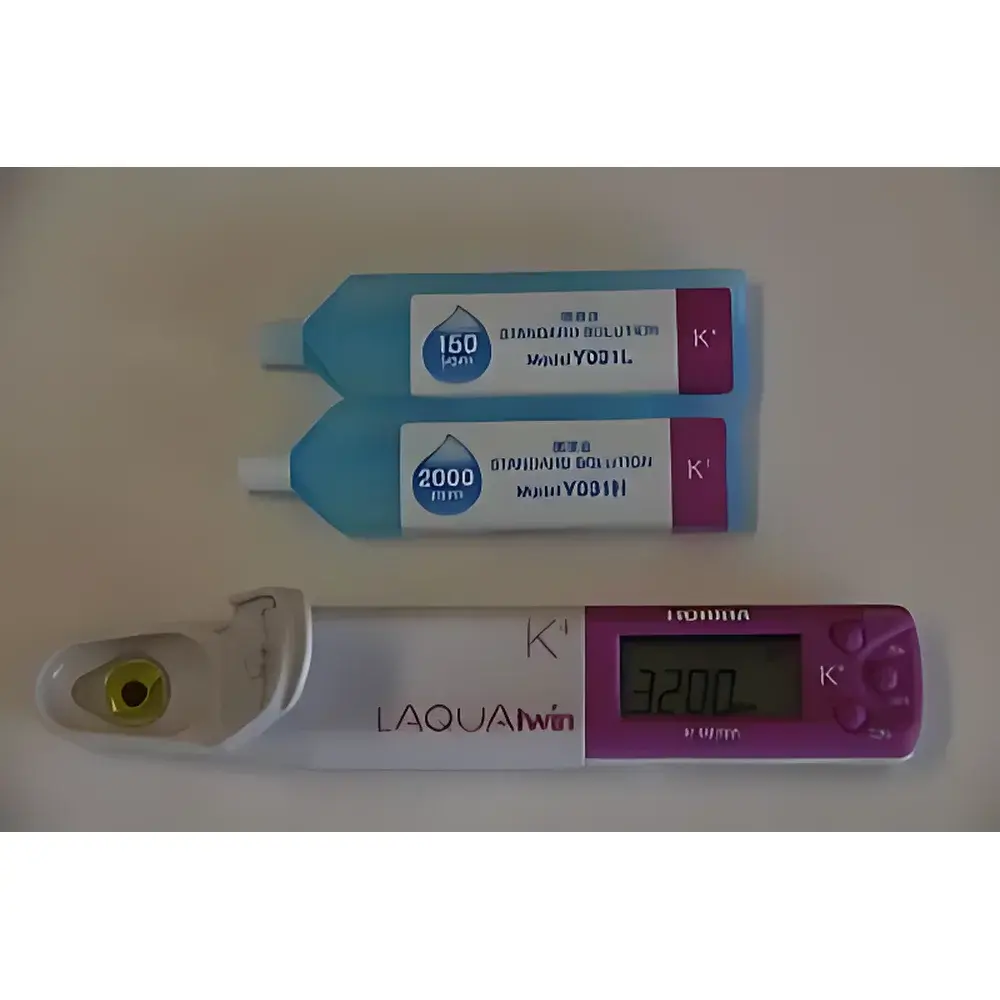
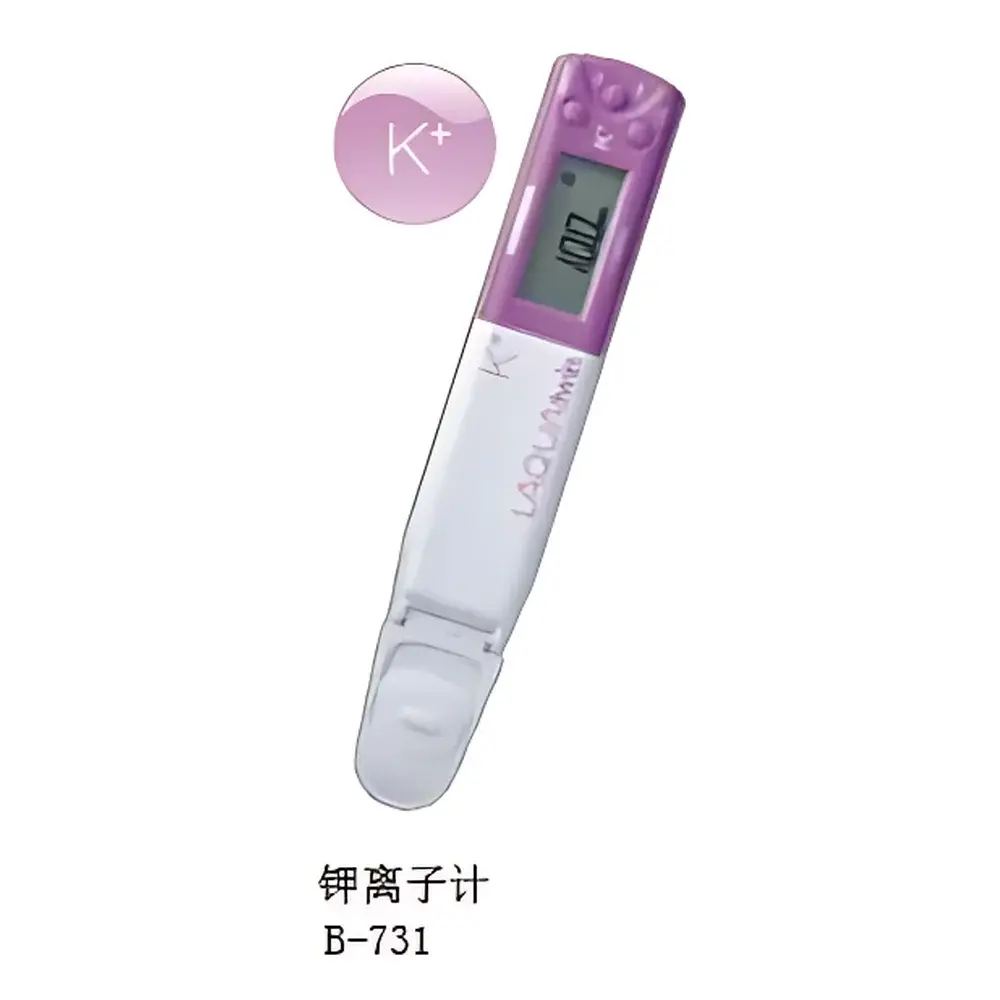
HORIBA B-731 Portable Potassium Ion Meter
| Brand | HORIBA |
|---|---|
| Origin | Japan |
| Model | B-731 |
| Type | Pen-style portable ion meter |
| Measurement Principle | Solid-state ion-selective electrode (ISE) method |
| Measuring Range | 39–3900 ppm (mg/L) or 10⁻³–10⁻¹ mol/L K⁺ |
| Temperature Range | 5–40 °C |
| Accuracy | ±10% of reading |
| Resolution | 0.1 ppm (mg/L) |
| Calibration | Two-point calibration |
| Temperature Compensation | Automatic (2%/°C fixed coefficient) |
| IP Rating | IP67 |
| Power Supply | Two CR2032 batteries |
| Dimensions | 164 × 29 × 20 mm (excl. probe protrusion) |
| Weight | Approx. 50 g (instrument only) |
Overview
The HORIBA B-731 is a compact, pen-style portable potassium ion meter engineered for rapid, field-deployable quantification of potassium (K⁺) concentration in aqueous samples using solid-state ion-selective electrode (ISE) technology. Unlike conventional laboratory-grade potentiometric analyzers requiring bulky reference electrodes and complex calibration protocols, the B-731 integrates a miniaturized, membrane-based K⁺-selective sensor with built-in temperature compensation and auto-hold functionality—enabling direct, single-parameter measurement without external modules or PC connectivity. Its operational principle relies on the Nernstian response of the ion-selective membrane to K⁺ activity, generating a millivolt potential proportional to log[K⁺], which is linearly converted and displayed as concentration (ppm or mol/L) after two-point calibration. Designed specifically for routine water quality assessment, hydroponic nutrient monitoring, soil extract analysis, and agricultural runoff screening, the B-731 delivers field-ready reliability while maintaining traceability to standard reference solutions (e.g., KCl standards per ISO 10523 and ASTM D1293).
Key Features
- Pen-form factor with ergonomic grip and one-handed operation—optimized for use in greenhouses, irrigation channels, wastewater sampling points, and teaching laboratories.
- IP67-rated enclosure ensures full protection against dust ingress and immersion in water up to 1 m for 30 minutes—validated per IEC 60529—making it suitable for outdoor and humid environments.
- Integrated temperature sensor enables automatic temperature compensation based on a fixed 2%/°C coefficient, minimizing drift across the 5–40 °C operating range.
- Auto-hold function freezes the stabilized reading upon signal convergence, eliminating manual timing errors during batch measurements.
- Low sample volume requirement (as little as 0.05 mL per measurement, with optional 0.3 mL mode for turbid or particulate-laden samples) reduces reagent consumption and waste generation.
- Two-point calibration protocol supports user-defined standard concentrations (e.g., 100 ppm and 1000 ppm K⁺), ensuring accuracy across the full 39–3900 ppm dynamic range.
- CR2032 battery power (2 × 3 V) provides >1000 hours of standby life and >200 hours of continuous operation—no charging circuitry required, simplifying logistics in remote deployments.
Sample Compatibility & Compliance
The B-731 is validated for use with clear to moderately turbid aqueous matrices including drinking water, surface water, nutrient solutions, leachates, and diluted soil extracts. It is not recommended for highly viscous, organic solvent-containing, or strongly oxidizing samples (e.g., >1% H₂O₂ or >0.1 M HNO₃), which may degrade the ion-selective membrane. While not certified for regulated compliance testing under GLP or GMP frameworks, its calibration traceability aligns with general laboratory practice guidelines outlined in ISO/IEC 17025:2017 (Clause 7.7) for non-accredited field instruments. The ±10% of reading accuracy meets typical requirements for process control and environmental screening per EPA Method 9055B (ion-selective electrode procedures for K⁺ in water).
Software & Data Management
The B-731 operates as a standalone instrument with no embedded data logging, Bluetooth, or USB interface. All measurements are displayed in real time on a high-contrast LCD screen with dual-unit capability (ppm and mol/L). For documentation purposes, users are expected to manually record results in lab notebooks or integrate readings into LIMS via transcription. Though lacking FDA 21 CFR Part 11-compliant audit trails, its calibration history—including date, standard values, and slope verification—can be maintained externally to support internal QA/QC workflows.
Applications
- Real-time monitoring of potassium levels in hydroponic reservoirs to prevent deficiency or toxicity in leafy greens and fruiting crops.
- Rapid assessment of fertilizer leaching in agricultural soils using 1:5 soil-water extracts.
- Field validation of potable water treatment efficacy where K⁺ serves as an indirect indicator of cation exchange resin saturation.
- Educational demonstrations of ion-selective electrode theory and Nernst equation applications in undergraduate analytical chemistry labs.
- Pre-screening of industrial effluents prior to submission for certified laboratory analysis (e.g., ISO 11885 or APHA 3111D).
FAQ
What is the minimum detectable potassium concentration?
The lower limit of quantification is 39 ppm (mg/L), corresponding to 10⁻³ mol/L—consistent with the Nernstian detection threshold of the integrated solid-state K⁺-selective membrane.
Can the B-731 measure potassium in seawater or brine?
No. High ionic strength (>10,000 µS/cm conductivity) and competing ions (e.g., Na⁺, Ca²⁺, Mg²⁺) cause significant activity coefficient deviation and membrane interference; use is restricted to freshwater and low-salinity matrices (<1000 ppm TDS).
How often should calibration be performed?
Calibrate before each measurement session and recheck mid-session when analyzing >10 samples or when ambient temperature shifts by >5 °C.
Is the electrode replaceable?
The sensor is integrated and non-user-replaceable; the entire unit is serviced or replaced by HORIBA-authorized distributors upon end-of-life or performance degradation.
Does the B-731 comply with ISO or ASTM standards?
It adheres to the operational principles defined in ISO 10523 (pH and ion measurement in water) and ASTM D1293 (electrochemical methods for ions), though it is not formally certified to these standards as a Class A reference instrument.
Related Products






