
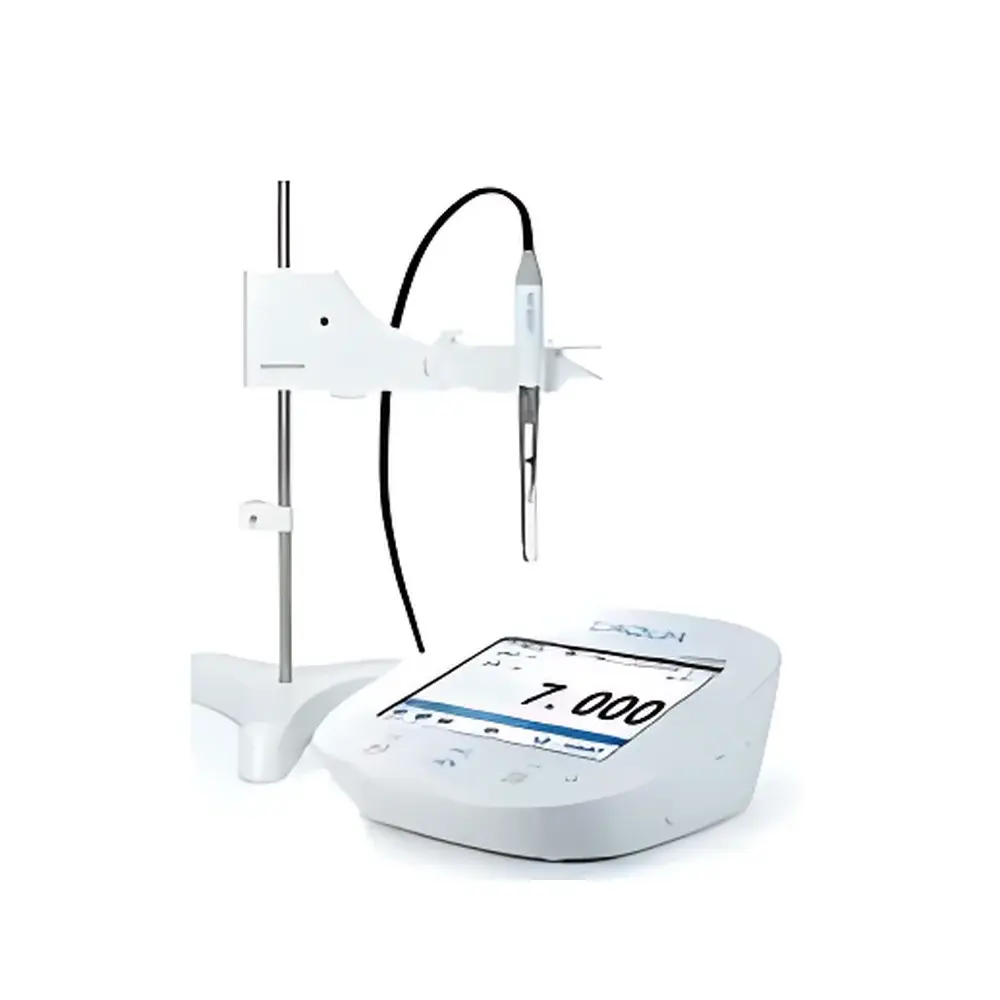
HORIBA F-74 Benchtop Multi-Parameter Water Quality Analyzer
| Brand | HORIBA |
|---|---|
| Origin | Japan |
| Model | F-74 Benchtop |
| Measurement Parameters | pH, ORP, Ion Concentration, Conductivity, Resistivity, Salinity, TDS, Temperature |
| Display | Dual-channel capacitive touchscreen |
| Data Storage | 2000 measurements |
| Compliance | JIS, USP <645>, EP 2.2.38, JP/CP Pharmacopoeial water standards |
| Language Support | English, Japanese, Korean, Chinese |
| Power Supply | AC adapter 100–240 V, 50/60 Hz |
| Weight | 700 g |
Overview
The HORIBA F-74 is a high-precision, dual-channel benchtop multi-parameter water quality analyzer engineered for rigorous laboratory applications in environmental monitoring, pharmaceutical manufacturing, academic research, and industrial process control. It employs standardized electrochemical measurement principles—including glass electrode potentiometry for pH and ORP, ion-selective electrode (ISE) methodology for quantitative ion analysis, and two-electrode AC conductivity measurement with automatic cell constant compensation—to deliver traceable, reproducible results across diverse aqueous matrices. Designed to meet the stringent metrological requirements of regulated environments, the F-74 supports full compliance with pharmacopoeial specifications for purified water and water for injection (WFI), including USP , European Pharmacopoeia 2.2.38, Japanese Pharmacopoeia (JP), and Chinese Pharmacopoeia (CP). Its architecture integrates hardware-level stability with software-driven validation workflows, enabling users to perform routine calibration verification, system suitability testing, and audit-ready data capture without external instrumentation.
Key Features
- Dual-channel real-time display supporting simultaneous measurement and comparison of two independent parameters (e.g., pH + conductivity or ORP + ion concentration)
- Capacitive touchscreen interface with intuitive navigation, contextual help, and guided troubleshooting—designed for rapid operator onboarding and minimal training overhead
- Automated calibration verification and electrode health diagnostics aligned with JIS Z 8401 and ISO/IEC 17025 documentation practices
- Modular electrode compatibility: supports interchangeable pH, ORP, ISE, and conductivity sensors with auto-recognition and stored calibration history per probe
- GLP/GMP-ready functionality including user-accessible audit trails, electronic signatures (via optional PC software), and time-stamped measurement logs with operator ID tagging
- Onboard periodic inspection mode configured for JIS-compliant performance checks and pharmacopoeial water system validation protocols
Sample Compatibility & Compliance
The F-74 accommodates a broad range of aqueous samples—from ultrapure water (resistivity up to 18.2 MΩ·cm) to high-salinity brines and aggressive industrial effluents—without requiring manual range switching. Its conductivity module dynamically selects optimal cell constants (0.01, 0.1, or 1.0 cm⁻¹) based on measured conductance, ensuring accuracy across six decades (0.001 µS/m to 199.9 S/m). All derived parameters—including resistivity, salinity (0.00–80.00 ppt), and TDS (0.01 mg/L–1000 g/L)—are calculated using NIST-traceable algorithms compliant with ASTM D1125 and ISO 7888. The instrument satisfies FDA 21 CFR Part 11 requirements when used with HORIBA’s certified LabSolutions software, providing secure user authentication, immutable data archiving, and electronic record integrity.
Software & Data Management
Data acquisition, export, and reporting are managed via USB 2.0 interface compatible with Windows-based LabSolutions PC software. The F-74 stores up to 2000 measurement records locally, each containing parameter values, timestamps, electrode IDs, calibration status, ambient temperature, and operator metadata. Export formats include CSV and PDF reports with embedded calibration certificates. USB mass storage mode enables direct file transfer to external drives without host software. All firmware updates and language packs (English, Japanese, Korean, Chinese) are delivered through HORIBA’s secure customer portal, with version-controlled release notes and validation documentation available for regulatory submissions.
Applications
- Pharmaceutical water system qualification (PW, WFI, SW) per USP and Annex 1
- Environmental compliance testing for wastewater discharge permits (EPA Methods 120.1, 125.1)
- Academic and industrial research involving electrolyte behavior, corrosion studies, and membrane fouling analysis
- Calibration laboratory verification of reference standards and secondary standards
- Quality control of reagent-grade chemicals, buffers, and standard solutions
- Validation of cleaning-in-place (CIP) rinse endpoints in biopharmaceutical facilities
FAQ
Does the F-74 support automatic temperature compensation (ATC) for all measured parameters?
Yes—ATC is applied in real time to pH, ORP, conductivity, resistivity, salinity, and TDS calculations using integrated Pt1000 thermistor input with ±0.1 °C repeatability.
Can the F-74 be used for USP purified water testing without additional accessories?
Yes—the instrument’s conductivity module meets USP System Suitability Test (SST) requirements out-of-the-box when paired with a certified 0.01 cm⁻¹ cell and calibrated using NIST-traceable KCl standards.
Is audit trail functionality built into the device firmware?
No—audit trail generation requires connection to LabSolutions software, which logs all user actions (calibrations, measurements, configuration changes) with digital signatures and tamper-evident timestamps per 21 CFR Part 11.
What electrode types are validated for use with the F-74?
HORIBA-certified electrodes only: LAQUA twin pH/ORP combination electrodes (e.g., 9615S-10D), ion-selective electrodes (e.g., fluoride 9639S-10D), and conductivity cells (e.g., 3551-10D, 3552-10D, 3553-10D) with embedded memory chips.
How is measurement uncertainty estimated for conductivity readings?
Uncertainty is calculated per ISO/IEC Guide 98-3 (GUM) incorporating contributions from cell constant tolerance (±0.5%), temperature sensor drift (±0.1 °C), and signal-to-noise ratio at low conductance levels—reported in the calibration certificate generated by LabSolutions.







