
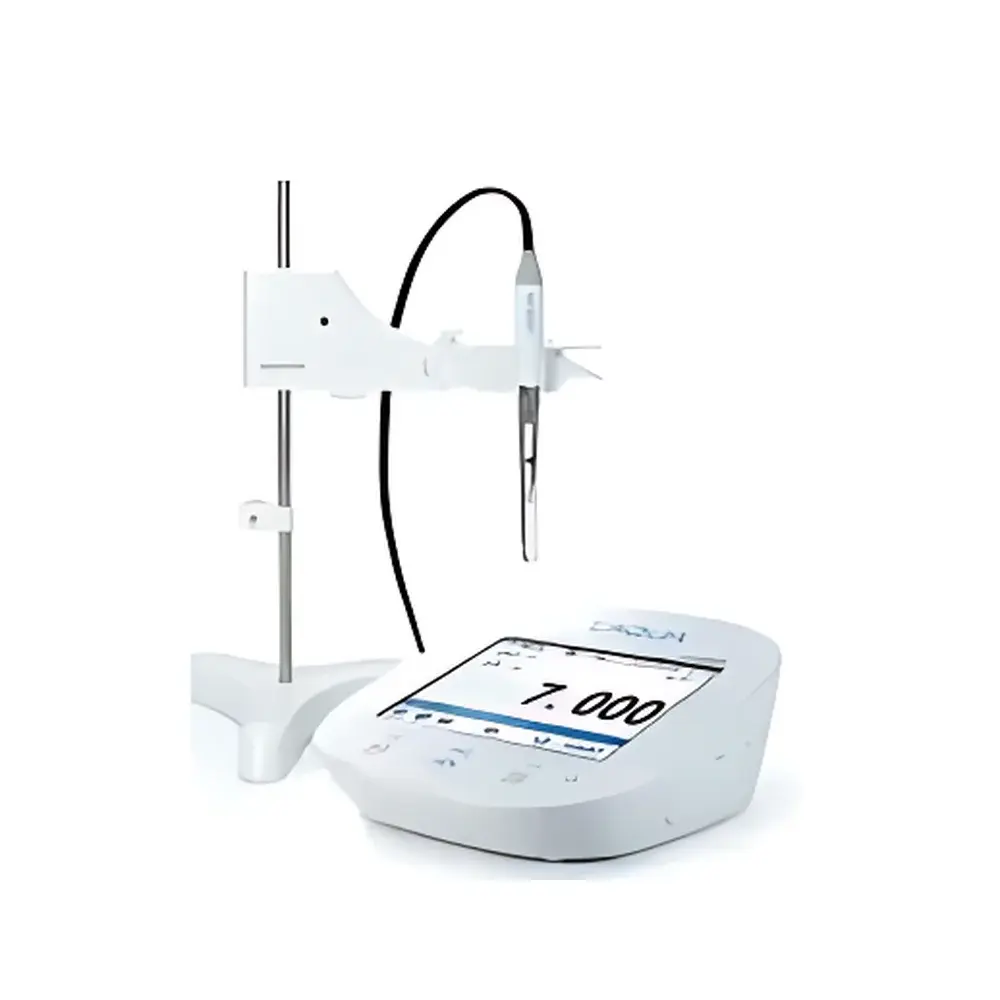
HORIBA F-74 Desktop Multi-Parameter Water Quality Analyzer
| Brand | HORIBA |
|---|---|
| Origin | Japan |
| Model | F-74 |
| Instrument Type | Laboratory Water Quality Analyzer |
| Measurable Parameters | pH, ORP, Ion Concentration, Conductivity, Resistivity, Salinity, TDS |
| Display | Dual-channel capacitive touchscreen |
| Data Storage | 2000 measurements |
| Compliance | JIS, USP <645>, EP 2.2.38, JP/CP Pharmacopoeial water standards |
| Language Support | English, Japanese, Korean, Chinese |
| Power Supply | AC 100–240 V, 50/60 Hz |
| Weight | 0.7 kg |
Overview
The HORIBA F-74 is a high-precision, dual-channel desktop multi-parameter water quality analyzer engineered for rigorous laboratory environments where regulatory compliance, measurement traceability, and operational efficiency are critical. It employs fundamental electrochemical and conductometric principles to deliver metrologically sound results across seven core parameters: pH (via glass electrode potentiometry), oxidation-reduction potential (ORP), ion concentration (using selective ion electrodes), conductivity (via two-electrode AC excitation), and derived values—resistivity, salinity, and total dissolved solids (TDS)—all calculated in real time from conductivity and temperature inputs. Designed specifically for pharmaceutical, environmental, and industrial QC/QA laboratories, the F-74 meets stringent requirements for purified water testing under USP , European Pharmacopoeia 2.2.38, Japanese Pharmacopoeia (JP), and Chinese Pharmacopoeia (CP), supporting full GLP/GMP-aligned workflows through audit-trail-capable data handling and standardized calibration verification.
Key Features
- Dual-channel capacitive touchscreen interface with intuitive, icon-driven navigation—enabling simultaneous display of primary and secondary parameters without menu cycling.
- Integrated calibration and diagnostic guidance: On-screen step-by-step prompts for electrode conditioning, multi-point pH/ORP calibration, conductivity cell constant verification, and troubleshooting of common measurement anomalies (e.g., unstable readings, out-of-range signals).
- Pharmaceutical-grade validation support: Preconfigured test modes for pharmacopoeial purified water assessments—including periodic system suitability checks per JIS Z 8401 and automated pass/fail evaluation against USP conductivity limits at specified temperatures.
- Modular electrode compatibility: Accepts standard BNC and DIN connectors for pH, ORP, ion-selective, and conductivity sensors; features quick-release glass electrode housing for simplified cleaning, storage, and replacement.
- Robust data integrity architecture: 2000-measurement internal memory with timestamp, operator ID (optional), parameter values, electrode IDs, and calibration history—all exportable via USB to CSV or proprietary .hda format.
- Regulatory-ready connectivity: Native USB interface supports direct connection to GLP-compliant printers (with configurable report templates) and PCs running HORIBA’s optional LabSolutions software for advanced trend analysis, electronic signature, and 21 CFR Part 11-compliant audit trails.
Sample Compatibility & Compliance
The F-74 is validated for aqueous samples ranging from ultrapure water (18.2 MΩ·cm resistivity) to high-conductivity industrial effluents (up to 199.9 S/m). Its conductivity measurement engine utilizes dual-frequency AC excitation to minimize polarization errors and enable stable readings across wide dynamic ranges—critical for monitoring WFI (Water for Injection), Purified Water, and process rinse solutions. The instrument conforms to ISO/IEC 17025 documentation practices and supports IQ/OQ documentation packages. All measurement algorithms adhere to IUPAC-recommended temperature compensation models (e.g., non-linear Nernstian correction for pH, linear/non-linear cell constant adjustment for conductivity), ensuring comparability across global laboratories. Built-in compliance checks automatically flag deviations from pharmacopoeial acceptance criteria during routine testing.
Software & Data Management
Data capture is fully traceable: each stored record includes measurement time, ambient temperature, electrode serial numbers, calibration dates, and user-defined sample IDs. USB mass storage mode allows direct transfer of datasets to external drives without proprietary drivers. When paired with HORIBA LabSolutions PC software (sold separately), users gain access to statistical process control (SPC) charts, customizable report generation (PDF/Excel), automated calibration certificate printing, and role-based access control. The software enforces ALCOA+ principles—ensuring data is Attributable, Legible, Contemporaneous, Original, Accurate, Complete, Consistent, Enduring, and Available—meeting FDA 21 CFR Part 11 and EU Annex 11 expectations for electronic records.
Applications
- Pharmaceutical manufacturing: Routine verification of Purified Water and WFI systems per USP , EP 2.2.38, and JP specifications.
- Environmental monitoring labs: Field-deployable benchtop verification of surface water, groundwater, and wastewater treatment effluents.
- Academic research: Teaching and method development in analytical chemistry, environmental science, and materials corrosion studies.
- Food & beverage QA: Monitoring rinse water conductivity, brine concentration, and pH stability in production lines.
- Power generation: Boiler feedwater and condensate purity assessment using high-resistivity measurement capability.
FAQ
Does the F-74 support 21 CFR Part 11 compliance?
Yes—when used with HORIBA LabSolutions software and configured with electronic signatures, audit trails, and role-based permissions, the system satisfies key elements of 21 CFR Part 11 for electronic records and signatures.
Can the F-74 measure low-conductivity ultrapure water accurately?
Yes—the instrument supports conductivity cells with constants down to 0.01 cm⁻¹ and applies automatic temperature compensation and cell constant verification routines essential for sub-1 µS/cm measurements.
Is calibration verification traceable to national standards?
All calibration buffers and conductivity standards used with the F-74 are NIST-traceable; the instrument logs calibration date, standard lot number, and deviation from certified values for full metrological traceability.
How does the F-74 handle temperature compensation for pH and conductivity?
It implements IUPAC-recommended nonlinear Nernst equation correction for pH and automatic linear/nonlinear compensation for conductivity based on selected cell constant and reference temperature (25°C default).
What electrode types are compatible with the F-74’s dual channels?
Channel 1 accepts standard pH, ORP, and ion-selective electrodes (BNC); Channel 2 supports 2- or 4-electrode conductivity cells (DIN or mini-DIN), including temperature-compensated probes with integrated Pt1000 RTDs.







