
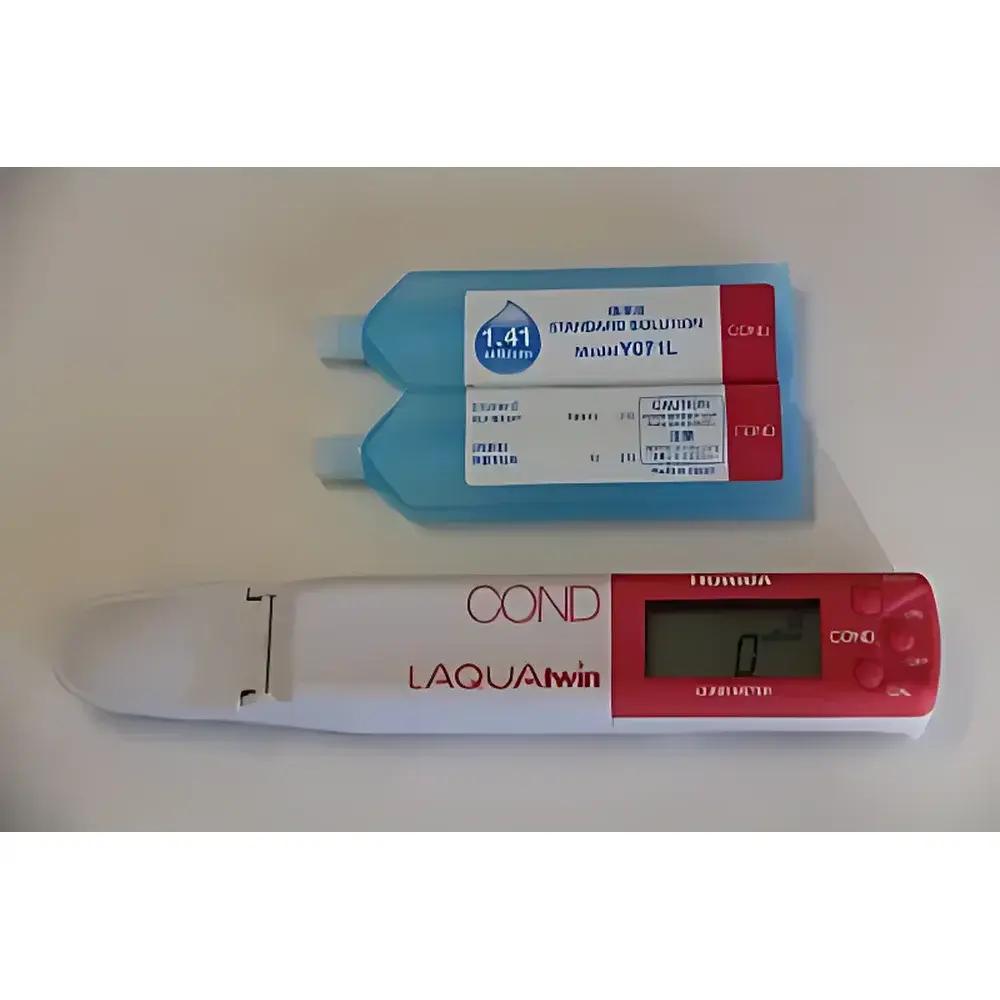
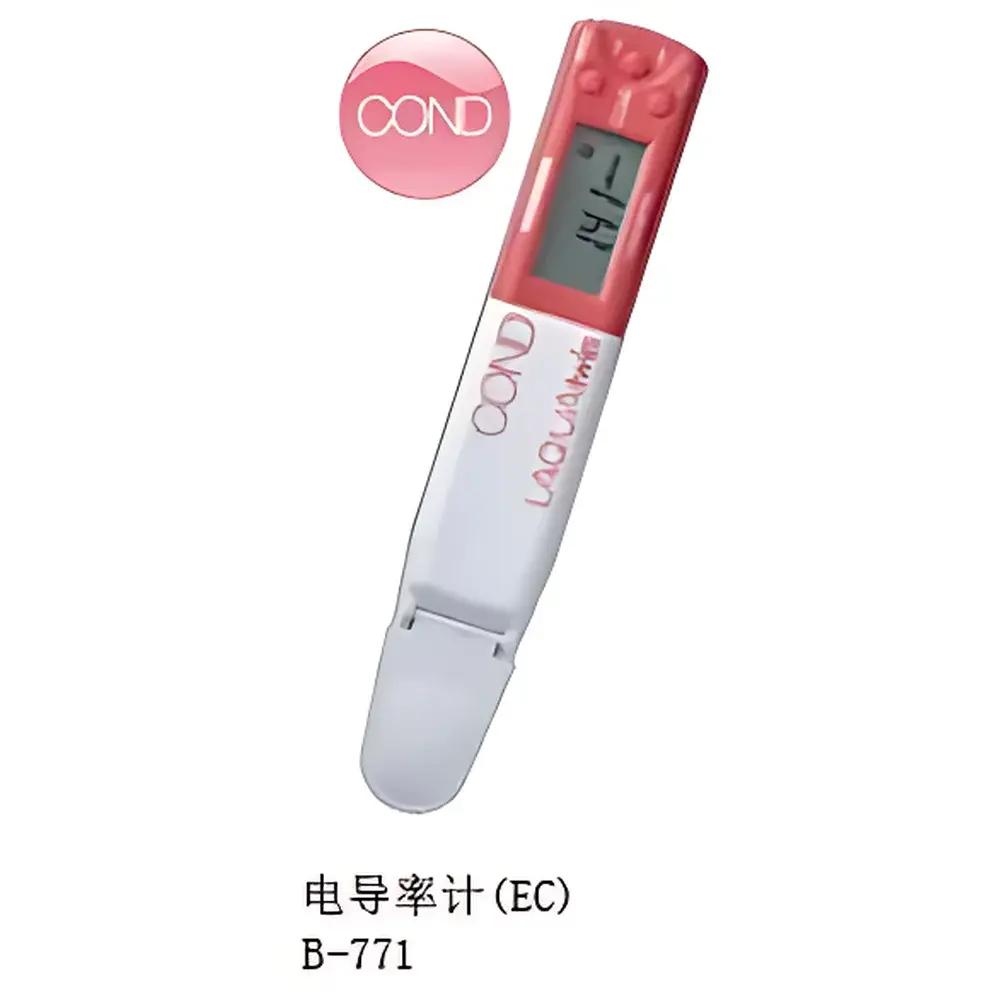
HORIBA B-771 Portable Conductivity Pen Meter
| Brand | HORIBA |
|---|---|
| Origin | Japan |
| Model | B-771 |
| Portability | Pen-type |
| Conductivity Range | 0–19.9 mS/cm |
| TDS Range | 0–9900 ppm |
| Salinity Range | 0–1.1% (NaCl) |
| Temperature Range | 5–40 °C |
| Accuracy | ±2% F.S. ±1 digit |
| Resolution | 0.1 (for conductivity, TDS, salinity, and temperature) |
| Measurement Principle | Two-electrode AC conductometric method |
| Sample Volume | ≥0.12 mL |
| Temperature Compensation | Fixed 2%/°C (linear, referenced to 25 °C) |
| Calibration | Two-point calibration (using standard KCl solutions) |
| Ingress Protection | IP67 |
| Power Supply | Two CR2032 batteries |
| Dimensions | 164 × 29 × 20 mm (L×W×H, excluding probe protrusion) |
| Weight | ~45 g (instrument only, batteries excluded) |
Overview
The HORIBA B-771 is a compact, field-deployable conductivity pen meter engineered for rapid, reliable measurement of electrical conductivity (EC), total dissolved solids (TDS), salinity (as NaCl), and temperature in aqueous samples. It employs a two-electrode AC conductometric measurement principle—eliminating polarization effects and ensuring stable readings across variable ionic strength conditions. Unlike DC-based systems, the AC excitation frequency minimizes electrode fouling and extends sensor longevity, particularly in turbid or organic-laden waters. Designed for routine quality control, environmental monitoring, hydroponics, aquarium management, and educational laboratories, the B-771 delivers traceable, reproducible results without requiring benchtop infrastructure. Its fixed 2%/°C linear temperature compensation algorithm conforms to industry-standard EC-to-25 °C normalization practices, enabling consistent inter-laboratory comparisons when ambient temperature deviates from reference conditions.
Key Features
- Pen-form factor with ergonomic grip and integrated electrode—enables one-handed operation and direct immersion into small-volume samples (≥0.12 mL)
- IP67-rated enclosure ensures full protection against dust ingress and temporary submersion (up to 1 m for 30 min), supporting use in humid, outdoor, or washdown environments
- Simultaneous real-time display of conductivity (mS/cm), TDS (ppm), salinity (% NaCl), and temperature (°C) on a high-contrast LCD screen
- Two-point calibration using certified KCl standards (e.g., 1413 µS/cm and 12.88 mS/cm) ensures traceable accuracy across the full 0–19.9 mS/cm range
- Auto-hold function freezes the stabilized reading upon signal convergence—critical for handheld measurements where motion-induced noise may affect stability
- Low-power design powered by two replaceable CR2032 coin cells, providing >10,000 measurement cycles per set under typical usage
- No software drivers or USB interfaces required—fully self-contained with zero configuration overhead
Sample Compatibility & Compliance
The B-771 is validated for use with freshwater, brackish water, nutrient solutions, wastewater effluents, and process rinse waters. It is not intended for highly viscous, non-aqueous, or strongly oxidizing media (e.g., concentrated bleach or HNO₃). Electrode geometry and cell constant (k = 1.0 cm⁻¹, factory-trimmed) are optimized for low-to-moderate conductivity matrices. While not certified to ISO/IEC 17025 or accredited for regulatory reporting, its performance aligns with ASTM D1125 (Standard Test Methods for Electrical Conductivity and Resistivity of Water) and supports GLP-aligned field data collection when used with documented calibration logs and environmental controls (5–40 °C, RH <85%, non-condensing). The instrument meets RoHS Directive 2011/65/EU and WEEE compliance requirements for electronic instrumentation.
Software & Data Management
The B-771 operates as a standalone, embedded measurement system with no onboard memory or digital connectivity. All data acquisition, processing, and display occur within the microcontroller unit; no external software, firmware updates, or cloud synchronization are supported. Users record readings manually or integrate the device into paper-based or LIMS-linked workflows via transcription. For audit readiness, laboratories should maintain a calibration log documenting date, standard values used, observed deviations, and operator identity—consistent with FDA 21 CFR Part 11 expectations for manual data entry systems. No electronic signature or audit trail functionality is implemented.
Applications
- Hydroponic and aquaponic nutrient solution monitoring—tracking EC drift to prevent osmotic stress in crops or aquatic species
- Environmental field surveys—screening surface water conductivity as an indicator of anthropogenic contamination or mineral leaching
- Drinking water quality verification at point-of-use—compliance checks against WHO guideline values (<2500 µS/cm)
- Educational demonstrations of ionic concentration relationships—correlating conductivity with known salt concentrations in controlled experiments
- Manufacturing process water checks—verifying rinse water purity prior to electroplating or semiconductor cleaning stages
- Aquarium and reef tank maintenance—ensuring stable salinity (0.3–0.5% for marine tanks) and detecting evaporation-induced concentration shifts
FAQ
What is the cell constant of the B-771 sensor?
The integrated electrode has a nominal cell constant of k = 1.0 cm⁻¹, factory-calibrated and non-adjustable.
Can the B-771 measure resistivity?
No—the instrument does not compute or display resistivity (Ω·cm); it reports conductivity only, with automatic TDS and salinity conversions applied internally.
Is temperature compensation adjustable?
No—compensation is fixed at 2%/°C (linear coefficient), per common industrial practice for general-purpose EC meters.
How often should calibration be performed?
Daily calibration is recommended for critical applications; otherwise, before each measurement session or after exposure to extreme temperatures or contaminants.
Does the B-771 comply with USP for purified water testing?
No—it lacks the specified accuracy (±0.1 µS/cm), temperature resolution (0.1 °C), and validation documentation required for pharmacopeial compliance.





