
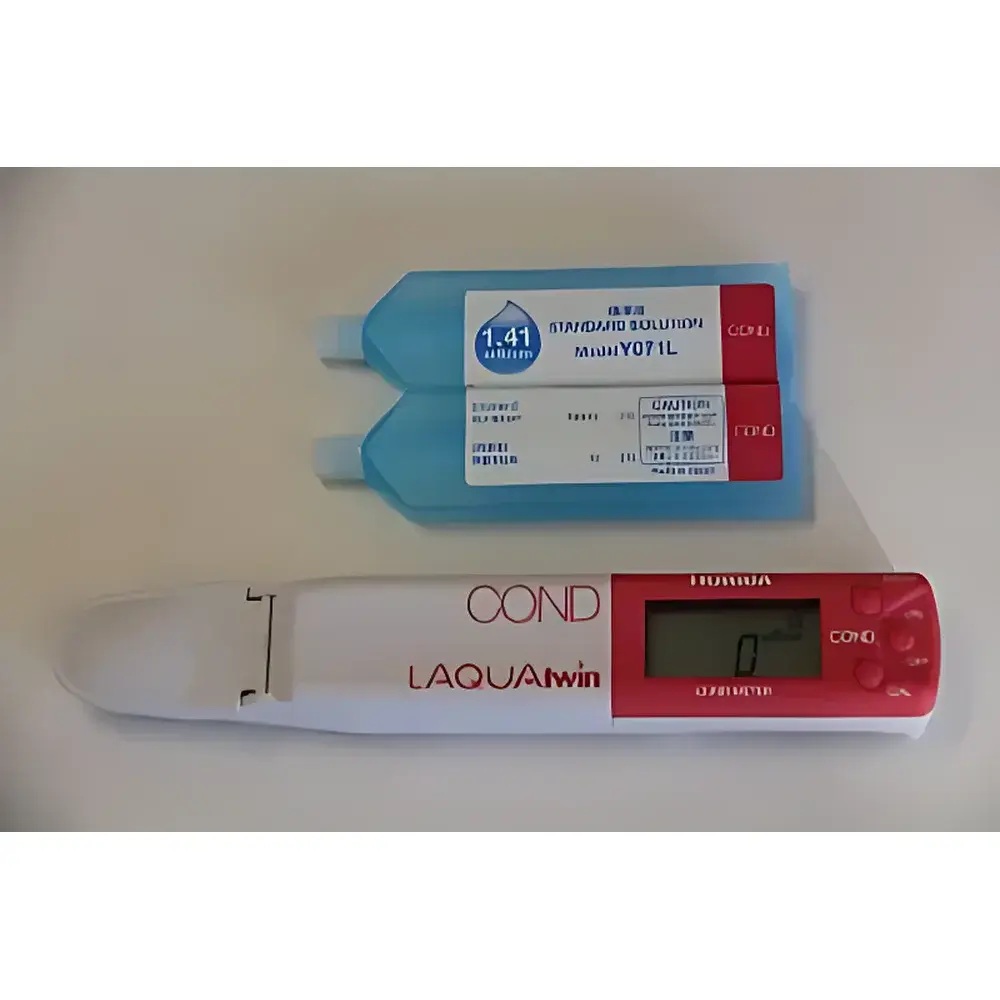
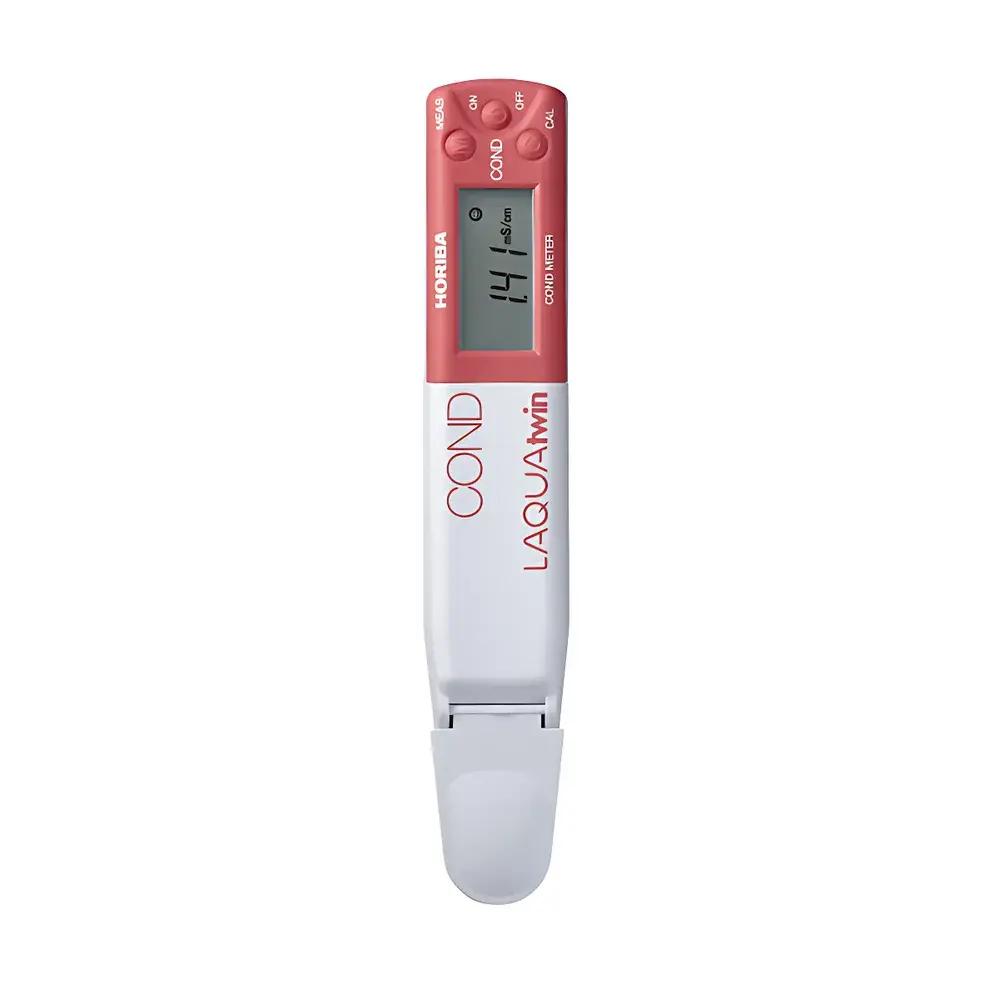
HORIBA B-771 Portable Pen-Type Conductivity Meter
| Brand | HORIBA |
|---|---|
| Origin | Japan |
| Model | B-771 |
| Detection Parameter | Single (Conductivity) |
| Portability | Pen-style |
| Conductivity Range | 0–19.9 mS/cm |
| TDS Range | 0–9900 ppm |
| Resistivity Range | Not applicable |
| Salinity Range | Not applicable |
| Temperature Range | 5–40 °C |
| Accuracy | ±2% F.S. ±1 digit |
| Minimum Resolution | 0.1 mS/cm |
| Measurement Principle | Two-electrode AC method |
| Sample Volume | ≥0.12 mL |
| Calibration | Two-point calibration |
| Temperature Compensation | Fixed 2%/°C coefficient |
| IP Rating | IP67 |
| Power Source | Two CR2032 batteries |
| Dimensions | 164 × 29 × 20 mm (excl. protrusions) |
| Weight | ~45 g (instrument only) |
Overview
The HORIBA B-771 is a compact, rugged pen-type conductivity meter engineered for rapid, reliable field and routine laboratory measurements of aqueous solution conductivity. It employs a two-electrode alternating current (AC) measurement principle to eliminate polarization effects and ensure stable readings across a broad range of ionic strengths — from low-conductivity deionized water rinses to moderately conductive process streams or environmental samples. Designed specifically for single-parameter conductivity analysis, the B-771 delivers traceable, repeatable results without requiring complex setup or maintenance. Its fixed temperature compensation factor of 2%/°C aligns with standard NaCl-based calibration conventions per ISO 7888 and ASTM D1125, enabling consistent inter-laboratory comparability in non-temperature-controlled environments. The instrument operates within a defined ambient range of 5–40 °C and ≤85% RH (non-condensing), making it suitable for use in quality control labs, aquaculture facilities, hydroponic operations, and municipal water monitoring stations where portability and robustness are essential.
Key Features
- Pen-style ergonomic design with IP67-rated housing — fully protected against dust ingress and immersion in water up to 1 m for 30 minutes.
- Two-electrode AC excitation circuitry minimizes electrode fouling and polarization drift during repeated measurements.
- Minimal sample requirement of just 0.12 mL — ideal for spot-checking small-volume containers, drip lines, or microcosm experiments.
- Integrated automatic hold function freezes the stabilized reading on-screen, eliminating manual timing errors during field deployment.
- Two-point calibration capability using standard KCl solutions (e.g., 1413 µS/cm and 12.88 mS/cm) ensures traceable accuracy across the full 0–19.9 mS/cm range.
- Low-power operation powered by two replaceable CR2032 coin cells, providing >1000 hours of typical usage life under intermittent operation.
- Compact footprint (164 × 29 × 20 mm) and lightweight construction (~45 g body-only) enable one-handed operation and convenient storage in lab coat pockets or field kits.
Sample Compatibility & Compliance
The B-771 is optimized for aqueous solutions with conductivity values between 0 and 19.9 mS/cm (equivalent to 0–1.99 S/m), covering applications such as drinking water verification (per WHO Guideline Limits), boiler feedwater screening, nutrient solution monitoring in controlled-environment agriculture, and effluent pre-treatment assessment. It does not support resistivity, salinity (as % NaCl), or ion-specific measurements — those functions are reserved for multi-parameter HORIBA models (e.g., B-711, B-722). The device complies with IEC 60529 for IP67 protection and meets electromagnetic compatibility requirements per IEC 61326-1 for industrial environments. While not certified for GLP/GMP-regulated workflows requiring audit trails or electronic records, its calibration protocol supports basic ISO/IEC 17025-compliant verification when documented manually.
Software & Data Management
The B-771 operates as a standalone, battery-powered instrument with no onboard data logging, Bluetooth, or USB connectivity. All measurements are displayed in real time on a high-contrast LCD screen with auto-ranging digits and unit indicators (mS/cm or ppm TDS). TDS conversion uses a fixed 0.5–0.7 factor (user-selectable via internal dip switch configuration per factory documentation), calibrated against NaCl standards. For regulatory environments requiring data integrity, users must manually record readings alongside calibration dates, reference standard lot numbers, and environmental conditions. No software drivers, firmware updates, or cloud synchronization capabilities are provided — consistent with its role as a dedicated, low-maintenance verification tool rather than a regulated analytical platform.
Applications
- Routine QC checks of purified water systems (e.g., Type II/III water per ASTM D1193).
- On-site validation of reverse osmosis (RO) and deionization (DI) system performance.
- Monitoring nutrient solution conductivity in greenhouse hydroponics and vertical farming installations.
- Field screening of surface water, groundwater, and wastewater influent/effluent prior to lab submission.
- Educational demonstrations of ionic strength principles in undergraduate chemistry and environmental science laboratories.
- Quick verification of cleaning solution concentration in pharmaceutical equipment rinse validation protocols.
FAQ
What calibration standards are recommended for the B-771?
Standard KCl solutions at 1413 µS/cm (0.01 M) and 12.88 mS/cm (0.1 M) are recommended for two-point calibration per ISO 7888. Avoid using non-KCl standards unless validated for your specific matrix.
Does the B-771 support automatic temperature compensation (ATC)?
Yes — it applies a fixed 2%/°C linear compensation coefficient based on the built-in thermistor, aligned with conventional NaCl-based conductivity references.
Can the B-771 measure resistivity or salinity directly?
No — it reports only conductivity (mS/cm) and derived TDS (ppm). Resistivity and % salinity require separate instrumentation or post-processing calculations.
Is the electrode replaceable or serviceable?
The sensor is integrated into the pen body and not user-replaceable; HORIBA recommends periodic verification against certified standards and replacement of the entire unit after 24 months of continuous use or if physical damage or drift exceeds ±5% F.S.
How often should calibration be performed?
Daily calibration is advised for critical applications; for general-purpose screening, calibration before each measurement session or at least once per shift is sufficient per ASTM D1125 guidance.
Related Products





