
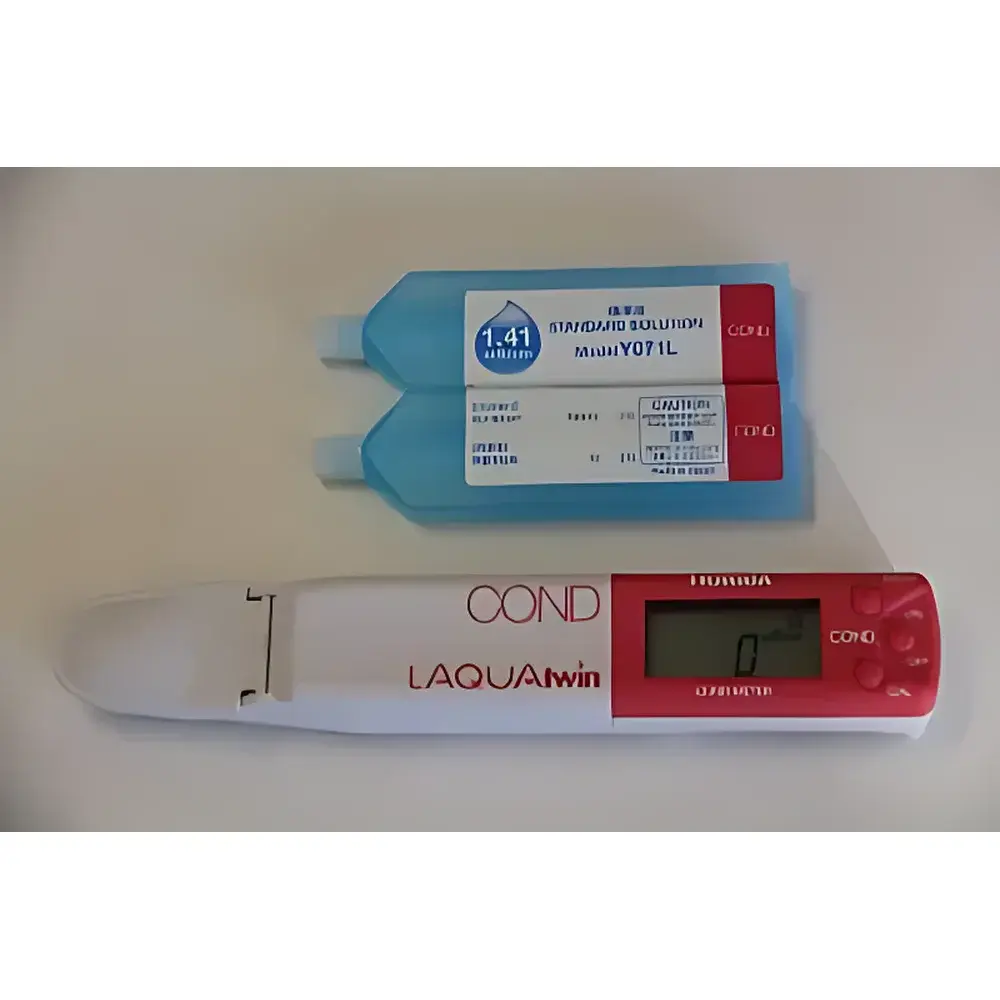
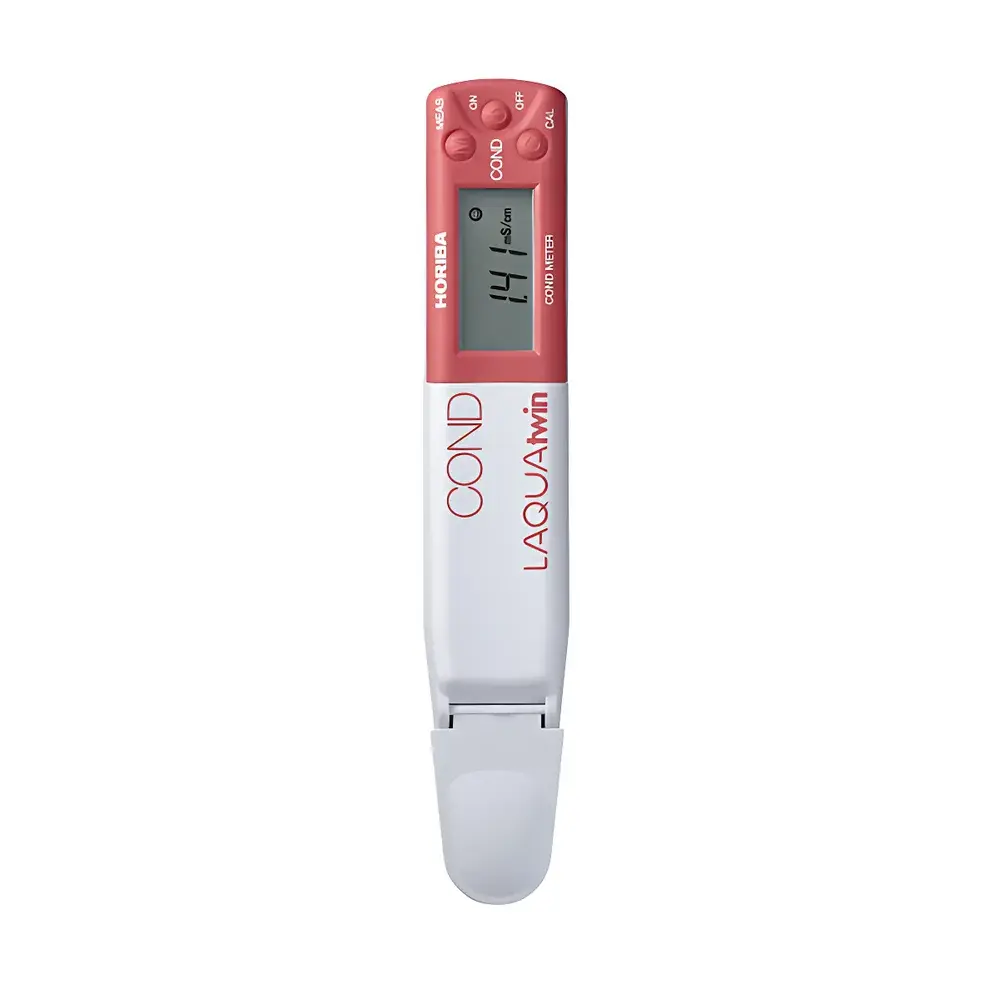
HORIBA B-771 Portable Pen-Type Conductivity Meter
| Brand | HORIBA |
|---|---|
| Origin | Japan |
| Model | B-771 |
| Portability | Pen-type |
| Conductivity Range | 0–19.9 mS/cm |
| TDS Range | 0–9900 ppm |
| Salinity Range | 0–1.1% |
| Temperature Range | 5–40 °C |
| Accuracy | ±2% F.S. ±1 digit |
| Resolution | 0.1 |
| Calibration | Two-point |
| IP Rating | IP67 |
| Power | Two CR2032 batteries |
| Dimensions | 164 × 29 × 20 mm (excl. protrusions) |
| Weight | ~45 g (instrument only) |
Overview
The HORIBA B-771 is a compact, field-deployable pen-type conductivity meter engineered for rapid, reliable measurement of electrical conductivity (EC), total dissolved solids (TDS), and salinity in aqueous samples. It employs a two-electrode AC excitation method—minimizing polarization effects and enabling stable readings in low-conductivity and variable-ionic-strength environments. Unlike DC-based sensors, this AC technique ensures high reproducibility across repeated measurements and eliminates electrode fouling-related drift during routine use. Designed for on-site water quality assessment—including freshwater monitoring, hydroponics, aquarium management, and educational laboratories—the B-771 delivers laboratory-grade functionality in a handheld form factor weighing only 45 g. Its fixed 2%/°C linear temperature compensation aligns with standard NaCl-based reference curves, ensuring consistent EC-to-TDS conversion without user-selectable compensation algorithms.
Key Features
- Pen-style ergonomic design with integrated sensor and display—optimized for single-hand operation and pocket portability.
- IP67-rated enclosure provides full protection against dust ingress and immersion in water up to 1 m for 30 minutes—suitable for outdoor, industrial, or humid lab environments.
- Two-point calibration using standard KCl solutions (e.g., 1413 µS/cm and 12.88 mS/cm) ensures traceable accuracy across the full measurement range.
- Automatic hold function freezes the stabilized reading on-screen, eliminating parallax error during data recording.
- Low-power architecture powered by two replaceable CR2032 coin-cell batteries, delivering >500 hours of continuous operation under typical usage conditions.
- Minimal sample requirement of just 0.12 mL enables testing in confined vessels, microcosms, or small-volume process streams without dilution or transfer loss.
Sample Compatibility & Compliance
The B-771 is validated for use with clean to moderately turbid aqueous solutions, including drinking water, surface water, nutrient solutions, brackish effluents, and saline calibration standards. It is not recommended for highly viscous, suspended-solid-laden, or strongly oxidizing media (e.g., undiluted bleach or concentrated acids), which may compromise electrode integrity or thermal response. While the instrument does not carry formal ISO/IEC 17025 accreditation, its two-point calibration protocol conforms to ASTM D1125–22 (Standard Test Methods for Electrical Conductivity and Resistivity of Water) and supports GLP-compliant documentation when paired with external logbooks or LIMS-integrated workflows. The fixed temperature coefficient (2%/°C) meets USP general requirements for conductivity verification in non-pharmaceutical water systems.
Software & Data Management
The B-771 operates as a standalone, battery-powered measurement tool with no embedded memory, Bluetooth, or USB interface. All data must be manually recorded at point-of-use. This architecture intentionally prioritizes robustness, regulatory simplicity, and long-term reliability over digital connectivity—making it suitable for environments where electromagnetic interference, cybersecurity constraints, or audit-trail minimization are operational priorities. For users requiring electronic data capture, third-party barcode-scanned logging or synchronized manual entry into validated spreadsheets remains compatible with 21 CFR Part 11 compliance when supported by procedural controls (e.g., defined review cycles, change logs, and electronic signature protocols).
Applications
- Field verification of reverse osmosis (RO) and deionized (DI) water purity in pharmaceutical manufacturing support utilities.
- Routine monitoring of hydroponic reservoirs and aquaculture tanks to maintain optimal ion balance and prevent osmotic stress.
- Educational demonstrations of ionic strength relationships, electrolyte behavior, and temperature-dependent conductivity trends.
- Pre-screening of environmental water samples prior to laboratory analysis per EPA Method 120.1 or ISO 7888.
- Quick-check validation of cleaning-in-place (CIP) rinse endpoints in food & beverage processing lines.
FAQ
What is the minimum sample volume required for an accurate reading?
A minimum of 0.12 mL is sufficient to fully immerse the dual-electrode tip and ensure stable signal acquisition.
Does the B-771 support automatic temperature compensation (ATC)?
Yes—it features built-in ATC with a fixed 2%/°C coefficient referenced to 25 °C, optimized for NaCl-based solutions.
Can the B-771 measure resistivity?
No—the instrument calculates and displays conductivity (mS/cm), TDS (ppm), and salinity (%), but does not compute or output resistivity values.
Is calibration traceable to national standards?
Calibration uses NIST-traceable KCl standards; however, the instrument itself does not store calibration certificates or generate electronic audit trails.
How often should the electrode be cleaned or serviced?
Rinse with deionized water after each use; periodic cleaning with mild detergent or 0.1 M HNO₃ is recommended if readings become unstable or drift exceeds specification limits.
Related Products





