
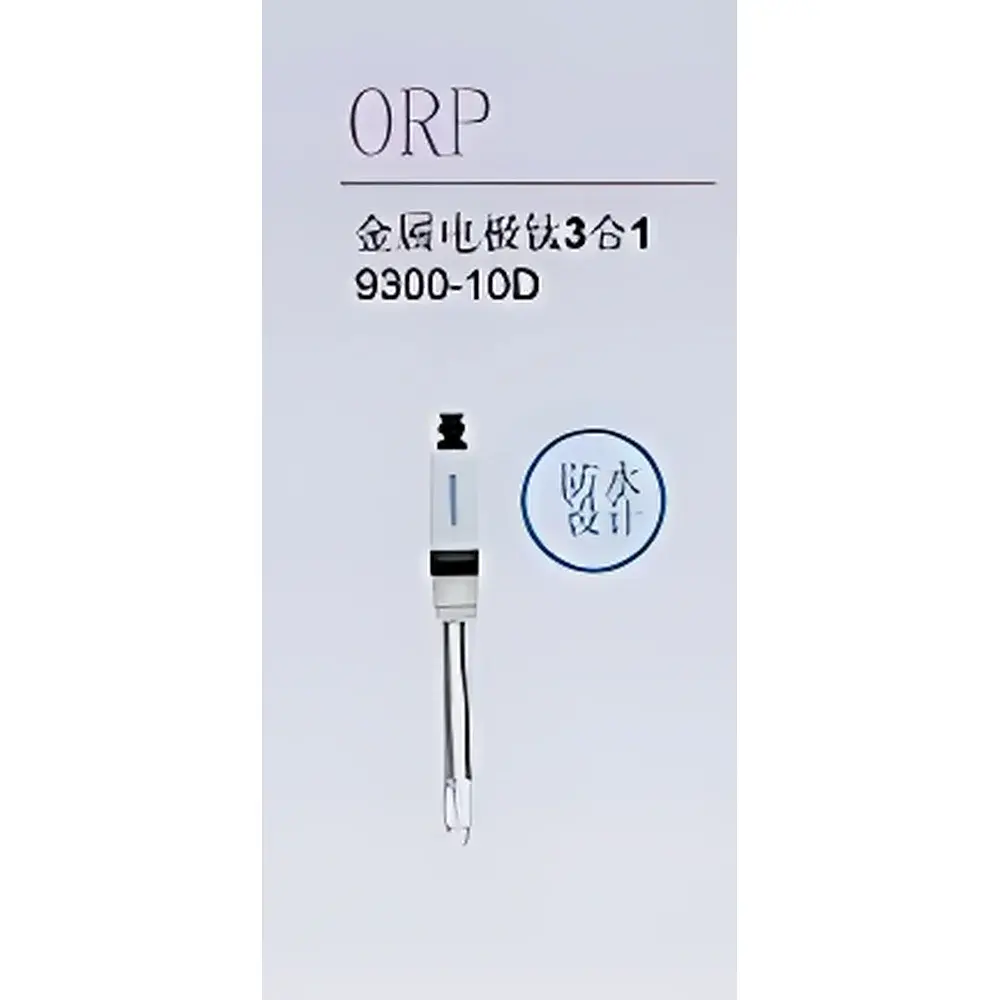
HORIBA 9300-10D Titanium-Bodied Waterproof Platinum Composite ORP Electrode
| Brand | HORIBA |
|---|---|
| Origin | Japan |
| Model | 9300-10D |
| Temperature Range | 0–60 °C |
| Electrode Type | Waterproof Pt/Ag-AgCl Composite ORP Electrode |
| Body Material | Titanium |
| Output Signal | mV (vs. Standard Hydrogen Electrode) |
| Compatibility | Designed for standalone ORP measurement only — not to be used concurrently with pH or other reference electrodes |
Overview
The HORIBA 9300-10D is a robust, titanium-bodied composite redox (oxidation-reduction potential) electrode engineered for high-stability, long-term ORP monitoring in demanding aqueous environments. Unlike conventional glass-body ORP sensors, this electrode integrates a platinum sensing element with an integrated Ag/AgCl reference system housed within a corrosion-resistant titanium sleeve—eliminating glass breakage risk and enhancing mechanical durability in industrial process streams, wastewater treatment basins, swimming pool control systems, and disinfection validation applications. Its design follows the fundamental electrochemical principle of potentiometric measurement: the electrode generates a stable, Nernstian voltage (in millivolts relative to the Standard Hydrogen Electrode, SHE) proportional to the logarithmic ratio of oxidized to reduced species in solution. The absence of a liquid junction or refillable electrolyte simplifies maintenance while maintaining sufficient reproducibility for routine redox process control.
Key Features
- Titanium housing provides exceptional resistance to mechanical impact, chemical corrosion, and UV degradation—ideal for outdoor or harsh industrial installations.
- Integrated Pt sensing element and Ag/AgCl reference system ensure fast response time (< 30 seconds to 95% stability) and minimal drift (< ±2 mV/24 h under continuous operation).
- Waterproof construction (IP68-rated) enables submersion up to 10 m depth without seal failure or electrolyte leakage.
- No liquid junction or external electrolyte filling required—reducing maintenance frequency and eliminating clogging risks associated with porous ceramic frits.
- Optimized geometry for consistent immersion depth and minimal flow dependence; calibrated for use with standard ORP meters supporting mV input and manual temperature compensation.
- Designed exclusively for ORP measurement—electrical isolation prevents cross-talk or reference contamination when deployed alongside pH or ion-selective electrodes in multi-parameter sensor arrays.
Sample Compatibility & Compliance
The 9300-10D is validated for use in low-to-moderate conductivity aqueous matrices including municipal and industrial wastewater, chlorinated pool water, cooling tower fluids, bioreactor effluents, and clean-in-place (CIP) rinse solutions. It is not recommended for non-aqueous solvents, highly viscous slurries, or samples containing sulfide, cyanide, or heavy metal ions above trace levels—substances known to poison Pt surfaces or destabilize Ag/AgCl references. While not certified to ISO 17025 or ASTM D1129 per se (as it is a component—not a complete measuring system), its performance aligns with requirements outlined in ASTM D1293 (Standard Test Method for pH of Water) and EPA Method 150.1 (for redox-sensitive disinfection residual monitoring). For regulated environments operating under GLP or GMP frameworks, users must validate electrode performance against traceable standards (e.g., quinhydrone or Zobell’s solution) and document calibration intervals, drift checks, and replacement history per internal SOPs.
Software & Data Management
As a passive analog sensor, the 9300-10D outputs a direct mV signal compatible with any benchtop or portable ORP meter featuring high-impedance (>1012 Ω) input circuitry and manual or automatic temperature compensation (0–60 °C range). It does not incorporate digital communication protocols (e.g., RS-485, SDI-12, or Bluetooth) nor onboard memory. When integrated into data acquisition systems (e.g., LabVIEW, SCADA, or Horiba’s LAQUA Smart software suite), users must configure appropriate scaling factors and apply linear or polynomial correction if compensating for temperature-induced Nernst slope variation. Audit trails, electronic signatures, and 21 CFR Part 11 compliance depend entirely on the host instrument’s firmware architecture—not the electrode itself.
Applications
- Real-time monitoring of chlorine, ozone, and chlorine dioxide disinfection efficacy in drinking water distribution networks.
- Redox control in anaerobic digesters and denitrification basins to optimize nitrogen removal efficiency.
- Process verification during electrochemical cleaning and passivation of stainless steel equipment (e.g., pharmaceutical bioreactors).
- Environmental compliance tracking of redox-sensitive contaminants such as Cr(VI), As(III), and Fe(II) in groundwater remediation sites.
- Quality assurance in semiconductor wet benches where precise oxidation state control is critical for wafer surface preparation.
FAQ
Can the 9300-10D be used simultaneously with a pH electrode in the same sample?
No. Concurrent use introduces reference electrode interference and may cause unstable readings due to electrical coupling between dissimilar reference systems.
Does this electrode require calibration with standard redox buffer solutions?
Yes. Routine calibration using certified Zobell’s solution (224 ± 5 mV at 25 °C) or quinhydrone solution (+470 mV at 25 °C) is required before critical measurements and after extended storage.
What is the expected service life under continuous immersion?
Typical operational lifespan exceeds 18 months in clean, chlorinated water; decreases significantly in sulfide-rich or abrasive slurry environments.
Is temperature compensation automatic?
No. The electrode itself provides no built-in temperature sensing; external Pt100 or thermistor-based compensation must be applied via the connected meter.
Can the titanium body be sterilized using autoclaving?
No. Autoclaving exceeds the 60 °C maximum operating temperature and may compromise internal seal integrity and reference stability. Chemical disinfection (e.g., 70% ethanol or diluted sodium hypochlorite) is recommended instead.
Related Products






