
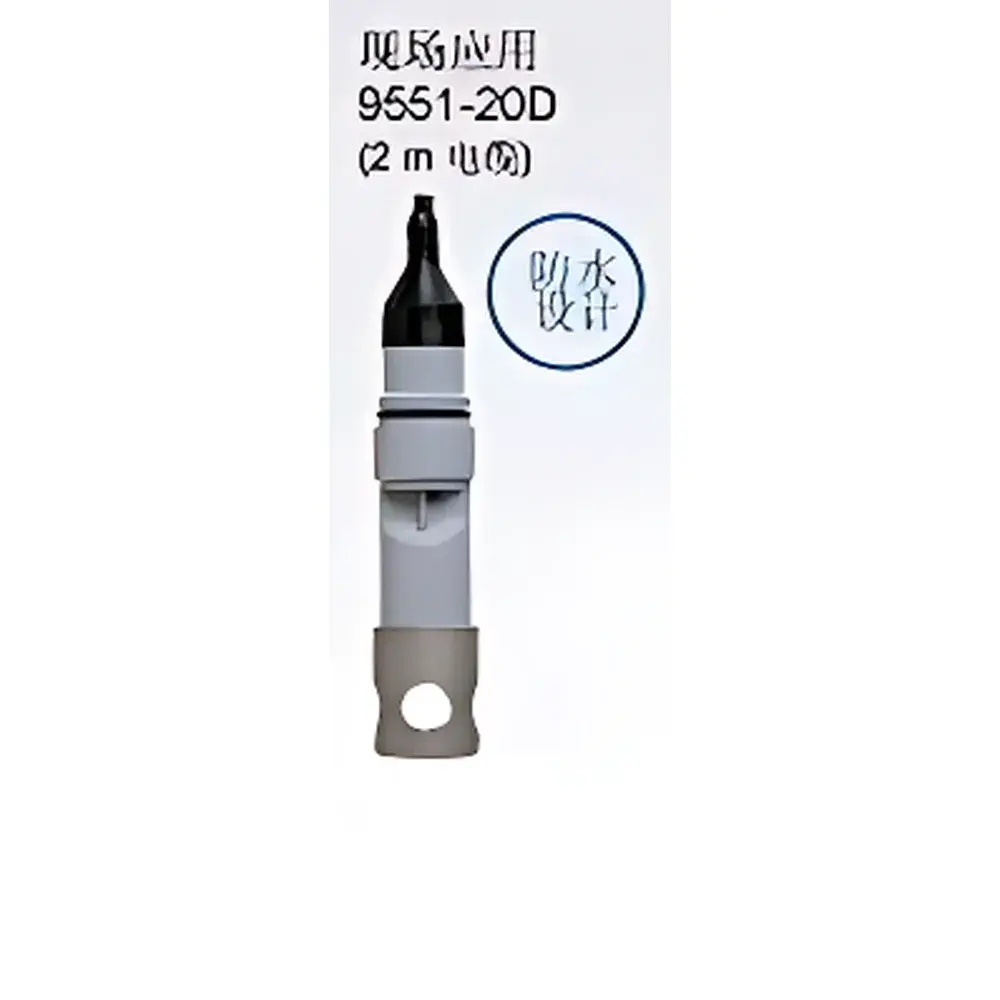
HORIBA 9551-20D Waterproof Dissolved Oxygen Electrode
| Brand | HORIBA |
|---|---|
| Origin | Japan |
| Model | 9551-20D |
| Cable Length | 2 m |
| Operating Temperature Range | 0–40 °C |
| IP Rating | IP68 (submersible) |
| Compatibility | Designed for use with HORIBA portable and benchtop DO meters (e.g., D-55, LAQUA twin series, or compatible analog input systems) |
| Electrode Type | Polarographic (Clark-type), membrane-covered, galvanic cell configuration |
Overview
The HORIBA 9551-20D is a submersible, polarographic dissolved oxygen (DO) electrode engineered for high-reliability field deployment in environmental water quality monitoring. Based on the Clark-cell principle, it employs a gas-permeable Teflon membrane to selectively allow molecular oxygen diffusion into an electrolyte-filled cathode chamber, where oxygen reduction generates a current linearly proportional to dissolved O₂ concentration (in mg/L or % saturation). Its robust stainless-steel body and IP68-rated housing ensure continuous operation under immersion in rivers, lakes, wastewater channels, and aquaculture systems. Unlike optical (luminescence-based) sensors, the 9551-20D offers stable zero-current baseline behavior, minimal drift over extended deployments, and insensitivity to flow rate variations—critical for low-flow or stagnant water profiling. The electrode is calibrated using standardized Winkler titration or air-saturation methods per ASTM D888 and ISO 5814, supporting traceable compliance in regulatory reporting.
Key Features
- Submersible design rated IP68 for continuous underwater operation up to 10 m depth
- Polarographic sensing principle with Ag/AgCl reference and gold cathode—optimized for long-term stability and low maintenance
- 2-meter integral shielded coaxial cable with BNC connector for direct compatibility with HORIBA D-55, LAQUA twin DO modules, and third-party data loggers featuring analog voltage or current inputs
- Temperature-compensated output (integrated NTC thermistor, 10 kΩ at 25 °C) enabling automatic correction across 0–40 °C operating range
- Replaceable membrane cap (part no. 9551-MC) and electrolyte solution (9551-EL) support in-field servicing without sensor replacement
- Low polarization voltage (−0.7 V DC) minimizes interference from redox-active species such as sulfides or ferrous ions commonly found in anaerobic sediments
Sample Compatibility & Compliance
The 9551-20D is validated for use in freshwater, seawater (with salinity compensation applied externally), wastewater effluents, and surface runoff samples. It meets the functional requirements of EPA Method 360.1, ASTM D888-22 (Standard Test Methods for Dissolved Oxygen in Water), and ISO 5814:2012 (Water quality — Determination of dissolved oxygen — Electrochemical probe method). While the electrode itself does not store calibration history, its analog output supports integration into GLP-compliant data acquisition systems that enforce audit trails, user authentication, and electronic signatures per FDA 21 CFR Part 11 when paired with validated software platforms (e.g., HORIBA LabSolutions or third-party SCADA interfaces).
Software & Data Management
As a transducer-level sensor, the 9551-20D outputs a millivolt signal (typically 0–30 mV full scale, corresponding to 0–20 mg/L DO) requiring external signal conditioning. When connected to HORIBA’s LAQUA twin handheld meter or D-55 benchtop analyzer, real-time temperature-compensated DO values are displayed with configurable units (mg/L, ppm, % saturation, or partial pressure). Raw analog output enables seamless integration into programmable logic controllers (PLCs), Campbell Scientific dataloggers, or custom LabVIEW-based monitoring stations. Calibration coefficients (slope and offset) can be stored in host instrumentation firmware; however, the electrode itself contains no embedded memory or firmware—ensuring deterministic behavior and eliminating firmware update dependencies.
Applications
- Field-based ambient water quality surveys in EPA Region-approved monitoring programs
- Wastewater treatment plant process control (aeration basin DO profiling, return activated sludge monitoring)
- Aquaculture pond management—real-time DO trending to prevent hypoxic stress in finfish and shellfish operations
- Stormwater outfall compliance verification under NPDES permits
- Academic limnology studies requiring ruggedized, low-drift sensors for longitudinal deployment
- Calibration verification of optical DO sensors in mixed-method QA/QC protocols
FAQ
What is the recommended recalibration interval for the 9551-20D in continuous field deployment?
For regulatory-grade applications, recalibration is advised before each sampling campaign and after every 72 hours of uninterrupted submersion; for non-regulatory monitoring, weekly two-point (zero-air and saturated-water) calibration is sufficient.
Can the 9551-20D be used in seawater without modification?
Yes, but salinity must be manually entered into the host meter to apply the Benson-Krause correction factor; the electrode does not include built-in conductivity compensation.
Is the membrane cap reusable after electrolyte refilling?
No—the membrane cap (9551-MC) is designed for single-use replacement after 3–6 months of field exposure or following any physical damage or fouling event.
Does the 9551-20D require warm-up time prior to measurement?
A stabilization period of 5–10 minutes is required after immersion to reach thermal equilibrium and stabilize the cathode potential, especially when transitioning between >10 °C temperature gradients.
What cleaning protocol is recommended for biofouled membranes?
Gentle wiping with lint-free tissue moistened with 70% isopropyl alcohol; avoid abrasive scrubbing or ultrasonic cleaning, which may compromise membrane integrity.







