
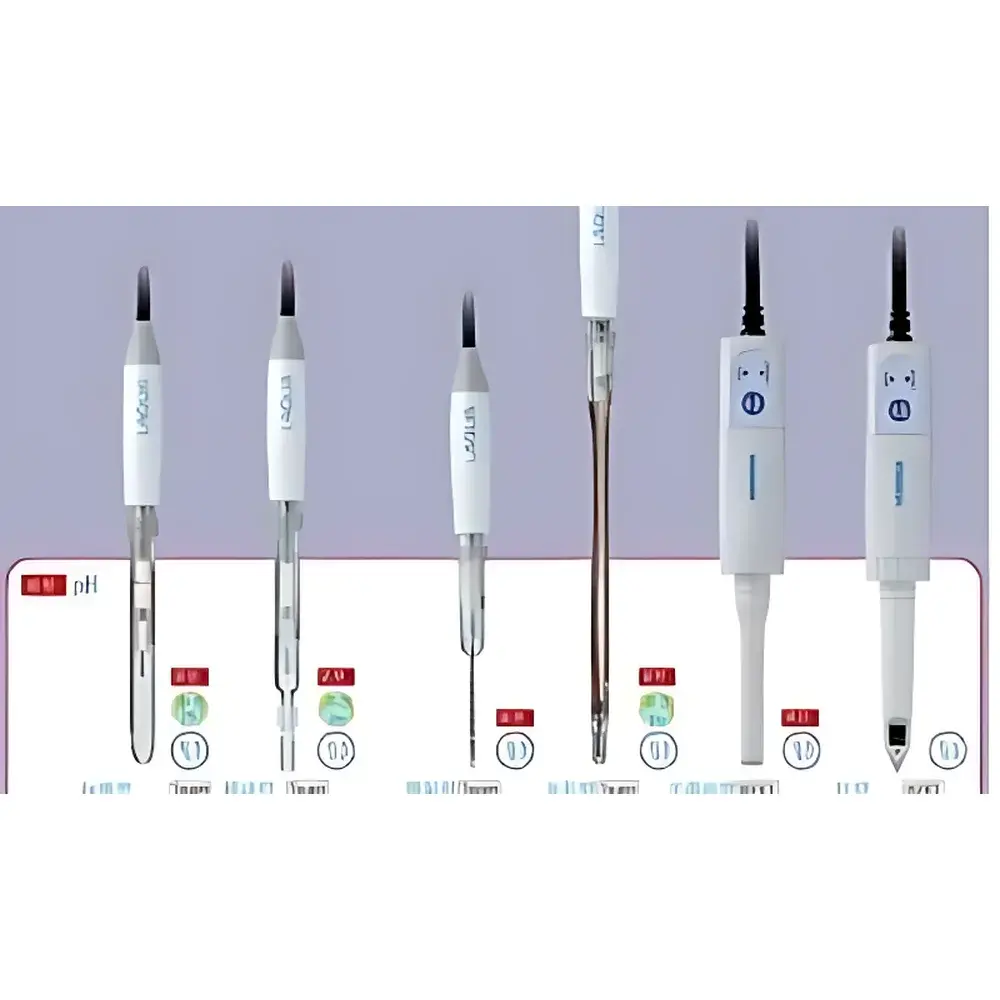
HORIBA 9625-10D Tri-Functional pH/ORP Electrode with Integrated Temperature Sensor
| Brand | HORIBA |
|---|---|
| Origin | Japan |
| Model | 9625-10D |
| Temperature Range | 0–100 °C |
| pH Range | 0–14 |
| ORP Range | ±1500 mV |
| Electrode Type | Combination pH/ORP/Temp (3-in-1), Gel-Filled, Plastic Body, Flat-Tipped ISFET-Glass Hybrid Design |
| Response Time (pH) | ≤15 s (t₉₀, ΔpH = 1.0) |
| Drift | <0.01 pH/h (25 °C, buffered solution) |
| Reference System | Cation-Selective Hollow-Fiber Junction |
| Glass Membrane | Rare-Earth-Doped High-Strength Bulb (JIS S 6001 Compliant, >10× strength) |
| Storage | Dry (no KCl soaking required) |
| Electrode Head Geometry | Flat, 100 µm clearance to protective sleeve |
| ESD Protection | Integrated semiconductor-grade anti-static circuitry |
Overview
The HORIBA 9625-10D is a tri-functional, all-in-one electrochemical sensor engineered for high-reliability pH, oxidation-reduction potential (ORP), and temperature measurement in demanding laboratory, quality control, and process monitoring environments. Unlike conventional glass electrodes, the 9625-10D integrates three sensing modalities—potentiometric pH detection via a proprietary rare-earth-doped glass membrane, redox potential measurement through a platinum-based reference/indicator system, and precision thermistor-based temperature compensation—within a single, robust plastic-bodied probe. Its hybrid architecture combines the accuracy and wide dynamic range of traditional glass electrode technology with the mechanical resilience, dry-storage capability, and microsample compatibility of ion-sensitive field-effect transistor (ISFET) design principles. The electrode operates on the Nernst equation principle for pH (−59.16 mV/pH at 25 °C) and the mixed-potential theory for ORP, with automatic temperature compensation (ATC) applied in real time to correct for thermal effects on both potentials and liquid junction potentials. Designed for ISO/IEC 17025-compliant laboratories and regulated manufacturing settings, it supports traceable calibration protocols and meets key performance benchmarks defined in ASTM D1293 (pH of water), ISO 7888 (electrical conductivity and pH of natural waters), and USP (pH measurement in pharmaceutical preparations).
Key Features
- Rare-earth-doped ultra-fast-response glass membrane: Patented formulation incorporating lanthanide oxides reduces response time (t₉₀) to ≤15 seconds—approximately half that of standard pH membranes—while increasing mechanical strength beyond JIS S 6001 industrial impact requirements by a factor of ten.
- Cation-selective hollow-fiber reference junction: Minimizes Ag⁺ leaching and silver complex precipitation by >99.9% versus conventional ceramic or sleeve junctions, ensuring stable liquid junction potential and long-term reproducibility of reference electrode potential (≤0.5 mV drift over 72 h).
- Flat-tip hybrid geometry: Combines a chemically resistant flat-surface glass membrane with an integrated ISFET-compatible housing; enables direct surface pH mapping of solids, measurement of droplets as small as 10 µL, and elimination of air bubble entrapment at the sensing interface.
- Dry-storage compatibility: Eliminates requirement for aqueous storage solution; maintains hydration layer integrity during ambient storage via proprietary internal gel electrolyte formulation (KCl-saturated polymer matrix).
- ESD-hardened semiconductor interface: Incorporates HORIBA’s proprietary anti-static protection circuitry, mitigating electrostatic discharge risks common in low-humidity cleanrooms or glovebox environments—critical for compliance with IEC 61326-1 EMC requirements.
- Integrated Pt1000 thermistor: Provides ±0.2 °C accuracy across 0–100 °C, enabling precise ATC in accordance with DIN 19263 and supporting GLP audit trails for temperature-stamped calibration records.
Sample Compatibility & Compliance
The 9625-10D is validated for use with aqueous buffers, biological fluids (serum, cell culture media), food extracts, wastewater effluents, and low-conductivity ultrapure water (≥1 µS/cm). It is not recommended for highly viscous non-aqueous solvents (e.g., ethylene glycol, DMSO) or strong oxidizing agents (>1 M HNO₃). The electrode complies with RoHS Directive 2011/65/EU and REACH Annex XIV restrictions. Its construction supports routine cleaning with soft-bristled brushes and mild detergent solutions—avoiding abrasive scrubbing or organic solvents that may degrade the gel electrolyte. For regulatory environments, the device supports 21 CFR Part 11–compliant electronic record generation when paired with HORIBA LAQUA Smart software (v3.2+), including user authentication, audit trail logging, and calibration lockout functionality.
Software & Data Management
When connected to HORIBA’s LAQUA Smart PC software or LAQUA Twin handheld meters (models B-771, B-781), the 9625-10D enables automated multi-point calibration (up to 5 points), slope/offset diagnostics, and real-time data export in CSV or PDF formats. Calibration history—including date/time stamp, operator ID, buffer lot numbers, and measured mV/pH values—is stored with cryptographic hashing to prevent post-acquisition modification. Raw sensor outputs (mV, °C, pH, ORP) are timestamped at 100 Hz sampling rate and support trend analysis, statistical process control (SPC) charting, and alarm-triggered data capture per ISO 9001 clause 8.5.2.
Applications
- Pharmaceutical QC testing of injectables, oral suspensions, and lyophilized powders (USP , EP 2.2.3)
- In-line pH monitoring in bioreactors and fermentation vessels (with optional IP67-rated extension cable)
- Surface pH characterization of hydrogels, wound dressings, and topical formulations
- Environmental analysis of soil leachates, sediment pore water, and acid mine drainage
- Food safety verification in dairy processing, brewing, and meat curing lines
- Academic research requiring simultaneous pH/ORP/temperature correlation under controlled atmospheres
FAQ
Can the 9625-10D be used for direct solid surface pH measurement?
Yes—the flat-tip geometry and sub-100 µm sleeve-to-sensor gap allow reliable contact with hydrated solid surfaces, including agar plates, polymer films, and biological tissues.
Is soaking required before first use or after dry storage?
No. The internal gel electrolyte retains sufficient hydration for immediate operation after unpacking or extended ambient storage (up to 12 months).
What is the recommended calibration frequency in GLP environments?
Daily calibration is advised prior to sample analysis; bracketing calibrations (before and after batch runs) are required for audit compliance per ISO/IEC 17025:2017 clause 7.7.1.
Does the electrode support automatic temperature compensation without external sensors?
Yes—the integrated Pt1000 thermistor provides fully embedded ATC, eliminating need for separate temperature probes or manual input.
Can this electrode be sterilized using autoclaving or chemical methods?
No. Autoclaving, ethanol immersion, or sodium hypochlorite exposure will damage the gel electrolyte and ISFET interface. Surface disinfection with 70% isopropanol is permissible.





