
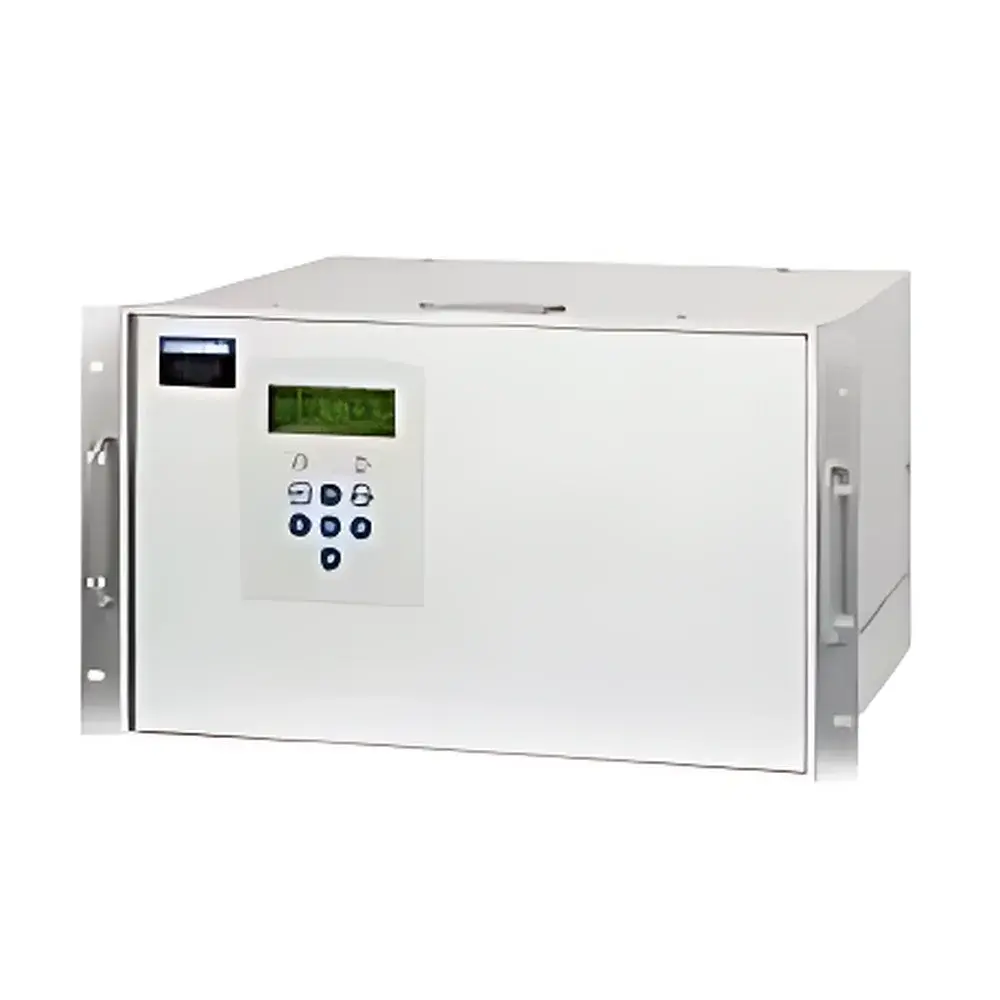
HORIBA APDA-370 Beta Attenuation Atmospheric PM2.5/PM10 Monitor
| Brand | HORIBA |
|---|---|
| Origin | Japan |
| Model | APDA-370 |
| Measurement Principle | Beta-ray attenuation |
| Measured Parameters | PM2.5 and PM10 |
| Range | 0–1000/5000 µg/m³ (standard), up to 10,000 µg/m³ (custom configurations) |
| Repeatability | ±20 µg/m³ @ 200/500 µg/m³ |
| Linearity | ±30 µg/m³ @ 200/500 µg/m³ |
| Zero Drift | ±20 µg/m³/day across all ranges |
| Span Drift | ±30 µg/m³/day @ low ranges |
| Sampling Flow Rate | ~16.7 L/min |
| Measurement Interval | 1 hour |
| Data Output | RS-232C, optional LAN (TCP/IP), analog 0–1 V, pulse & contact I/O |
| Power Supply | AC 100 V ±10 V, 50/60 Hz, ~200 VA |
| Dimensions (W×D×H) | 430 × 483.5 × 266 mm |
| Weight | Monitor unit: ~19 kg |
| Sampling pump | ~5 kg |
Overview
The HORIBA APDA-370 is a certified, continuous ambient air monitoring instrument engineered for regulatory-grade measurement of fine particulate matter—specifically PM2.5 and PM10—using the beta-ray attenuation (BAM) principle. This method relies on the quantitative absorption of beta particles (electrons) emitted from a 14C radioactive source as they pass through a continuously advancing fluororesin sampling tape loaded with collected airborne particles. The attenuation differential between clean and loaded tape segments is directly proportional to mass concentration, enabling traceable, gravimetrically referenced quantification without reliance on optical assumptions or environmental correction factors. Designed for unattended operation in national reference networks, urban background stations, and industrial fence-line monitoring sites, the APDA-370 meets international performance criteria aligned with ISO 10473, EN 12341, and U.S. EPA EQPM-0899-057 equivalency requirements for BAM-based PM monitors.
Key Features
- Automated, maintenance-optimized design supporting up to 60 days of continuous operation without manual intervention
- Real-time self-diagnostic capability including tape tension monitoring, flow validation, and source decay compensation
- Integrated fluororesin tape transport system ensuring high particle capture efficiency (>99% for PM2.5 under ISO-standardized sampling conditions)
- Programmable hourly span verification using internal calibration check standards
- Dual-range flexibility: factory-configured standard range (0–1000/5000 µg/m³) and extended-range variants (up to 10,000 µg/m³) for high-concentration environments such as construction zones or near industrial stacks
- Robust mechanical architecture with vibration-damped internal mechanics and temperature-stabilized detector electronics to minimize thermal drift
- Comprehensive fault logging with timestamped event records for audit-ready operational transparency
Sample Compatibility & Compliance
The APDA-370 draws ambient air through an EPA-designated PM10 or PM2.5 size-selective inlet (not included), compliant with ISO/CEN/ASTM specifications for aerodynamic cut-point accuracy and flow stability. Its BAM methodology is inherently insensitive to particle composition, refractive index, or humidity-induced hygroscopic growth—critical advantages over optical scattering methods in variable climatic conditions. The instrument satisfies data quality objectives outlined in EU Directive 2008/50/EC Annex II and supports compliance reporting under national air quality management frameworks requiring traceable, metrologically sound measurements. All firmware and calibration protocols are version-controlled and support GLP-aligned documentation practices.
Software & Data Management
Data acquisition and remote supervision are facilitated via native RS-232C serial interface, with optional Ethernet (TCP/IP) module enabling integration into centralized SCADA or EPA AirNow-compatible data aggregation platforms. Instrument-generated logs include date/time stamps, raw beta counts, calculated concentrations, flow rate, tape position, and diagnostic flags—all exportable in ASCII or CSV format. Optional CF card storage provides local redundancy for up to 12 months of 1-hour resolution data (configurable). Firmware supports configurable alarm thresholds and event-triggered data dumps. For regulated environments, optional software packages provide 21 CFR Part 11-compliant user access control, electronic signature workflows, and immutable audit trails—fully compatible with GMP and environmental laboratory QA/QC programs.
Applications
- National and municipal ambient air quality monitoring networks requiring Tier 1 reference-equivalent instrumentation
- Long-term epidemiological exposure assessment studies requiring high temporal resolution and inter-site comparability
- Industrial emissions compliance verification at perimeter and stack locations
- Indoor-outdoor penetration ratio analysis in building science and occupational health investigations
- Calibration transfer and field validation of lower-cost optical sensors using co-located BAM reference data
- Research applications in atmospheric chemistry, aerosol physics, and climate modeling where mass-based quantification is essential
FAQ
What regulatory standards does the APDA-370 comply with?
The APDA-370 conforms to ISO 10473 (ambient air—determination of PM10 and PM2.5 by BAM), EN 12341:2014, and demonstrates equivalency to U.S. EPA EQPM-0899-057 for PM2.5 monitoring. It is approved for use in EU Member State national reference networks under 2008/50/EC.
Is the 14C beta source subject to licensing or special handling?
Yes. The sealed 14C source is classified as exempt quantity under IAEA RS-G-1.9 and national radiation safety regulations in most jurisdictions; however, site-specific registration with local radiation protection authorities is required prior to installation.
Can the APDA-370 measure both PM2.5 and PM10 simultaneously?
No. It operates with a single size-selective inlet configuration per deployment. Dual-fraction monitoring requires two independent units or integration with a sequential cyclone manifold (third-party accessory).
What maintenance intervals are recommended for routine operation?
Tape replacement every 30–60 days depending on ambient loading; annual source activity verification and detector sensitivity calibration; biannual flow calibration using NIST-traceable rotameters or primary standards.
Does the instrument support remote firmware updates?
Firmware updates require local physical access via RS-232 connection and HORIBA-certified update utilities. Over-the-air updates are not supported to ensure integrity and regulatory compliance.
Related Products







