
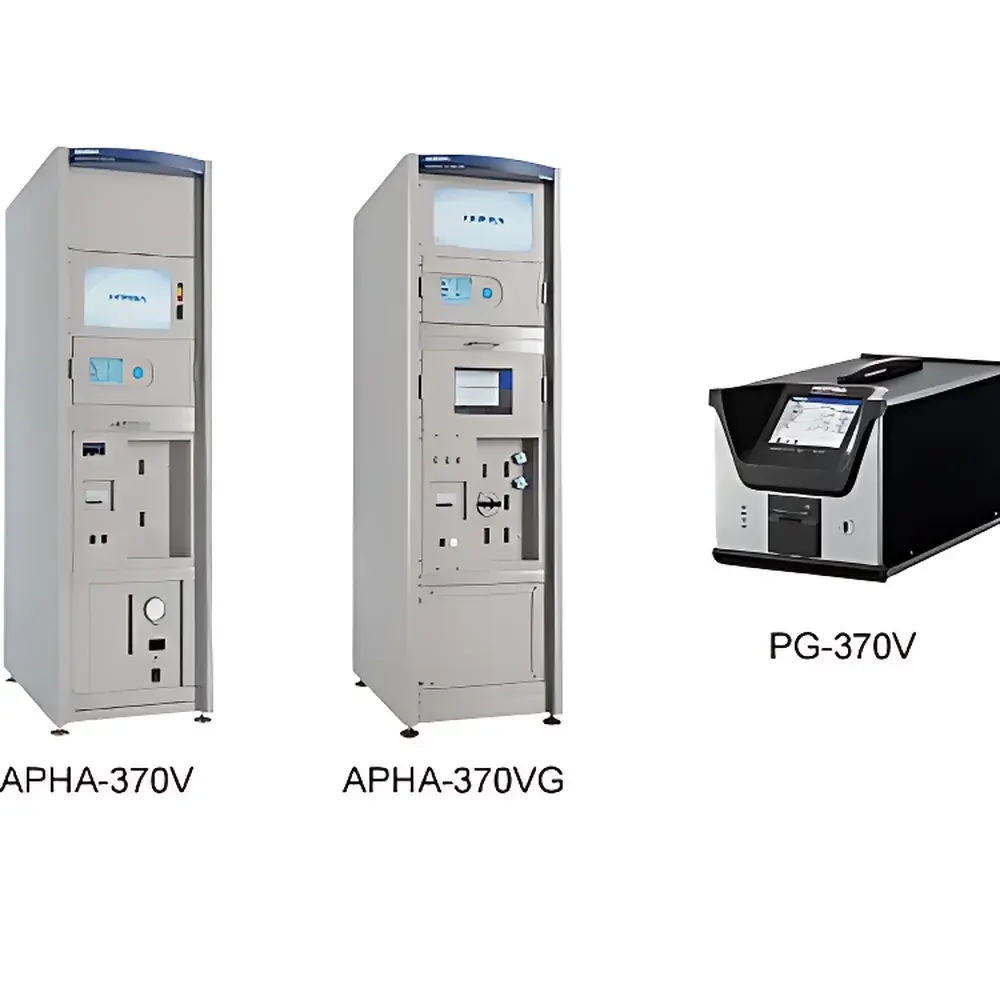
HORIBA APHA-370V Fixed Source VOCs Continuous Emission Monitoring System (CEMS) with Catalytic Oxidation–FID Detection
| Brand | HORIBA |
|---|---|
| Origin | Japan |
| Instrument Type | Laboratory Benchtop CEMS |
| Detection Principle | Selective Catalytic Oxidation + Flame Ionization Detection (FID) |
| Measurement Targets | CH₄, NMHC, THC |
| Detection Range | 0–50 / 200 / 500 / 1000 / 2000 ppm (selectable full-scale ranges) |
| Response Time | <150 s at sample inlet |
| Configuration | Integrated VOC Analyzer for Stack/Flue Gas Applications |
| Compliance Context | Designed for regulatory-grade monitoring per EPA Method 25A, ISO 12039, and EN 12619 requirements |
Overview
The HORIBA APHA-370V is a certified, laboratory-benchtop continuous emission monitoring system (CEMS) engineered for precise, long-term quantification of volatile organic compounds (VOCs) from stationary industrial sources—such as thermal oxidizers, chemical reactors, coating lines, and incinerators. It operates on the principle of selective catalytic oxidation followed by flame ionization detection (FID), enabling robust, interference-resistant measurement of total hydrocarbons (THC), non-methane hydrocarbons (NMHC), and methane (CH₄) in hot, humid, and particulate-laden flue gas streams. Unlike generic portable detectors, the APHA-370V integrates conditioned sampling, heated transport lines (up to 180 °C), catalytic conversion modules with temperature-controlled reaction zones, and a high-stability FID detector with auto-zero and span verification routines—all housed in an industrial-grade enclosure rated for Class 1, Division 2 hazardous locations. Its architecture conforms to the metrological rigor required for compliance reporting under national and international emissions regulations.
Key Features
- Triple-range selectable detection capability (0–50 ppm, 0–200 ppm, 0–2000 ppm) with automatic range switching based on real-time signal amplitude
- Heated sample conditioning system including Nafion dryer, particle filter (0.3 µm), and thermostatically controlled catalytic oxidizer (350 °C ± 2 °C)
- FID detector with low-noise electrometer, optimized hydrogen/air flow control, and drift-compensated baseline stabilization
- Integrated internal calibration gas manifold supporting dual-point (zero/span) automated verification every 24 hours
- Robust data acquisition module with 16-bit ADC, 1 Hz sampling rate, and onboard storage for ≥30 days of 1-minute averaged data
- Modbus TCP and RS-485 communication interfaces compliant with EPA Appendix F and EU IED (Industrial Emissions Directive) data transmission protocols
Sample Compatibility & Compliance
The APHA-370V is validated for use with stack gases containing up to 15% O₂, 10% CO₂, 500 ppm SO₂, 1000 ppm NOₓ, and 5 mg/m³ particulate matter—conditions typical of cement kilns, waste-to-energy plants, and petrochemical exhausts. All wetted components are constructed from 316L stainless steel and fluoropolymer-lined tubing to resist corrosion from acidic condensates. The system meets performance specifications outlined in EPA Method 25A for THC measurement, ISO 12039 for NMHC determination in combustion exhaust, and EN 12619 for continuous monitoring of organic compounds in waste incineration. It supports audit-ready data logging with time-stamped events for zero/span checks, maintenance alerts, and sensor diagnostics—fully traceable for GLP/GMP-aligned environmental QA/QC programs.
Software & Data Management
HORIBA’s proprietary CEMS Manager software provides secure, role-based access for configuration, real-time visualization, alarm management, and report generation. Data output complies with EPA 40 CFR Part 60, Subpart IIII and EU MRV (Monitoring, Reporting, Verification) frameworks. Raw analog outputs (4–20 mA) and digital streams support integration into DCS/SCADA systems. All measurement records include embedded metadata: calibration gas lot numbers, operator IDs, ambient temperature/pressure compensation flags, and instrument health status. Audit trails adhere to FDA 21 CFR Part 11 requirements, featuring electronic signatures, immutable log files, and configurable retention policies.
Applications
- Regulatory compliance monitoring of VOC emissions from fixed sources under local air quality ordinances (e.g., China’s GB 31571–2015, US EPA NESHAP Subpart HHHHHH)
- Process optimization in semiconductor fab exhaust abatement units and pharmaceutical solvent recovery systems
- Performance verification of thermal/catalytic oxidizers and carbon adsorption beds
- Baseline characterization and fugitive emission screening during plant commissioning or modification
- Supporting environmental impact assessments (EIAs) and Title V permit renewals with defensible, third-party-validated data
FAQ
Does the APHA-370V require external gas supplies beyond hydrogen and zero air?
Yes—it requires certified zero-grade air (hydrocarbon-free, <0.1 ppm THC) and ultra-high-purity hydrogen (99.999%) for FID operation. Optional internal gas cabinets with pressure regulation and leak detection are available.
Can it measure individual aromatic compounds like benzene or xylene?
No—the APHA-370V measures aggregate hydrocarbon classes. For speciated VOC analysis, HORIBA recommends the APHA-370VG variant, which incorporates GC-FID separation prior to detection.
What maintenance intervals are recommended for routine operation?
FID electrode cleaning and catalytic converter regeneration every 90 days; Nafion dryer replacement every 6 months; full system performance verification annually per ISO/IEC 17025 guidelines.
Is remote diagnostics supported?
Yes—via optional Ethernet-connected gateway with TLS-encrypted telemetry, enabling secure firmware updates, live parameter adjustment, and predictive fault alerts through HORIBA’s cloud-based CEMS Connect platform.







