
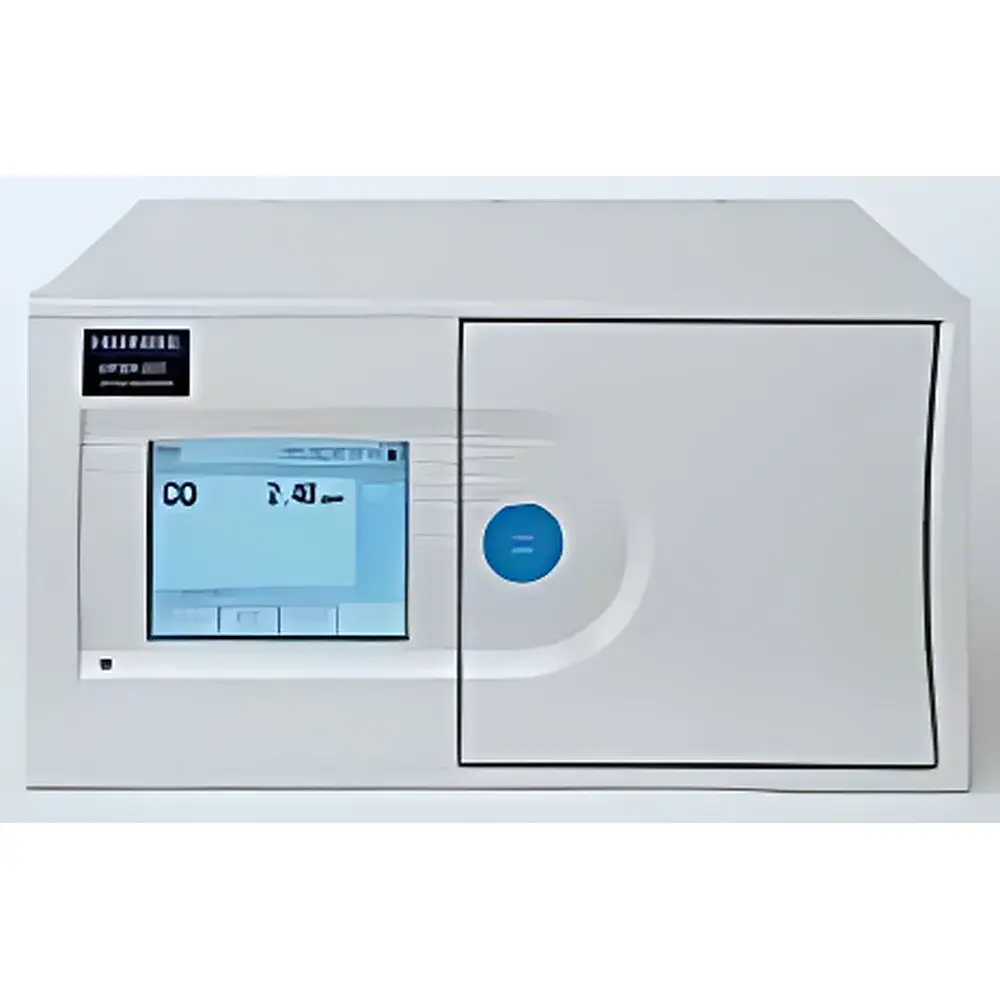
HORIBA APMA-370 Portable Carbon Monoxide Analyzer
| Brand | HORIBA |
|---|---|
| Origin | Japan |
| Model | APMA-370 |
| Instrument Type | Portable Gas Analyzer |
| Detection Target | Single-component (CO) |
| Measurement Range | 0–5 / 0–10 / 0–20 / 0–50 ppm (selectable) |
| Repeatability | ±1.0% F.S. |
| Response Time (T90) | ≤60 s (at lowest range) |
| Zero Drift | ±0.1 ppm/day or ±1.0% F.S./day (whichever is greater) |
| Span Drift | ±2.0% F.S./day or ±3.0% F.S./week |
| Linearity Error | ±1.0% F.S. |
| Detection Limit | 0.05 ppm (2σ, for ranges ≤10 ppm) |
| Sample Flow Rate | ~1.5 L/min |
| Operating Temperature | 5–40 °C |
| Power Supply | 100–240 VAC, 50/60 Hz |
| Dimensions | 430 × 550 × 221 mm (W×D×H) |
| Weight | ~16 kg |
Overview
The HORIBA APMA-370 is a high-stability, portable carbon monoxide (CO) analyzer engineered for continuous ambient air quality monitoring in regulatory, industrial hygiene, and environmental research applications. It employs alternating flow modulation non-dispersive infrared (NDIR) absorption spectroscopy—a robust, interference-resistant optical technique that eliminates the need for manual optical alignment and ensures long-term baseline integrity. Unlike conventional single-beam NDIR systems, the APMA-370 integrates an AS-type interference-compensated detector and a dynamically generated reference gas stream. Sample air is continuously split: one portion flows directly to the measurement cell, while the other passes through a catalytic oxidizer that quantitatively converts CO to CO2, producing a stable, CO-free reference gas. This dual-path, real-time compensation architecture effectively suppresses spectral interferences from water vapor, hydrocarbons, and other common atmospheric constituents—delivering trace-level CO quantification with metrological confidence under field-deployed conditions.
Key Features
- Interference-free measurement via catalytic reference generation and AS-type dual-detector NDIR optics—no mirrors or reflective surfaces susceptible to contamination.
- Auto-ranging capability across four selectable CO concentration spans (0–5, 0–10, 0–20, 0–50 ppm), configurable manually or remotely via digital interface.
- Stable optical path design with no consumable optical components; maintains calibration integrity over extended operational cycles without periodic realignment.
- Integrated diagnostics and self-monitoring: real-time alerts for zero calibration failure, span calibration deviation, catalyst temperature anomaly, and flow irregularities.
- Multi-protocol connectivity: standard RS-232C serial port; optional Ethernet/LAN interface for networked data acquisition and remote configuration.
- Onboard CF card slot enables autonomous logging of time-stamped CO concentration data, system status, and maintenance events—supporting offline analysis and audit-ready record retention.
Sample Compatibility & Compliance
The APMA-370 is optimized for ambient air sampling at standard temperature and pressure (STP), with a nominal sample flow rate of 1.5 L/min. Its catalytic oxidation module ensures complete CO conversion without cross-sensitivity to methane, ethane, or formaldehyde—validated per ISO 12039:2000 and aligned with EPA Method TO-11A requirements for ambient CO monitoring. The instrument meets CE marking directives for electromagnetic compatibility (EMC) and low-voltage safety (LVD). Its analog output options (0–1 V, 0–10 V, 4–20 mA) support integration into SCADA and PLC-based environmental monitoring networks compliant with IEC 61131-3. Data logging functionality satisfies basic GLP documentation requirements, and optional Ethernet firmware supports time-synchronized timestamping traceable to NTP servers—facilitating alignment with ISO/IEC 17025 quality management frameworks.
Software & Data Management
Data acquisition and configuration are managed via a built-in graphical LCD interface supporting English, German, French, and Japanese languages. All operational parameters—including range selection, alarm thresholds, averaging intervals (instantaneous, dynamic moving average, cumulative), and calibration schedules—are programmable without external software. Analog outputs provide simultaneous transmission of primary CO concentration and secondary diagnostic signals (e.g., catalyst temperature, flow status). When equipped with the optional LAN module, the APMA-370 functions as an HTTP-enabled device: users can access live readings, download CSV-formatted logs, initiate remote calibrations, and push firmware updates via secure web browser sessions. CF card archives include metadata headers (instrument ID, firmware version, UTC timestamps), enabling direct import into Excel, MATLAB, or environmental data management platforms such as EQuIS or ArcGIS Environmental Data Management System (EDMS).
Applications
- Ambient air quality monitoring networks (AQN) operated by national and municipal environmental agencies.
- Urban roadside and traffic corridor CO surveillance for compliance with WHO Air Quality Guidelines and EU Directive 2008/50/EC.
- Indoor air quality (IAQ) assessment in parking garages, tunnels, and underground transit facilities where CO accumulation poses acute health risks.
- Calibration verification and field validation of lower-cost electrochemical or metal oxide semiconductor (MOS) CO sensors.
- Research-grade emission characterization studies requiring stable, low-drift reference measurements over multi-week deployments.
FAQ
What measurement principle does the APMA-370 use?
It utilizes alternating flow modulation non-dispersive infrared (NDIR) absorption spectroscopy with active catalytic reference gas generation.
Is the instrument suitable for unattended long-term deployment?
Yes—its zero and span stability specifications (±0.1 ppm/day and ±2.0% F.S./day), combined with onboard CF logging and remote diagnostics, support continuous operation for ≥30 days without manual intervention.
Can the APMA-370 be integrated into existing environmental monitoring infrastructure?
Yes—via configurable 4–20 mA analog output, RS-232C serial communication, or optional Ethernet interface compatible with Modbus TCP and HTTP-based APIs.
Does the analyzer require routine optical maintenance?
No—the optical path contains no mirrors, lenses, or windows exposed to sample gas; the catalytic reference generation eliminates drift caused by optical fouling.
What standards does the APMA-370 comply with for regulatory reporting?
Its performance aligns with ISO 12039:2000 (ambient CO determination), EPA Method TO-11A, and EN 14625:2012 for fixed-location CO analyzers used in ambient air quality assessment.







