
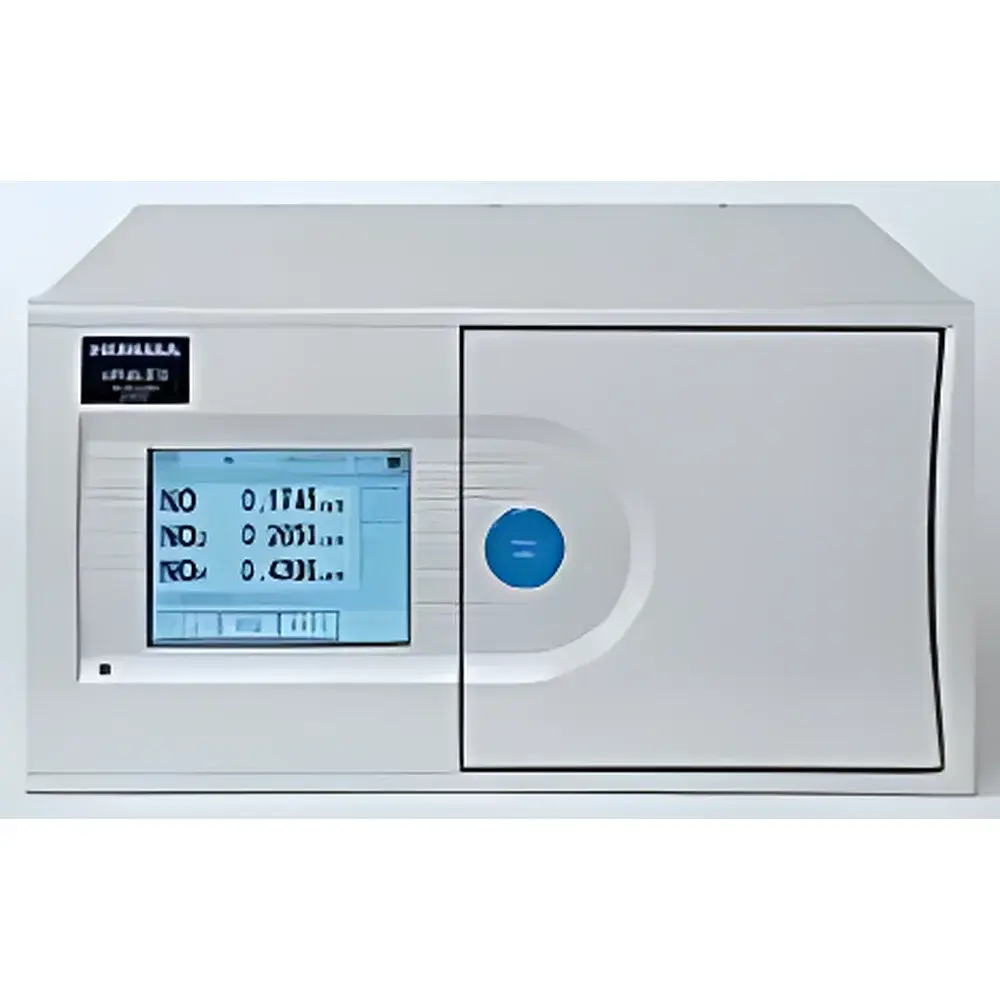
HORIBA APNA-370 Nitrogen Oxides (NO/NO₂/NOₓ) Analyzer for Ambient Air Monitoring
| Brand | HORIBA |
|---|---|
| Origin | Japan |
| Model | APNA-370 |
| Measurement Principle | Dual-Flow Modulated Chemiluminescence Detection (CLD) |
| Range Options | 0–0.1 / 0.2 / 0.5 / 1.0 ppm (standard) |
| LOD | 0.5 ppb (2σ, ≤0.2 ppm range) or 1.0% F.S. (2σ, >0.2 ppm range) |
| Repeatability | ±1.0% F.S. |
| Linearity | ±1.0% F.S. |
| Zero Drift | ±1.0 ppb/day or ±1.0% F.S./day (whichever greater) |
| Span Drift | ±1.0% F.S./day |
| Response Time (T₉₀) | ≤120 s (at minimum range) |
| Sample Flow Rate | ~0.8 L/min |
| Operating Temperature | 5–40 °C |
| Power Supply | 100–240 VAC, 50/60 Hz (configurable) |
| Dimensions | 430 W × 550 D × 221 H mm |
| Weight | ~21 kg |
Overview
The HORIBA APNA-370 is a high-performance, laboratory-grade nitrogen oxides (NO/NO₂/NOₓ) analyzer engineered for continuous, real-time monitoring of ambient air quality in regulatory compliance, urban network stations, and industrial fence-line applications. It employs dual-flow modulated chemiluminescence detection (CLD), a refined variant of the classical ozone-based CLD method. Unlike conventional single-flow CLD systems, the APNA-370 alternately directs sample and reference gas streams across a common reaction chamber using precision solenoid valves—effectively eliminating zero drift caused by ozone generator instability and photomultiplier tube (PMT) aging. This architecture enables simultaneous, interference-free quantification of NO (via direct reaction with ozone), NO₂ (via catalytic conversion to NO in a heated molybdenum converter), and total NOₓ (calculated as NO + NO₂), all within a single optical detection path. The system’s inherent stability, sub-part-per-trillion sensitivity, and minimal maintenance footprint make it suitable for unattended operation over extended periods—critical for EPA Reference Method-equivalent monitoring under 40 CFR Part 53 and ISO 7935:1990 compliance frameworks.
Key Features
- Integrated dry-air generation: Built-in desiccant dryer with automatic cycling ensures consistent, moisture-free air supply to the ozone generator—eliminating external drying systems and enhancing long-term calibration integrity.
- Self-contained design: All critical subsystems—including ozone generator, NO₂-to-NO molybdenum converter, photomultiplier detector, sample pump, and reference gas source—are housed within a single 21 kg chassis (430 × 550 × 221 mm), requiring no auxiliary gases (e.g., zero air, span gas, or carrier gas) for baseline operation.
- Multi-range flexibility: Four standard ranges (0–0.1, 0.2, 0.5, 1.0 ppm) and four extended options (up to 0–10 ppm) are software-selectable and remotely switchable via Ethernet or RS-232C, supporting dynamic field adaptation without hardware modification.
- Dual-output analog interface: Configurable 0–1 V, 0–10 V, or 4–20 mA outputs support both instantaneous concentration values and time-weighted averages (e.g., 1-min, 1-hr rolling means), facilitating integration into SCADA and EMS platforms.
- Embedded diagnostics & audit trail: Onboard event logging captures zero/span validation timestamps, converter temperature anomalies, ozone generator status, and PMT voltage drift—supporting GLP/GMP-aligned data integrity requirements per FDA 21 CFR Part 11 when paired with validated data acquisition software.
Sample Compatibility & Compliance
The APNA-370 is optimized for ambient air matrices at atmospheric pressure and temperatures between 5–40 °C. Its sampling train includes a heated inlet line (optional) to prevent condensation and ammonium nitrate artifact formation, and an integrated oxygen scrubber to suppress NO₂ interference from O₃ side reactions. The instrument meets performance specifications aligned with U.S. EPA Equivalent Method designation criteria for NOₓ analyzers (40 CFR Part 53, Appendix A), and its measurement uncertainty profile satisfies ISO 12039:2002 (stationary source emissions) and EN 14211:2012 (ambient air—performance characteristics). All firmware and calibration procedures are traceable to NIST-certified gas standards, and factory calibration certificates include full uncertainty budgets per ISO/IEC 17025:2017 requirements.
Software & Data Management
Data acquisition and remote configuration are supported via built-in Ethernet (10/100BASE-TX) and RS-232C ports. The unit ships with HORIBA’s proprietary APNA Control Software, enabling automated zero/span scheduling, multi-point linearity verification, and converter efficiency checks. Raw data—including timestamped analog outputs, diagnostic flags, and internal sensor voltages—can be logged directly to removable CompactFlash (CF) cards (up to 32 GB) with FAT32 formatting. CF card exports are compatible with third-party analysis tools (e.g., MATLAB, Python pandas) and comply with EU Air Quality Directive (2008/50/EC) Annex IX reporting templates. Audit logs retain ≥30 days of operational history with immutable timestamps, satisfying data retention mandates under ISO 50001 and ISO 14001 environmental management systems.
Applications
- Ambient air quality monitoring networks (national, regional, municipal)
- Urban traffic pollution hot-spot assessment and trend analysis
- Industrial perimeter monitoring and fugitive emission verification
- Research-grade field campaigns requiring high temporal resolution (1–60 s averaging)
- Calibration transfer standards for portable NOₓ analyzers and diffusion tube programs
- Validation of satellite-derived tropospheric NO₂ column measurements (e.g., TROPOMI, OMI)
FAQ
Does the APNA-370 require external zero air or calibration gases for routine operation?
No. The instrument generates its own zero air internally via the integrated desiccant dryer and ozone generator shutdown sequence. Span calibration requires certified NO-in-N₂ or NO₂-in-N₂ standard gases, but these are only introduced during scheduled maintenance—not during continuous monitoring.
Can the APNA-370 distinguish between NO and NO₂ without manual mode switching?
Yes. It performs fully automated, sequential measurement cycles: first measuring NO directly, then converting NO₂ to NO in the molybdenum converter and re-measuring total NOₓ. NO₂ concentration is derived by difference (NOₓ − NO) in real time, with no user intervention required.
Is the molybdenum converter lifetime documented, and how is converter efficiency monitored?
Converter efficiency is verified automatically every 24 hours via a built-in NO₂ permeation source and recorded in the diagnostic log. Typical service life exceeds 18 months under continuous operation; replacement kits include NIST-traceable efficiency certification.
What cybersecurity protocols does the Ethernet interface support?
The embedded TCP/IP stack supports static IP assignment, subnet masking, and MAC address filtering. HTTPS and TLS 1.2 are not natively implemented; secure remote access must be established through enterprise-grade firewalls or VLAN segmentation per IEC 62443-3-3 guidelines.
How is temperature compensation handled for the photomultiplier detector?
The PMT housing incorporates a Peltier thermoelectric cooler stabilized at 25 ± 0.5 °C, with real-time thermal feedback control logged alongside each measurement cycle to ensure signal stability across ambient fluctuations.
Related Products







