
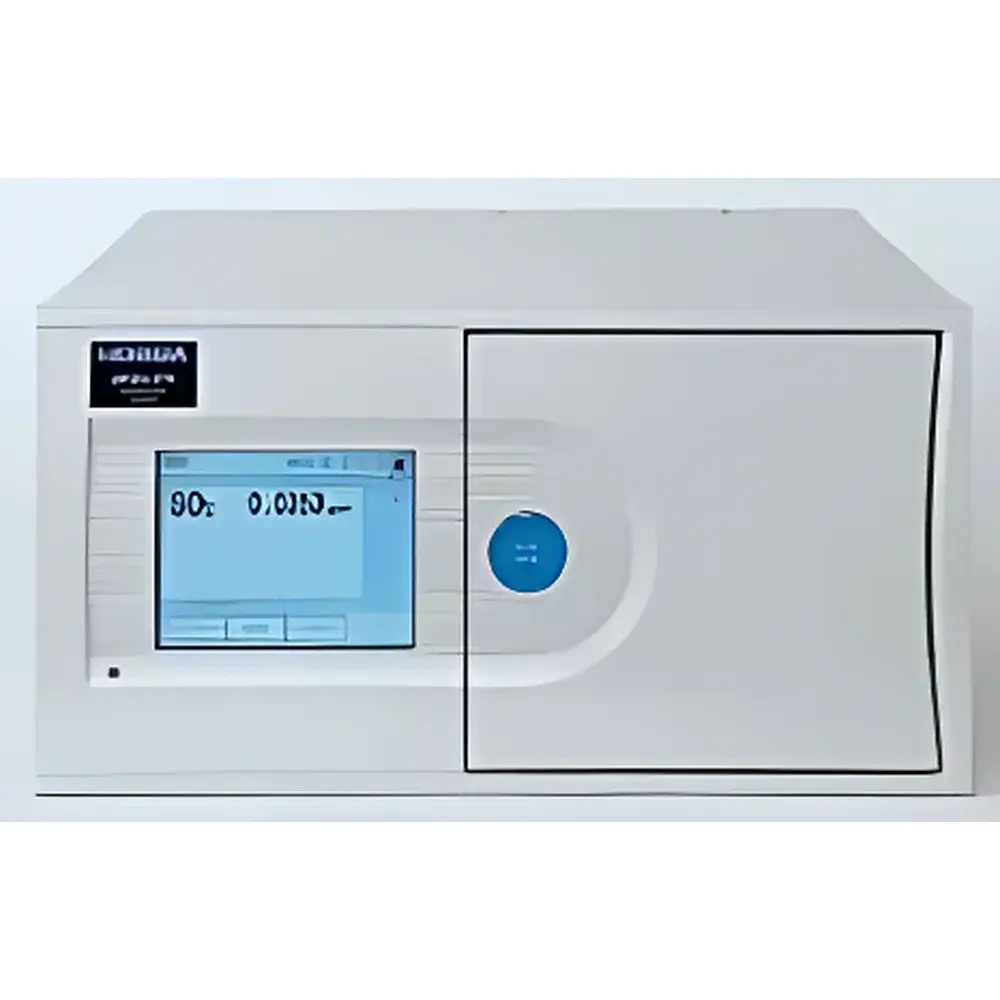
HORIBA APOA-370 Fixed-Position Ozone Analyzer
| Brand | HORIBA |
|---|---|
| Origin | Japan |
| Model | APOA-370 |
| Instrument Type | Fixed-Position |
| Measurement Range | 0–10 ppm |
| Detection Limit | 0.5 ppb |
| Response Time (T90) | ≤120 s |
| Zero Drift | ±1% F.S./day |
| Resolution | 0.1 ppb |
Overview
The HORIBA APOA-370 is a high-stability, fixed-position ozone (O3) analyzer engineered for continuous ambient air quality monitoring in regulatory, research, and industrial compliance applications. It employs the well-established non-dispersive ultraviolet (NDUV) absorption principle—operating at the characteristic 254 nm absorption band of ozone—to deliver trace-level quantification with metrological rigor. Unlike conventional UV photometers susceptible to interferences from humidity, hydrocarbons, or nitrogen dioxide, the APOA-370 integrates HORIBA’s proprietary heated catalytic ozone decomposer. This module thermally dissociates ozone in a dedicated reference stream, enabling true dual-beam differential measurement without chemical scrubbers or moving parts. As a result, the instrument achieves immunity to water vapor fluctuations and minimizes cross-sensitivity to common atmospheric interferents—critical for long-term unattended operation in variable environmental conditions.
Key Features
- Heated catalytic ozone decomposer for stable, interference-free reference generation—eliminates dependence on external zero-air generators or permeation tubes
- Full-wetted path constructed exclusively from PTFE and borosilicate glass—ensures chemical inertness, low memory effect, and resistance to acidic or oxidizing sample matrices
- Multi-range capability: Four selectable full-scale ranges (0–0.1, 0–0.2, 0–0.5, 0–1.0 ppm) plus extended 0–10 ppm option; all ranges support automatic or remote switching via digital interface
- High-resolution detection: 0.1 ppb digital resolution with verified 0.5 ppb (2σ) limit of detection at ≤0.2 ppm range
- Robust thermal management: Precision-controlled decomposer temperature and stabilized UV lamp output ensure <±1.0% F.S. zero drift per day and <±2.0% F.S. per week
- Comprehensive diagnostics: Real-time self-monitoring of lamp intensity, decomposer temperature, zero calibration status, span validation, and flow integrity—displayed in English, German, French, or Japanese
Sample Compatibility & Compliance
The APOA-370 is designed for direct sampling of ambient air, stack effluents, and indoor environments without pre-conditioning. Its sample inlet accepts standard 6 mm OD PTFE tubing and maintains consistent 0.7 L/min volumetric flow via integrated mass-flow-controlled aspiration. The instrument complies with core international performance standards for ozone monitoring, including EN 14625:2012 (ambient air—specification and testing of ozone analyzers), ISO 13964:1998 (air quality—determination of ozone—UV photometric method), and U.S. EPA EQOA-0112-172 (Equivalent Method designation for ozone). All internal calibration events—including zero and span checks—are timestamped and logged with operator ID (if enabled), supporting GLP/GMP-aligned data integrity requirements. Optional Ethernet and RS-232C interfaces facilitate integration into SCADA systems compliant with IEC 61131-3 and Modbus RTU protocols.
Software & Data Management
Data acquisition and configuration are managed via an embedded 5.7-inch TFT-LCD touchscreen interface with intuitive menu navigation. Raw and processed values—including instantaneous concentration, dynamic 1-, 8-, and 24-hour moving averages—are continuously recorded to removable CompactFlash (CF) cards (optional). Each log entry includes UTC timestamp, range setting, diagnostic flags, and calibration history—enabling full audit trails required under FDA 21 CFR Part 11 when paired with user-access controls and electronic signature modules (available as system add-ons). Remote maintenance is supported via secure Telnet or HTTP access over standard Ethernet (10/100BASE-TX), permitting firmware updates, parameter adjustments, and diagnostic retrieval without on-site intervention. Analog outputs (0–1 V, 0–10 V, or 4–20 mA) are configurable for either real-time concentration or averaged output signals, with isolated relay contacts for alarm and maintenance status reporting.
Applications
- Ambient air quality monitoring networks (e.g., national EPA or EEA reference stations)
- Photochemical smog research and ozone precursor studies
- Indoor air quality assessment in cleanrooms, hospitals, and laboratories
- Process control and emissions verification in semiconductor fabrication, water treatment, and pharmaceutical manufacturing
- Calibration transfer and field validation of portable ozone sensors and drone-based monitoring platforms
- Long-term trend analysis under WHO, EU Air Quality Directive (2008/50/EC), and U.S. NAAQS compliance frameworks
FAQ
What measurement principle does the APOA-370 use, and why is it preferred for regulatory monitoring?
The APOA-370 applies non-dispersive ultraviolet (NDUV) absorption at 254 nm—a primary absorption peak for ozone with minimal spectral overlap from other atmospheric gases. Its dual-beam architecture, enhanced by the heated catalytic decomposer, ensures high specificity and stability—making it suitable for reference-grade measurements aligned with EN 14625 and EPA equivalency criteria.
Can the APOA-370 operate reliably in high-humidity environments?
Yes. The heated decomposer and all-wetted PTFE/glass flow path eliminate humidity-induced baseline shifts and condensation artifacts—validated across 10–95% RH at 5–40°C ambient operating range.
Is the instrument compatible with centralized data acquisition systems?
Absolutely. Standard Ethernet (TCP/IP) and optional RS-232C interfaces support Modbus RTU, ASCII command sets, and HTTP-based polling—enabling seamless integration into existing environmental data management platforms.
How frequently does the APOA-370 require calibration, and what documentation is provided?
Zero and span calibrations are recommended every 7 days for regulatory compliance; however, the instrument’s low drift (<±1% F.S./day) supports extended intervals under controlled conditions. All calibration events generate time-stamped logs with operator ID, gas concentration, and pass/fail status—exportable via CF card or network.
Does the APOA-370 meet cybersecurity requirements for network-connected instruments?
The base Ethernet interface supports configurable IP filtering and password-protected access levels. For advanced IT security (e.g., TLS 1.2 encryption, RADIUS authentication), HORIBA offers certified firmware upgrades aligned with IEC 62443-3-3 SL2 implementation guidelines.







