
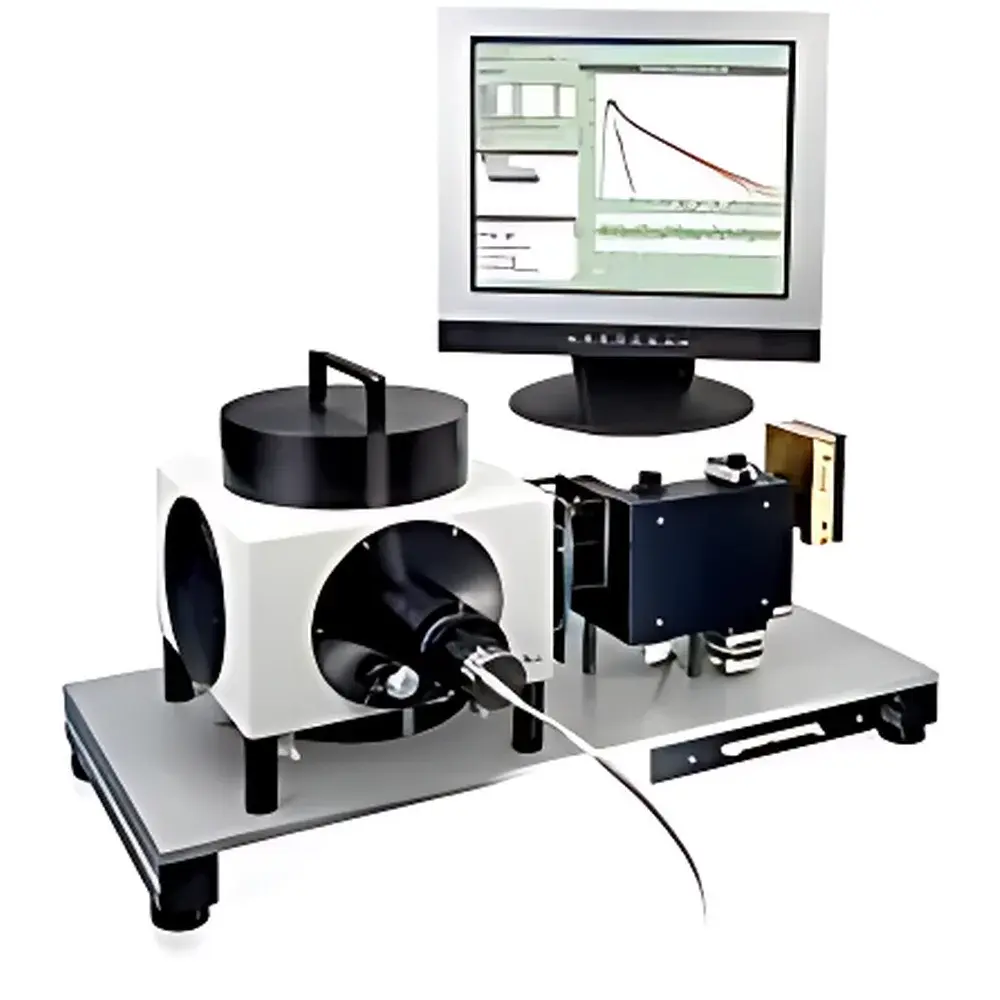
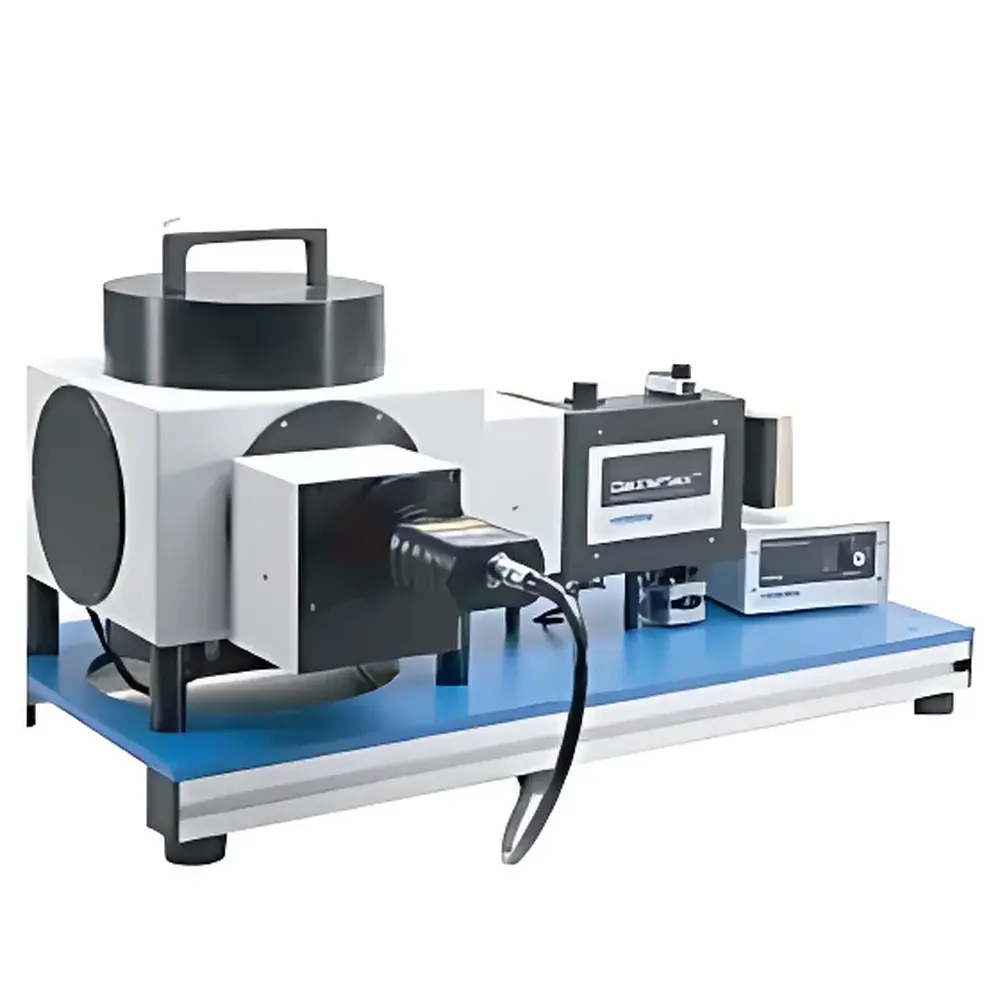
HORIBA DeltaFlex Ultrafast Time-Resolved Fluorescence Spectrometer
| Brand | HORIBA |
|---|---|
| Origin | United Kingdom |
| Model | DeltaFlex |
| Dispersion Element | Grating |
| Instrument Type | Transient Fluorescence Spectrometer |
| Slit Width (Spectral Bandpass) | 1–64 nm |
| Resolution | 1 nm |
| Sensitivity | >3000:1 |
| Wavelength Accuracy | ±0.05 nm |
| Excitation Source | Pulsed Laser Diode / LED System |
| Lifetime Range | <5 ps – 1 s |
| Minimum Acquisition Interval | 1 ms |
| Dead Time | 10 ns |
| Standard Detector | Picosecond PPD Module |
| Optional NIR Detection | up to ~1700 nm |
| Spectral Coverage | 200–1600 nm (with aberration-corrected gratings) |
| Sample Volume | as low as 1 µL |
| Software | Lifetime analysis suite with ≥5-exponential fitting, FRET, anisotropy, and decay-associated spectra (DAS) modules |
Overview
The HORIBA DeltaFlex Ultrafast Time-Resolved Fluorescence Spectrometer is a modular, research-grade TCSPC (Time-Correlated Single Photon Counting) platform engineered for precision kinetic characterization of luminescent species across an unprecedented lifetime range—from sub-5 picoseconds to 1 second. Leveraging over four decades of expertise in fluorescence lifetime instrumentation, the DeltaFlex implements a robust optical architecture centered on ultra-low-dead-time electronics (10 ns), high-repetition-rate pulsed excitation sources (up to 100 MHz), and time-gated photon detection optimized for both fluorescence and phosphorescence dynamics. Its core measurement principle relies on statistical reconstruction of photon arrival times relative to precisely synchronized laser pulses, enabling quantitative extraction of decay kinetics, amplitude-weighted lifetimes (τav), and multi-exponential population distributions under controlled thermal, polarization, or electro-optical conditions. Designed for compliance with rigorous scientific workflows, the system supports GLP/GMP-aligned data integrity protocols—including audit-trail-enabled software logging and instrument parameter traceability—making it suitable for regulated environments in materials science, pharmaceutical photophysics, and academic spectroscopy laboratories.
Key Features
- Ultra-broad lifetime coverage: <5 ps to 1 s, achieved without hardware reconfiguration via intelligent detector gating and adaptive timing electronics
- Dynamic acquisition capability: Continuous lifetime monitoring from 1 ms to 10,000 minutes, enabling real-time tracking of photochemical reactions, conformational transitions, or electroluminescent decay under bias
- DeltaHub core electronics: Integrated timing hub with 10 ns dead time ensures zero photon loss at high count rates (>106 cps), preserving statistical fidelity in fast-decaying systems
- Modular excitation suite: DeltaDiode (265–900 nm, up to 100 MHz) and SpectraLED (265–1275 nm) sources—plug-and-play, calibration-free, maintenance-free—replace traditional flashlamps with superior spectral stability and no afterglow artifacts
- F-Link auto-identification interface: Automatically detects and configures spectrometers, detectors, polarizers, and temperature controllers; eliminates manual setup errors and accelerates method transfer
- Picosecond-optimized PPD detector (standard): High quantum efficiency, low dark count, and intrinsic time resolution <30 ps enable reliable sub-nanosecond decay analysis
- Expandable NIR detection: Optional PPD-850C/PPD-900C modules extend spectral response to ~1700 nm for lanthanide, quantum dot, or organic semiconductor studies
Sample Compatibility & Compliance
The DeltaFlex accommodates liquid, solid, thin-film, and powder samples via interchangeable sample holders—including UV-grade cuvette stages with integrated temperature sensors and magnetic stirring, solid-sample mounts with adjustable angle control, and cryogenic dewar interfaces. Its large-volume optical chamber (≥120 mm clear aperture) permits integration of external electric field cells, magnetic field coils, or fiber-coupled microfluidic devices. All optical components meet ISO 10110 surface quality standards; grating coatings are certified for UV durability (200 nm). The system complies with IEC 61000-6-3 (EMC) and IEC 61010-1 (safety); software adheres to FDA 21 CFR Part 11 requirements for electronic records and signatures when configured with user authentication, audit trails, and electronic signature modules. Data export formats (CSV, ASCII, HDF5) support ASTM E2983-22 and ISO/IEC 17025-compliant reporting pipelines.
Software & Data Management
The included FluoroFit lifetime analysis suite provides a comprehensive, scriptable environment for model-based decay deconvolution—including mono- to penta-exponential fitting, global analysis across wavelengths or conditions, FRET efficiency mapping, anisotropy decay modeling, and decay-associated spectra (DAS) generation. All algorithms are mathematically transparent, with full access to residual plots, χ² diagnostics, and confidence interval estimation. Raw TCSPC histograms are stored in vendor-neutral binary format with embedded metadata (excitation wavelength, slit width, detector gain, temperature, polarization angle). Batch processing supports automated QA/QC flagging based on count rate stability, χ² thresholds, or lifetime reproducibility across replicates. Data archiving follows hierarchical directory structures compliant with FAIR (Findable, Accessible, Interoperable, Reusable) principles, and optional LIMS integration enables direct assay-level metadata tagging.
Applications
- Forster Resonance Energy Transfer (FRET) quantification in protein-protein interactions and nucleic acid folding
- Stern-Volmer quenching analysis for oxygen sensing, metal ion detection, and microenvironment polarity mapping
- Phosphorescence lifetime thermometry in OLED emissive layers and triplet-state photocatalysts
- Time-resolved anisotropy for rotational diffusion studies of macromolecular complexes
- Electroluminescence transient analysis—including turn-on/off dynamics, trap-state emission, and field-dependent decay modulation
- Single-molecule burst analysis (via optional confocal coupling) and heterogeneous population decomposition
- Photodynamic therapy agent characterization: singlet oxygen quantum yield correlation with triplet lifetime
- Perovskite solar cell degradation kinetics monitored via in situ PL lifetime mapping
FAQ
What lifetime ranges can the DeltaFlex resolve without hardware changes?
The system covers <5 ps to 1 s continuously using its adaptive timing electronics and selectable detector gating—no module swaps or recalibration required.
Is the software capable of global lifetime analysis across multiple emission wavelengths?
Yes. FluoroFit supports global fitting of decay datasets acquired at up to 100 discrete wavelengths simultaneously, generating decay-associated spectra (DAS) and species-associated spectra (SAS) with shared lifetime parameters.
Can the DeltaFlex perform time-resolved phosphorescence measurements?
Absolutely. With SpectraLED excitation and appropriate detector selection (e.g., PPD-900C), phosphorescence decays from microseconds to seconds are routinely resolved—even under ambient conditions.
How does the DeltaFlex ensure data integrity for regulatory submissions?
When configured with electronic signatures and audit-trail logging, the software meets FDA 21 CFR Part 11 requirements; all raw histograms, fit parameters, and instrument settings are cryptographically timestamped and immutable post-acquisition.
What sample volume is required for standard liquid measurements?
As little as 1 µL is sufficient when using micro-cuvettes or capillary cells—ideal for precious biological or synthetic samples.
Related Products





