
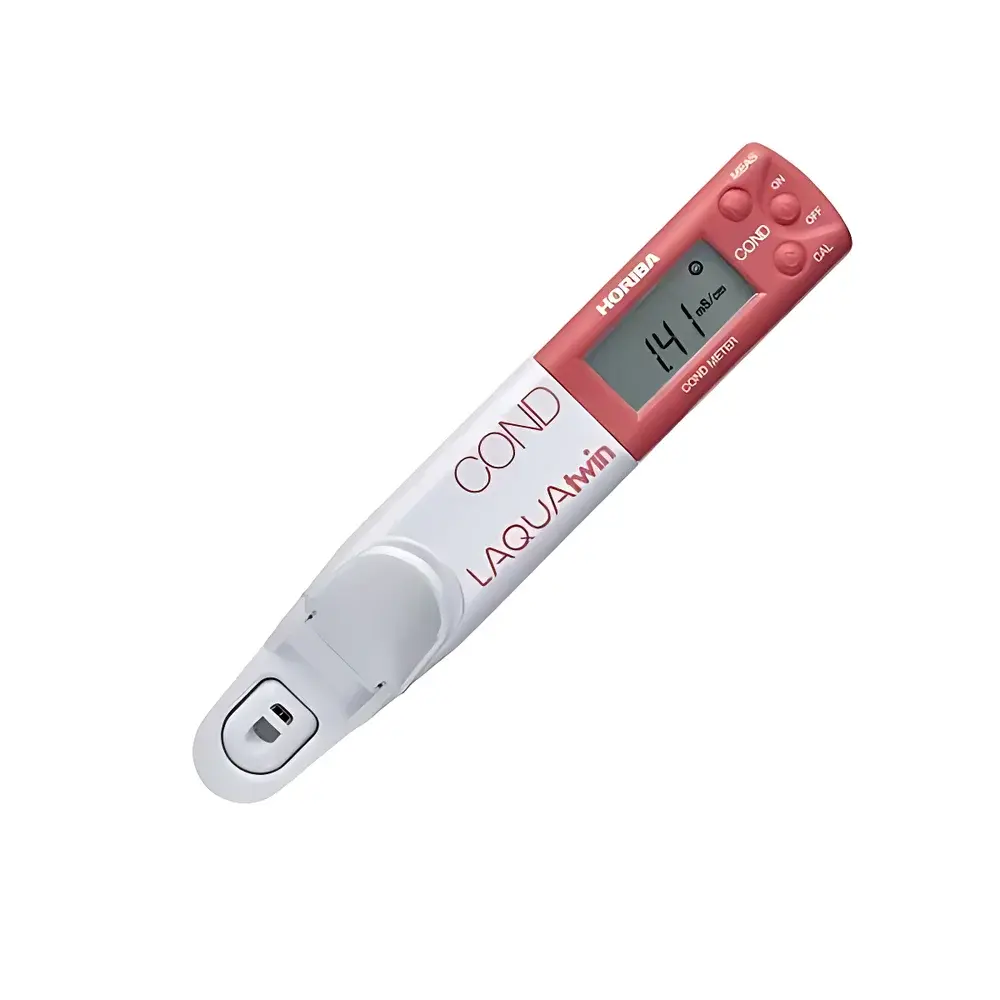
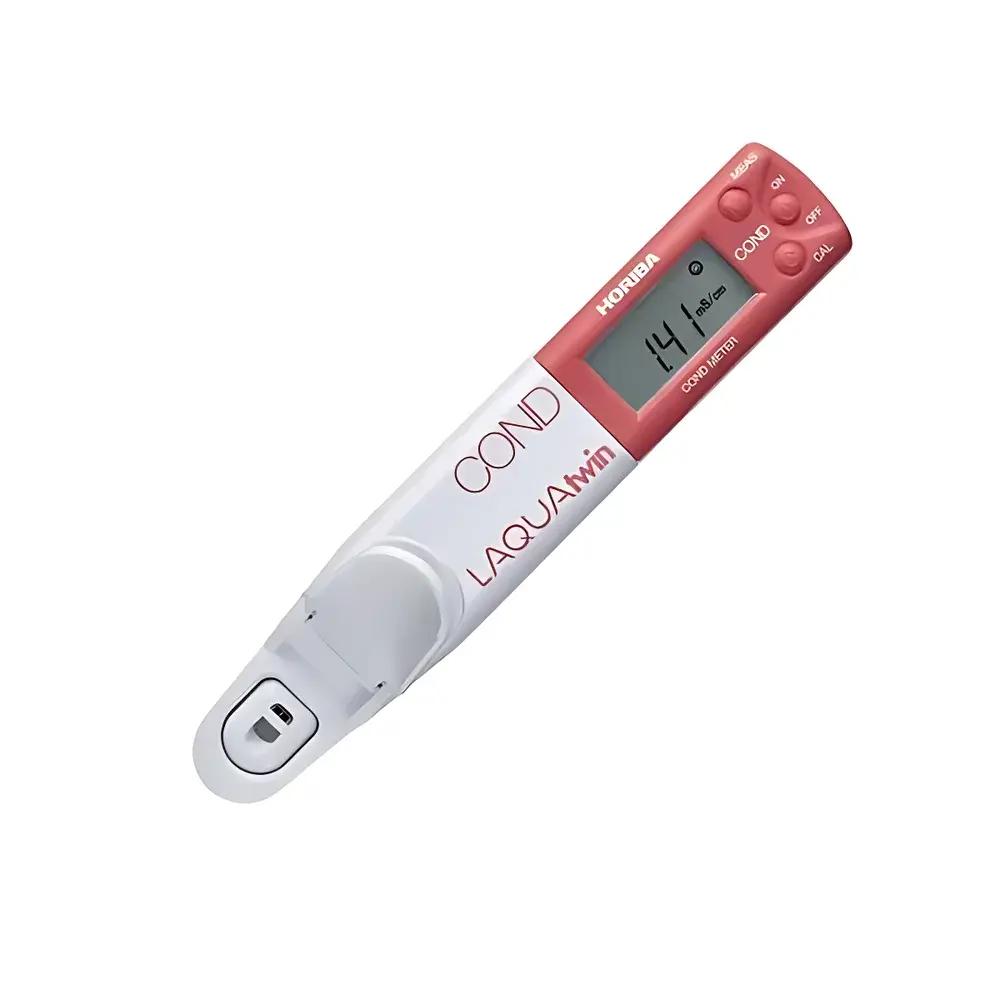
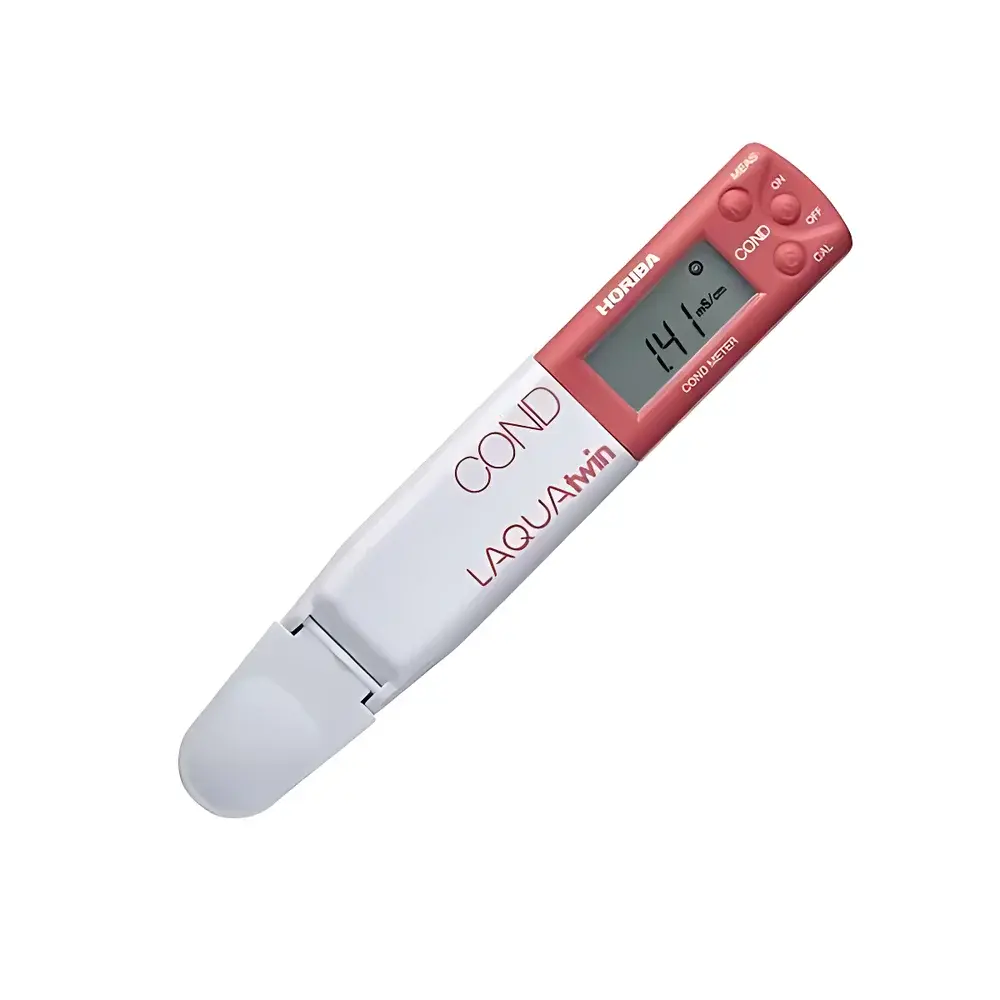
HORIBA EC22 Portable Conductivity Pen Meter
| Brand | HORIBA |
|---|---|
| Origin | Japan |
| Model | EC22 / EC33 |
| Portability | Pen-style |
| Conductivity Range | 0–199.9 mS/cm (auto-ranging across four sub-ranges) |
| TDS Range | 0.0–9990 ppm (EC33 only) |
| Resistivity Range | 0–100 kΩ·cm |
| Salinity Range | 0.1–100 ppt |
| Temperature Range | 10–100 °C |
| Accuracy | ±2% F.S. ±1 digit per range |
| Resolution | 1 µS/cm (lowest range), 0.1 mS/cm (highest range) |
| Temperature Compensation | Automatic, NIST-compliant |
| IP Rating | IP67 |
| Power | 2 × CR2032 batteries (~400 hours life) |
| Dimensions | 164 × 29 × 20 mm (L×W×H, excluding probe tip) |
| Weight | ~45 g (instrument only) |
| Electrode | Dual-ring platinum-black-coated titanium sensor |
| Minimum Sample Volume | 0.12 mL |
| Calibration Points | 3-point (1413 µS/cm, 12.88 mS/cm, and user-defined) |
Overview
The HORIBA EC22 is a precision-engineered portable conductivity pen meter designed for rapid, field-deployable measurement of electrical conductivity (EC), temperature, and—on the EC33 variant—total dissolved solids (TDS) and salinity in aqueous solutions. It operates on the principle of two-electrode conductometric measurement using a dual-ring platinum-black-coated titanium sensor, ensuring stable polarization resistance and high reproducibility across diverse sample matrices. Unlike conventional single-range handheld meters, the EC22 implements intelligent auto-ranging across four overlapping conductivity decades: 0–199 µS/cm, 200–1999 µS/cm, 2.00–19.99 mS/cm, and 20.0–199.9 mS/cm. This architecture eliminates manual range selection errors and supports seamless transition between low-conductivity freshwater and high-salinity industrial process streams. Built to meet international field instrumentation requirements, the device conforms to IEC 60529 (IP67) for dust-tight and immersion-resistant operation up to 1 m for 30 minutes, making it suitable for rigorous environmental, aquacultural, and maintenance applications where ruggedness and reliability are non-negotiable.
Key Features
- Auto-ranging four-decade conductivity measurement (0–199.9 mS/cm) with optimized resolution per range: 1 µS/cm (0–199 µS/cm), 0.01 mS/cm (2.00–19.99 mS/cm), and 0.1 mS/cm (20.0–199.9 mS/cm)
- Dual-ring platinum-black-coated titanium electrode providing low polarization drift, extended service life, and resistance to fouling in turbid or organic-rich samples
- Automatic temperature compensation (ATC) based on NIST-traceable thermistor calibration (10–100 °C), supporting both linear and non-linear (β) compensation modes per ISO 7888 and ASTM D1125
- IP67-rated housing constructed from impact-resistant ABS-epoxy composite, certified for operation in ambient conditions of 5–40 °C and ≤85% RH (non-condensing)
- Intelligent measurement stabilization algorithm with Auto-Hold and Auto-Stable functions—freezes display upon signal convergence within ±0.5% over 3 seconds
- Low-power design powered by two CR2032 lithium coin cells (typical operational life: 400 hours); auto-shutdown after 30 minutes of inactivity
- High-contrast monochrome LCD with customizable backlight-free digit display (12.8 mm character height), optimized for readability under direct sunlight or low-light conditions
Sample Compatibility & Compliance
The EC22 is validated for use with liquid-phase samples requiring minimal volume—only 0.12 mL is needed for reliable measurement, enabling analysis of small-volume containers, microcosms, soil leachates (via saturated paste extraction), and surface rinse waters. Its electrode geometry and material composition minimize interferences from redox-active species, suspended solids (up to 50 mg/L), and moderate levels of organic matter. The instrument complies with key regulatory frameworks governing field analytical instrumentation: its measurement traceability aligns with ISO/IEC 17025 laboratory accreditation requirements when used with certified reference standards (e.g., 1413 µS/cm and 12.88 mS/cm KCl solutions included), and its data integrity features—including non-volatile memory retention of calibration history—support GLP-compliant documentation practices. While not FDA 21 CFR Part 11–certified as a standalone system, audit trails generated via optional PC interface (using HORIBA’s optional DataBridge software) can be integrated into validated LIMS environments.
Software & Data Management
The EC22 operates as a stand-alone field instrument with no onboard data logging; however, it is fully compatible with HORIBA’s optional DataBridge PC software suite via USB-to-serial adapter (sold separately). This interface enables real-time streaming, timestamped calibration record export (including date, standard used, slope, offset, and temperature), and batch export of measurement sessions in CSV or Excel-compatible formats. All calibration parameters are stored in non-volatile memory and persist through battery replacement. For regulated environments, users may implement procedural controls—such as mandatory calibration verification before each sampling shift and documented operator sign-off—to satisfy internal QA/QC protocols aligned with ISO 5667-3 (water quality sampling) and ASTM D512 (chloride ion determination by conductivity correlation).
Applications
- Freshwater & Wastewater Monitoring: Rapid assessment of effluent conductivity pre- and post-treatment; detection of chloride intrusion in drinking water distribution systems
- Aquaculture & Hydroponics: Daily tracking of nutrient solution EC to maintain optimal osmotic balance for fish health and plant uptake efficiency
- Soil Science: Determination of electrical conductivity of saturated soil extracts (ECe) per USDA Handbook 40, supporting salinity classification and irrigation management decisions
- Industrial Maintenance: Monitoring of cooling tower cycles, boiler feedwater purity, and cleaning-in-place (CIP) rinse validation through conductivity break-point detection
- Education & Field Training: Hands-on instruction in electrochemical fundamentals, sensor calibration theory, and environmental parameter interrelationships (e.g., EC–TDS–salinity correlations)
FAQ
What calibration standards are included with the EC22?
The instrument ships with two certified reference solutions: 14 mL of 1413 µS/cm (±1% at 25 °C) and 14 mL of 12.88 mS/cm (±1% at 25 °C) potassium chloride solutions, plus 4 mL of electrode conditioning solution.
Can the EC22 measure TDS directly?
The EC22 measures conductivity only; TDS calculation requires user-defined conversion factors (typically 0.5–0.7 for natural waters). The EC33 model includes built-in TDS conversion and displays ppm values directly.
Is temperature compensation adjustable?
Yes—the EC22 supports both fixed α (0.020/°C) and variable β compensation modes, configurable via the setup menu to match sample-specific thermal response profiles.
How often should the electrode be cleaned and reconditioned?
Platinum-black electrodes should be rinsed with deionized water after each use; periodic cleaning with dilute HNO3 (0.1 M) followed by reconditioning in 12.88 mS/cm solution is recommended every 50–100 measurements or when slope deviation exceeds ±5%.
Does the EC22 comply with ASTM D1125 or ISO 7888?
While the EC22 itself is not certified to these standards, its measurement methodology, electrode design, and calibration traceability enable full compliance when operated according to the procedures outlined in ASTM D1125-22 and ISO 7888:2022 for routine field conductivity testing.
Related Products





