
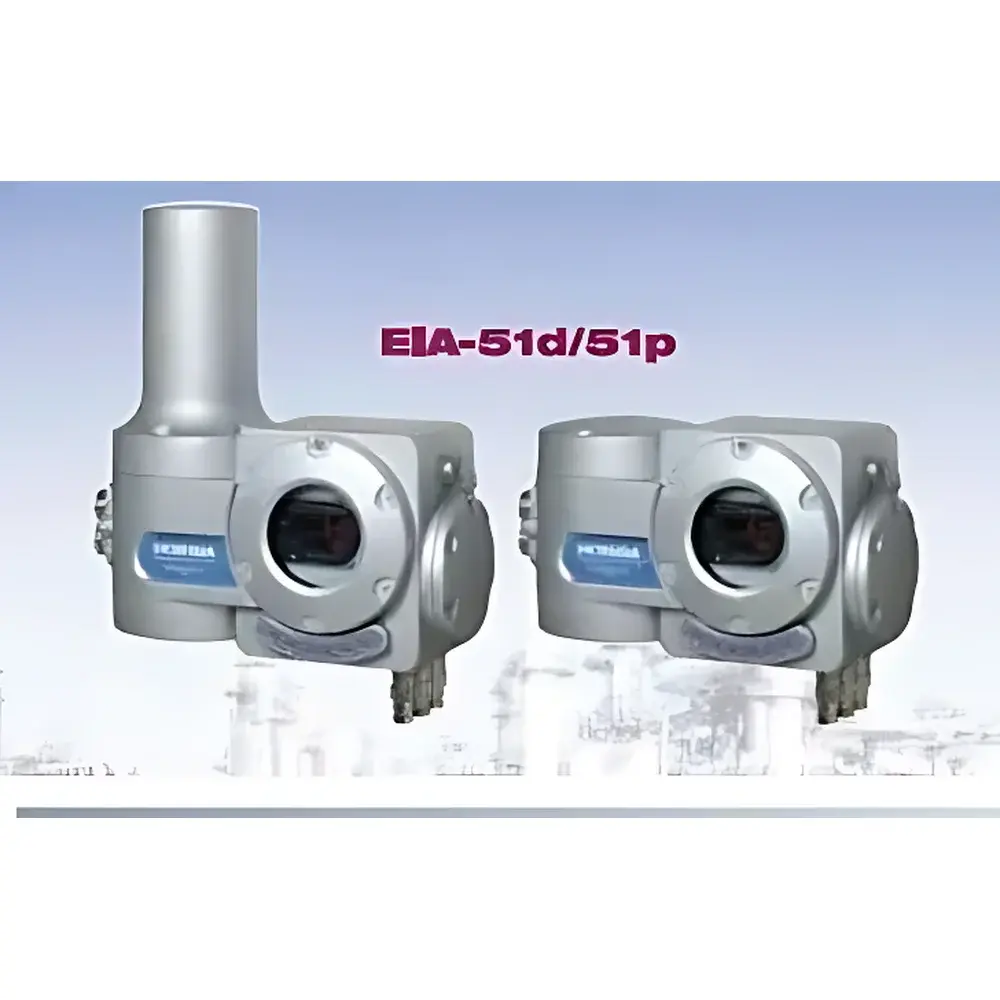
HORIBA EIA-51d / EIA-51p Explosion-Proof Infrared Gas Analyzer
| Brand | HORIBA |
|---|---|
| Origin | Japan |
| Model | EIA-51d / EIA-51p |
| Explosion Protection Type | Ex d IIB+H2 T4 (EIA-51d) / Ex p II T4X (EIA-51p) |
| Measurement Principle | Non-Dispersive Infrared (NDIR) with Interference Compensation |
| Detectable Gases | CO, CO₂, CH₄ (configurable per application) |
| Range | 0–0.11 vol% to 0–100 vol% (gas-dependent) |
| Minimum Detection Limit | 0–50 ppm (gas-dependent) |
| Repeatability | ±0.5% F.S. (standard range) |
| Linearity | ±1.0% F.S. |
| Zero & Span Drift | ±2.0% F.S./week |
| Response Time (T90) | ≤20 s (standard), ≤40 s (optional extended range) |
| Sample Flow Rate | 500 mL/min |
| Sample Pressure | ≥1.98 kPa |
| Operating Ambient Temperature | –5 to +40 °C |
| Analog Output | Isolated DC 4–20 mA (standard), optional 0–10 V / Modbus RTU via RS-485 |
| Sample Contact Materials | SUS304, SUS316, FKM, CaF₂, Au |
| Purge Gas | N₂ (196–690 kPa |
Overview
The HORIBA EIA-51d and EIA-51p are certified explosion-proof infrared gas analyzers engineered for continuous, reliable measurement of combustible gases—including CO, CO₂, and CH₄—in hazardous industrial environments. Built upon HORIBA’s decades of expertise in optical gas sensing, these analyzers employ a proprietary interference-compensated non-dispersive infrared (NDIR) detection principle. Unlike conventional single-detector NDIR systems, the interference-compensation architecture integrates dual parallel detectors within a shared optical path: one dedicated to target gas absorption measurement, the other to real-time correction of spectral interference from co-existing gases (e.g., H₂O vapor, hydrocarbons), optical drift, and mechanical perturbations such as vibration or thermal expansion. This design ensures high fidelity in challenging process streams—particularly those containing high moisture, particulate-free but chemically complex matrices—and delivers long-term stability without frequent recalibration. The EIA-51d implements flameproof (Ex d) protection compliant with IEC 60079-1 for Group IIB+H₂ atmospheres, while the EIA-51p utilizes pressurized enclosure (Ex p) protection per IEC 60079-2, rated for Group II applications with T4 temperature classification (max surface temperature ≤135 °C). Both models are intended for permanent installation in Zone 1/Zone 2 classified areas per IEC 60079-10-1.
Key Features
- Interference-compensated NDIR optics enabling robust quantification in multi-component gas matrices with minimal cross-sensitivity
- Dual-certified explosion protection: Ex d IIB+H₂ T4 (EIA-51d) and Ex p II T4X (EIA-51p), validated to IEC 60079 series standards
- High-stability optical bench with gold-coated mirrors, CaF₂ windows, and corrosion-resistant wetted materials (SUS304/SUS316, FKM seals, Au-coated detectors)
- Configurable measurement ranges spanning 0–50 ppm to 0–100 vol%, optimized per gas species and application requirement
- T90 response time ≤20 seconds (standard configuration), supporting rapid process feedback control loops
- Integrated analog output (isolated 4–20 mA, standard) with programmable alarm thresholds across –10% to +110% signal span
- Optional Modbus RTU communication via RS-485 (selectable baud rates: 1200–19200 bps) for integration into DCS/SCADA systems
- Manual zero/span calibration standard; automatic calibration available as factory-configured option
Sample Compatibility & Compliance
The EIA-51d/51p is designed for clean, dry, dust-free sample gas streams with O₂ concentration ≤21% (v/v) and absolute pressure ≥1.98 kPa. Sample flow must be maintained at 500 mL/min; inlet particulate filtration and condensate removal upstream of the analyzer are mandatory. The instrument complies with IEC 61508 (SIL2 capable when integrated into certified safety instrumented systems) and meets electromagnetic compatibility requirements per IEC 61326-1. Its construction satisfies mechanical and thermal constraints defined in IEC 60079-0 for equipment intended for explosive atmospheres. While not intrinsically safe (Ex i), its explosion-protection methodology permits deployment in petrochemical refineries, biogas upgrading facilities, landfill gas monitoring stations, and hydrogen production units where flammable gas concentrations may exceed LEL thresholds. All wetted parts conform to FDA-relevant material certifications for incidental contact; however, direct food/pharma process use requires validation per USP and ISO 13485 context.
Software & Data Management
The analyzer operates autonomously without embedded software requiring user interaction. Configuration and diagnostics are performed via front-panel keypad and LCD interface, supporting multilingual menu navigation (English, Japanese, German). All operational parameters—including range selection, alarm setpoints, analog output scaling, and communication settings—are stored in non-volatile memory with write-protection logic. Audit trails are not natively generated; however, when interfaced via Modbus RTU, external historian systems can log timestamped concentration values, status flags (e.g., “calibration due”, “flow fault”), and diagnostic codes. For regulated environments requiring ALCOA+ data integrity (e.g., EPA Method 21 compliance, EU IED reporting), integration with third-party data acquisition platforms compliant with 21 CFR Part 11 (electronic signatures, audit trail, role-based access) is recommended. Firmware updates are performed offline using HORIBA’s authorized service tools and require physical access by certified personnel.
Applications
- Continuous emission monitoring (CEM) of CO and CO₂ in flare gas and incinerator stacks under EPA PS-4 or EN 15267-3
- Biogas quality control in anaerobic digestion plants (CH₄ purity verification prior to grid injection)
- Hazardous area monitoring in hydrogen compression skids and refueling stations (H₂ detection via catalytic or IR hybrid configurations)
- Process safety interlocks in solvent recovery units handling acetone, toluene, or ethanol vapors
- Landfill gas collection system optimization (real-time CH₄/CO₂ ratio tracking for energy recovery efficiency)
- Explosive atmosphere verification during confined space entry preparation (pre-entry sweep verification)
FAQ
What certification standards does the EIA-51d meet for explosion protection?
The EIA-51d conforms to IEC 60079-1:2014 for flameproof enclosure (Ex d) protection, rated Ex d IIB+H₂ T4, suitable for Zone 1 locations where Group IIB gases (e.g., ethylene) or hydrogen-air mixtures may be present.
Can the EIA-51p be installed in Zone 0 areas?
No—the EIA-51p is certified Ex p II T4X for Zone 1/Zone 2 only. It is not suitable for continuous operation in Zone 0 (continuous hazard presence); intrinsically safe (Ex i) analyzers are required for that classification.
Is automatic calibration supported out-of-the-box?
Automatic calibration is an optional factory-installed feature. Standard units require manual introduction of zero (N₂) and span (certified gas) standards via dedicated calibration ports.
What is the maximum allowable moisture content in the sample gas?
The analyzer requires dew point ≤ –20 °C at sample pressure. Condensable water must be removed upstream using refrigerated or permeation dryers; internal optical path contamination will degrade accuracy and accelerate drift.
Does HORIBA provide traceable calibration certificates with NIST-traceable gases?
Yes—factory calibration certificates include uncertainty budgets traceable to NIST SRMs (Standard Reference Materials) for CO, CO₂, and CH₄; on-site calibration services include full documentation aligned with ISO/IEC 17025 requirements.







