
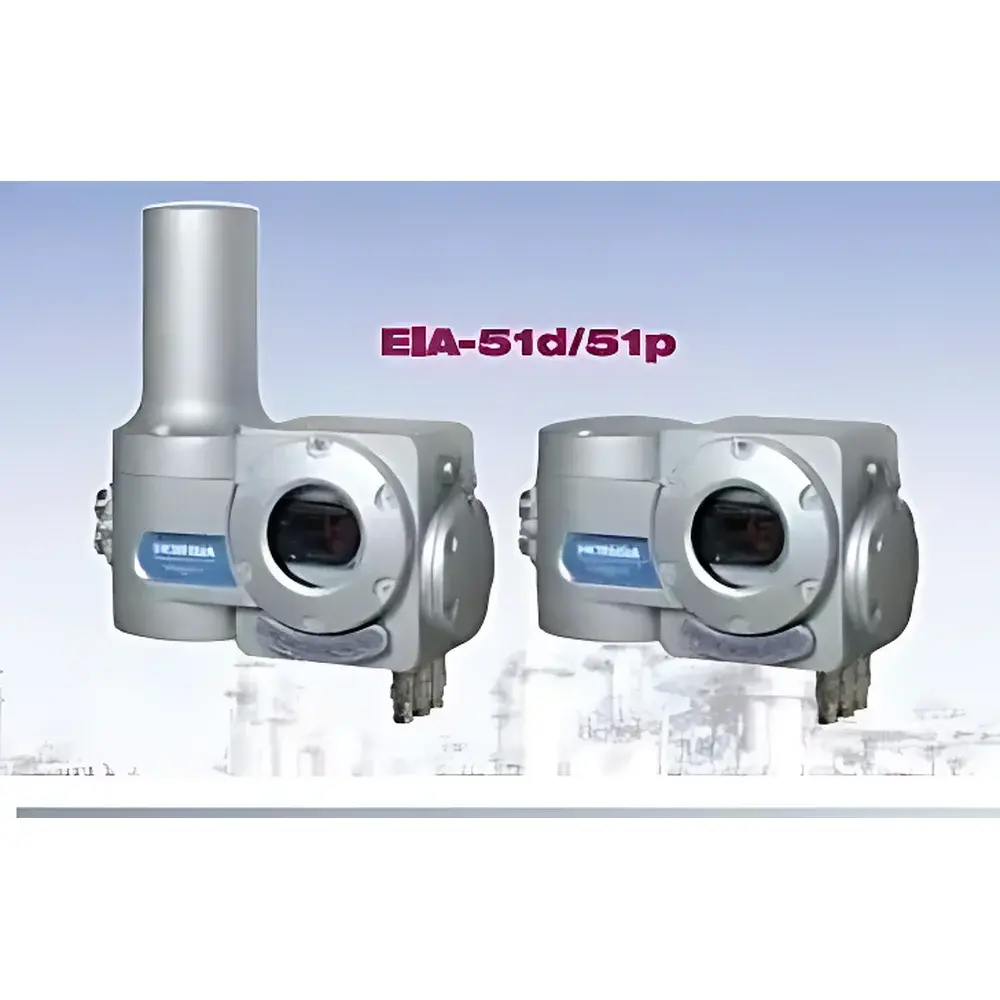
HORIBA EIA-51d / EIA-51p Intrinsically Safe and Explosion-Proof Infrared Gas Analyzer
| Brand | HORIBA |
|---|---|
| Origin | Japan |
| Model | EIA-51d / EIA-51p |
| Explosion Protection | Ex d IIB+H2 T4 (EIA-51d) / Ex p II T4X (EIA-51p) |
| Measurement Principle | Non-Dispersive Infrared (NDIR) with Interference Correction |
| Detectable Gases | CO, CO₂, CH₄ (configurable per application) |
| Range | 0–0.11 vol% to 0–100 vol% (gas-dependent) / 0–50 ppm to 0–2000 ppm |
| Repeatability | ±0.5% F.S. (standard range) |
| Linearity | ±1.0% F.S. |
| Zero & Span Drift | ±2.0% F.S./week |
| Response Time (T90) | ≤20 s (standard), ≤40 s (extended range) |
| Sample Flow | 500 mL/min |
| Operating Ambient | –5 to +40 °C, RH <90%, vibration <0.3 m/s² @ 100 Hz |
| Analog Output | Isolated 4–20 mA (DC), optional 0–10 V / 1–5 V |
| Communication | RS-485, Modbus RTU (selectable baud rates: 1200–19200 bps) |
| Sample Contact Materials | SUS304, SUS316, FKM, CaF₂, Au |
| Purge Gas | N₂, 196–690 kPa, 0.5 L/min (operational), 10 L/min (purge) |
Overview
The HORIBA EIA-51d and EIA-51p are certified explosion-proof infrared gas analyzers engineered for continuous, high-integrity concentration measurement in hazardous areas classified under IEC 60079 standards. These instruments employ non-dispersive infrared (NDIR) spectroscopy with proprietary interference correction—a dual-detector optical architecture that simultaneously acquires measurement and reference signals within a single optical path. This design mitigates spectral interference from co-existing gases (e.g., H₂O, SO₂, or hydrocarbons), suppresses signal drift induced by source aging or detector thermal drift, and enhances immunity to mechanical vibration and ambient temperature fluctuation. The EIA-51d implements flameproof (Ex d) protection conforming to IEC 60079-1 for Group IIB+H₂, T4 temperature class—suitable for environments where explosive gas-air mixtures containing hydrogen or ethylene may be present. The EIA-51p utilizes pressurized enclosure (Ex p) protection per IEC 60079-2, rated for Group II, T4X, enabling deployment in locations requiring positive-pressure inert gas purging. Both models support configurable multi-gas analysis of CO, CO₂, CH₄, and other IR-active species across wide dynamic ranges—from trace-level (ppm) to volume-percent concentrations—without hardware modification.
Key Features
- IEC-certified explosion protection: Ex d IIB+H₂ T4 (EIA-51d) and Ex p II T4X (EIA-51p), fully compliant with ATEX 2014/34/EU and IECEx system requirements
- Interference-corrected NDIR optics: Dual-channel detection architecture eliminates cross-sensitivity from background gas matrix effects, ensuring metrological robustness in complex industrial sample streams
- High-stability performance: ±0.5% F.S. repeatability (standard range), ±1.0% F.S. linearity, and ≤±2.0% F.S./week zero/span drift under controlled operating conditions
- Rapid response: T90 ≤ 20 seconds for standard ranges; extended-range configurations maintain T90 ≤ 40 seconds—critical for real-time process control and safety interlock integration
- Modular analog and digital interfaces: Standard isolated 4–20 mA output with programmable alarm thresholds (–10% to +110% span); optional RS-485 Modbus RTU communication supports remote configuration, diagnostics, and audit-trail logging
- Chemically resistant wetted materials: Sample contact surfaces fabricated from SUS304/SUS316 stainless steel, FKM elastomers, calcium fluoride (CaF₂) windows, and gold-coated optical components—ensuring long-term integrity in corrosive or particulate-laden streams
Sample Compatibility & Compliance
The EIA-51d/51p is designed for continuous monitoring of process or ambient gases in Zone 1 and Zone 2 hazardous locations. Sample gas must contain ≤21% O₂, be free of condensable moisture and particulates, and operate within specified pressure (≥1.98 kPa abs) and flow (500 mL/min) constraints. The analyzer complies with IEC 60079-0 (general requirements), IEC 60079-1 (flameproof enclosures), and IEC 60079-2 (pressurized enclosures). Its optical design meets ISO 12039 for CO and CO₂ determination in combustion exhaust, and supports method validation per EPA Method 3A and EN 15267-3 for automated measuring systems. When integrated into safety instrumented systems (SIS), the analyzer’s response time and diagnostic coverage align with SIL 2 capability per IEC 61508 and IEC 61511. All firmware and configuration data adhere to ALCOA+ principles for data integrity in regulated environments.
Software & Data Management
While the EIA-51d/51p operates as a standalone field analyzer, its RS-485 Modbus RTU interface enables seamless integration into distributed control systems (DCS), SCADA platforms, or centralized gas monitoring networks. Supported baud rates (1200–19200 bps) ensure compatibility with legacy and modern industrial networks. Configuration parameters—including range selection, alarm setpoints, calibration intervals, and output scaling—are accessible via Modbus function codes (03h, 06h, 10h), supporting remote commissioning and periodic verification without physical access. Optional auto-calibration modules integrate zero/span verification using certified reference gases, generating timestamped calibration logs with operator ID and deviation metrics—essential for GLP/GMP compliance and FDA 21 CFR Part 11 audit readiness. All analog outputs include hardware-based fault signaling (e.g., 3.6 mA / 21 mA) to indicate sensor failure or out-of-range conditions.
Applications
These analyzers serve mission-critical roles across petrochemical refining, chemical manufacturing, biogas upgrading, landfill gas recovery, and semiconductor fabrication. Typical use cases include: continuous monitoring of CO concentration in flare gas headers to verify combustion efficiency; real-time CO₂ tracking in syngas streams for Fischer–Tropsch catalyst protection; CH₄ leak detection in LNG transfer zones; and CO surveillance in confined-space entry protocols for refinery maintenance. In hydrogen production facilities, the IIB+H₂ rating of the EIA-51d permits safe installation near electrolyzer vents or compression skids. The EIA-51p’s pressurized enclosure allows deployment in dusty or high-humidity areas—such as cement kiln preheater stacks—where flameproof housings may be impractical. Both models support redundant installation architectures for fail-safe operation in Safety Integrity Level (SIL)-rated applications.
FAQ
What certification standards does the EIA-51d meet for hazardous area installation?
The EIA-51d is certified to IEC 60079-1 (Ex d) for Group IIB+H₂, T4 temperature class, and carries ATEX and IECEx markings for use in Zone 1 locations.
Can the EIA-51p be used in environments with high ambient dust or humidity?
Yes—the Ex p (pressurized enclosure) design isolates internal electronics from external contaminants; it requires continuous purge with clean, dry air or nitrogen at ≥196 kPa.
Is automatic calibration supported, and does it comply with regulatory audit requirements?
Automatic calibration is available as an option and generates full electronic records—including timestamps, reference gas values, deviations, and operator IDs—fully traceable for 21 CFR Part 11 and EU Annex 11 compliance.
What sample conditioning is required upstream of the analyzer inlet?
A dedicated sample conditioning system must deliver filtered, dried, and pressure-regulated gas at 500 mL/min; HORIBA recommends heated sample lines and thermoelectric coolers for dew point control below –10 °C.
How does the interference correction mechanism improve measurement accuracy in multi-component gas streams?
By acquiring simultaneous signals from a primary measurement detector and a secondary reference detector exposed to identical optical path length but different spectral bands, the system mathematically compensates for overlapping absorption features from interfering species—reducing cross-sensitivity by up to 90% compared to conventional single-detector NDIR designs.







