
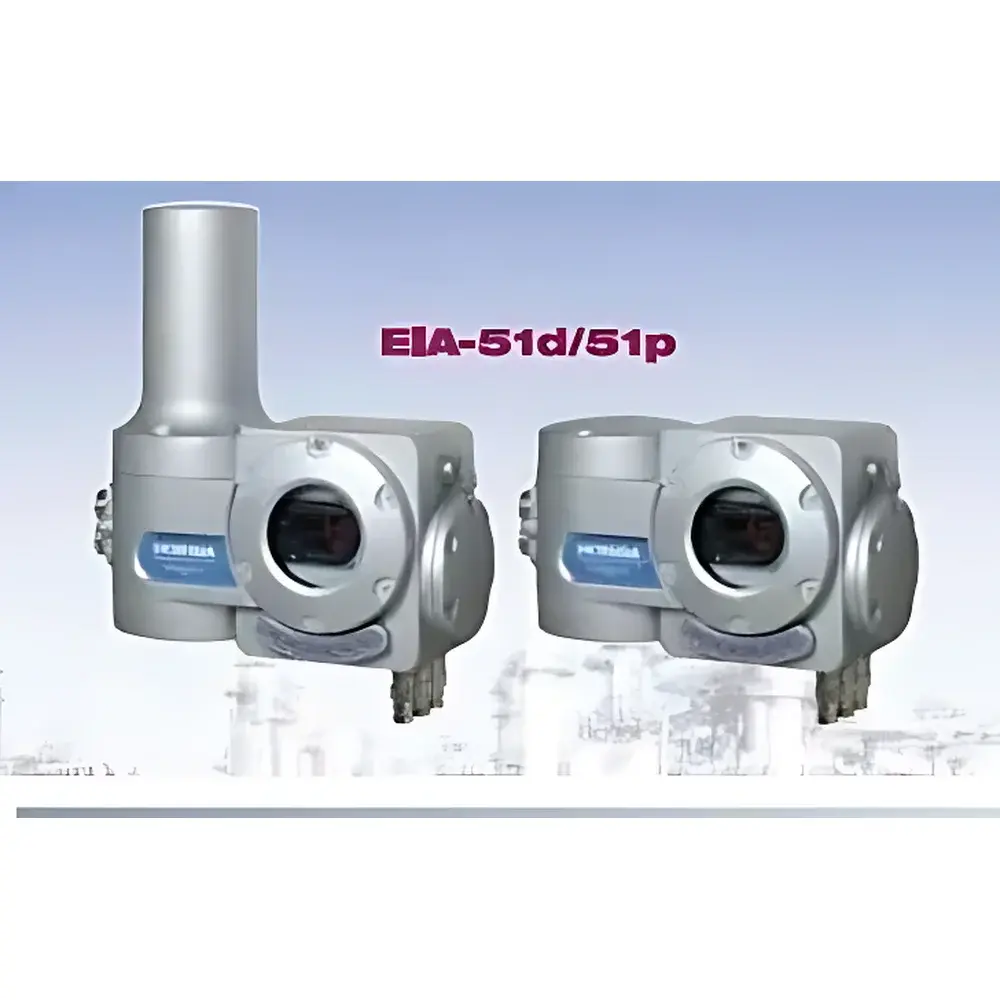
HORIBA EIA-51d / EIA-51p Intrinsically Safe and Explosion-Proof NDIR Gas Analyzer
| Brand | HORIBA |
|---|---|
| Origin | Japan |
| Model | EIA-51d / EIA-51p |
| Explosion Protection | Ex d IIB+H2 T4 (EIA-51d) / Ex p II T4X (EIA-51p) |
| Measurement Principle | Non-Dispersive Infrared (NDIR) with Interference Compensation |
| Measured Gases | CO, CO₂, CH₄ (configurable per application) |
| Range | 0–0.11 vol% to 0–100 vol% (gas-dependent) / 0–50 ppm to 0–2000 ppm |
| Repeatability | ±0.5% F.S. (standard range) |
| Linearity | ±1.0% F.S. |
| Zero & Span Drift | ±2.0% F.S./week |
| Response Time (T90) | ≤20 s (standard), ≤40 s (extended range) |
| Sample Flow Rate | 500 mL/min |
| Sample Pressure | ≥1.98 kPa |
| Ambient Operating Temperature | –5 to +40 °C |
| Analog Output | Isolated 4–20 mA (standard), optional 0–10 V / 0–5 V / 1–5 V |
| Communication | RS-485, Modbus-RTU (selectable baud rates: 1200–19200 bps) |
| Sample Contact Materials | SUS304, SUS316, FKM, CaF₂, Au |
| Purge Gas | N₂, 196–690 kPa, 0.5 L/min (operational), 10 L/min (purge mode) |
Overview
The HORIBA EIA-51d and EIA-51p are certified explosion-proof continuous gas analyzers engineered for reliable, high-fidelity measurement of combustible gases—including carbon monoxide (CO), carbon dioxide (CO₂), and methane (CH₄)—in hazardous industrial environments. Based on non-dispersive infrared (NDIR) spectroscopy with proprietary interference compensation technology, these analyzers deliver stable, drift-resistant performance even in complex sample matrices containing interfering background gases or subject to mechanical vibration and optical aging. Unlike conventional single-detector NDIR systems, the EIA-51 series employs a dual-detector optical architecture: one detector dedicated to target gas absorption measurement, the other configured as a reference channel to dynamically correct for spectral overlap, source intensity fluctuations, and cell contamination effects. This design ensures metrological robustness essential for safety-critical process monitoring, flare gas analysis, biogas conditioning, and confined-space entry verification.
Key Features
- Explosion protection certified to international standards: EIA-51d complies with Ex d IIB+H2 T4 (flameproof enclosure), while EIA-51p meets Ex p II T4X (pressurized enclosure); both rated for Zone 1/21 use in non-mining industrial facilities.
- Interference-compensated NDIR optical system minimizes cross-sensitivity from H₂O, hydrocarbons, and other IR-active species—enabling accurate quantification in raw syngas, landfill gas, or fermentation off-gas streams.
- High stability specification: ±0.5% F.S. repeatability and ±2.0% F.S./week zero/span drift support extended calibration intervals compliant with ISO 14644-3 and EPA Method 21 verification protocols.
- Modular analog and digital I/O: Standard isolated 4–20 mA output with programmable alarm thresholds (–10% to +110% span); optional RS-485 interface supporting Modbus-RTU for integration into DCS, SCADA, or asset management platforms.
- Corrosion-resistant wetted materials: Sample path components constructed from SUS304/SUS316 stainless steel, gold-coated optics, calcium fluoride (CaF₂) windows, and FKM elastomers ensure long-term integrity in acidic or humid sample conditions.
- Configurable purge and sweep capability: Integrated nitrogen purge system (0.5–10 L/min at 196–690 kPa) maintains optical path cleanliness and prevents explosive mixture ingress during maintenance or low-flow operation.
Sample Compatibility & Compliance
The EIA-51d/51p is validated for continuous analysis of dry, particulate-free sample gas with oxygen concentration ≤21% (v/v) and dew point ≤–20 °C. It operates within Class II B+H2 (EIA-51d) or Class II (EIA-51p) hazardous area classifications, conforming to IEC 60079-0, IEC 60079-1 (flameproof), and IEC 60079-2 (pressurization). The analyzer satisfies functional safety requirements aligned with IEC 61508 SIL 2 for gas detection subsystems. Its hardware architecture and firmware design support audit-ready data integrity under FDA 21 CFR Part 11 when paired with validated software configurations. Calibration traceability follows NIST-traceable standards, and routine verification procedures align with ISO 12039 (CO/CO₂ in stationary sources) and EN 15267-3 (performance certification of automated measuring systems).
Software & Data Management
While the EIA-51d/51p operates as a stand-alone analyzer with local front-panel configuration, its RS-485 Modbus-RTU interface enables seamless integration into enterprise-level monitoring infrastructures. Supported communication parameters include selectable baud rates (1200–19200 bps), parity modes, and frame formats—ensuring compatibility with legacy PLCs and modern IIoT gateways. When deployed in regulated environments, the device supports time-stamped analog output logging, configurable alarm event flags (e.g., sensor fault, flow loss, calibration overdue), and diagnostic status registers accessible via Modbus function code 0x03. Optional automatic zero/span calibration modules (not standard) provide scheduled or event-triggered recalibration with electronic audit trail generation—meeting GLP/GMP documentation requirements for pharmaceutical cleanroom ambient monitoring or chemical reactor vent gas surveillance.
Applications
- Continuous emission monitoring (CEM) of CO and CO₂ in thermal oxidizers, incinerators, and cement kiln stacks where explosion risk precludes standard analyzer placement.
- Biogas upgrading control: Real-time CH₄/CO₂ ratio tracking in anaerobic digestion facilities to optimize membrane separation or pressure swing adsorption efficiency.
- Hydrogen production and fuel cell feedstock validation: Detection of CO impurities at sub-ppm levels in PEM electrolyzer outlet gas, with T4 temperature class ensuring safe operation near compressors and storage vessels.
- Hazardous area refinery flare gas analysis: Quantification of unburned hydrocarbons and combustion byproducts in elevated-pressure flare headers using pressurized (Ex p) EIA-51p configuration.
- Confined space entry pre-check: Portable deployment of EIA-51d units with integrated sample draw pump for verification of atmospheric flammability limits prior to personnel entry per OSHA 1910.146.
FAQ
What explosion protection certifications does the EIA-51d hold?
The EIA-51d is certified Ex d IIB+H2 T4 per IEC 60079-1, suitable for use in Zone 1 areas where IIB-class gases (e.g., ethylene, acetone) or hydrogen-air mixtures may be present.
Can the EIA-51p measure hydrogen (H₂) directly?
No—H₂ is not detectable by NDIR; however, the EIA-51p platform supports optional electrochemical or thermal conductivity sensors for H₂ when integrated into multi-gas configurations.
Is automatic calibration available as a factory-installed option?
Yes—automated zero/span calibration kits with solenoid valves and certified span gas manifolds are available as configurable options (order code suffix “-ACAL”).
What is the minimum detectable concentration for CO using the EIA-51 series?
The lowest standard range is 0–50 ppm CO; extended sensitivity down to 0–10 ppm is achievable with custom optical path length and signal averaging—subject to site-specific ATEX/IECEx review.
Does the analyzer require external sample conditioning?
Yes—sample must be filtered to ≤0.3 µm, dried to dew point ≤–20 °C, and pressure-regulated to ≥1.98 kPa; HORIBA recommends pairing with the PG-200 series particulate/moisture removal system for unattended operation.
Related Products







