
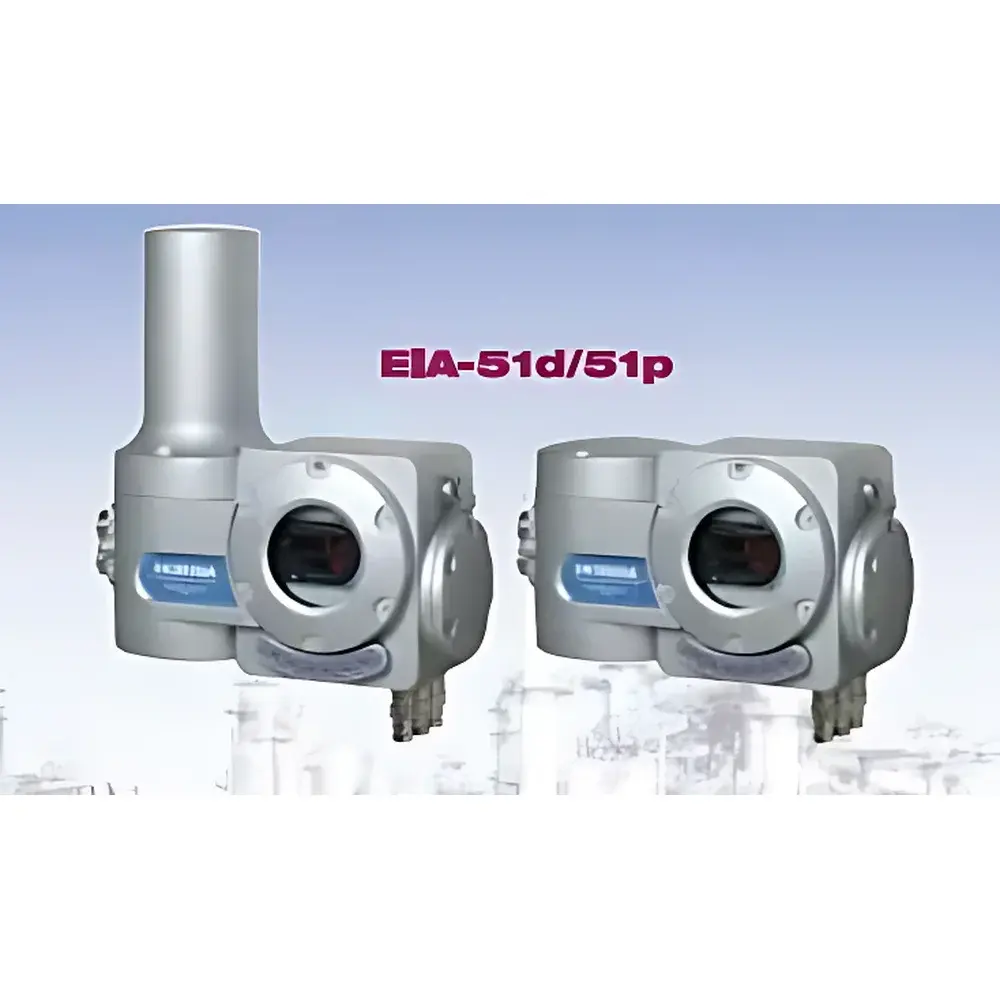
HORIBA EIA-51d / EIA-51p Intrinsically Safe and Explosion-Proof NDIR Gas Analyzer
| Brand | HORIBA |
|---|---|
| Origin | Japan |
| Model | EIA-51d / EIA-51p |
| Explosion Protection Type | Ex d IIB+H2 T4 (EIA-51d) / Ex p II T4X (EIA-51p) |
| Measurement Principle | Non-Dispersive Infrared (NDIR) with Interference Compensation |
| Detectable Gases | CO, CO₂, CH₄ (configurable per application) |
| Range | 0–0.11 vol% to 0–100 vol% (gas-dependent) / 0–50 ppm to 0–2000 ppm (gas-dependent) |
| Repeatability | ±0.5% F.S. (standard range) |
| Linearity | ±1.0% F.S. |
| Zero & Span Drift | ±2.0% F.S./week |
| Response Time (T90) | ≤20 s (standard), ≤40 s (extended range) |
| Sample Flow Rate | 500 mL/min |
| Sample Pressure | ≥1.98 kPa |
| Operating Ambient Temperature | –5 to +40 °C |
| Analog Output | Isolated DC 4–20 mA (standard), optional 0–10 V / 0–5 V / 1–5 V / 0–16 mA |
| Communication Interface | RS-485 |
| Protocol | Modbus-RTU |
| Baud Rates | 1200–19200 bps |
| Wetted Materials | SUS304, SUS316, FKM, CaF₂, Au |
| Calibration | Manual (standard), Auto-calibration (optional) |
Overview
The HORIBA EIA-51d and EIA-51p are certified explosion-proof continuous gas analyzers engineered for reliable, high-fidelity measurement of combustible and hazardous gases—including carbon monoxide (CO), carbon dioxide (CO₂), and methane (CH₄)—in classified hazardous areas. These analyzers employ a dual-detector non-dispersive infrared (NDIR) optical architecture with interference compensation, a proprietary design that actively mitigates spectral overlap from interfering gas species (e.g., water vapor, hydrocarbons), mechanical vibration, and long-term optical drift caused by source aging or cell contamination. Unlike conventional single-beam NDIR systems, the interference-compensated configuration integrates a dedicated reference detector alongside the primary measurement detector within the same optical path—enabling real-time correction of baseline shifts and cross-sensitivity artifacts. This architecture ensures metrological stability under demanding industrial conditions, supporting compliance with process safety integrity requirements in petrochemical, refining, chemical manufacturing, and biogas facilities where Class I, Division 1 or Zone 1 environments are present.
Key Features
- Two certified explosion-protection variants: EIA-51d (flameproof/Ex d IIB+H₂ T4) and EIA-51p (pressurized/Ex p II T4X), both compliant with IEC 60079-0, IEC 60079-1, and IEC 60079-2 standards.
- Interference-compensated NDIR optics delivering robust selectivity and long-term zero/span stability—critical for unattended operation in continuous emission monitoring (CEM) and process safety applications.
- Configurable multi-gas capability: factory-configured for CO, CO₂, or CH₄; optical filter and calibration parameters optimized per target analyte.
- High-reproducibility performance: ±0.5% F.S. repeatability on standard ranges; ±1.0% F.S. linearity; zero and span drift ≤±2.0% F.S./week under specified ambient conditions.
- Fast response dynamics: T90 ≤20 seconds for standard measurement ranges, enabling timely detection of gas excursions in safety-critical loops.
- Industrial-grade analog and digital interfaces: isolated 4–20 mA output (standard), optional voltage outputs, and RS-485 Modbus-RTU communication for integration into DCS, SCADA, or SIS platforms.
- Wetted materials selected for chemical compatibility and corrosion resistance: 316 stainless steel sample path, gold-coated optical components, FKM seals, and calcium fluoride (CaF₂) windows.
Sample Compatibility & Compliance
The EIA-51d and EIA-51p are designed for dry, dust-free sample streams with oxygen concentration ≤21% (v/v) and pressure ≥1.98 kPa (absolute). Sample flow is maintained at 500 mL/min via integrated mass flow control. The analyzers are not intended for direct measurement of corrosive, condensing, or particulate-laden gas streams without external conditioning (e.g., heated sample lines, coalescing filters, permeation dryers). Both models meet international hazardous area certification requirements: EIA-51d conforms to Ex d IIB+H₂ T4 (suitable for Group IIB gases including ethylene and hydrogen mixtures); EIA-51p meets Ex p II T4X (pressurized enclosure protection for general industrial use). Neither unit is rated for Zone 0 or Class I, Division 0. All configurations support traceability per ISO/IEC 17025 when operated within validated calibration intervals and documented maintenance procedures.
Software & Data Management
While the EIA-51d/51p operate as standalone hardware analyzers with local front-panel interface, their RS-485 Modbus-RTU port enables seamless integration into enterprise-level data acquisition and regulatory reporting systems. Configuration, alarm thresholds, and calibration logs are accessible via standard Modbus function codes (03h, 06h, 16h). Optional auto-calibration modules support scheduled zero/span verification using certified span gases—generating timestamped audit trails compatible with GLP/GMP documentation frameworks. Analog output signals include programmable fault indication (e.g., 3.6 mA for sensor failure, 20.5 mA for over-range), supporting SIL 2-capable safety instrumented functions when deployed with appropriate logic solvers. Firmware updates are performed offline via service-mode serial interface; no cloud connectivity or remote firmware execution is implemented—preserving network isolation for critical infrastructure.
Applications
- Continuous monitoring of flare gas composition and combustion efficiency in oil & gas refineries.
- Safety interlock sensing for CO accumulation in enclosed turbine enclosures, compressor stations, and LNG loading berths.
- Biogas upgrading control: real-time CO₂ and CH₄ tracking during amine scrubbing or membrane separation processes.
- Hydrogen production and handling facilities: H₂-compatible variants (via optional configuration) support leak detection and purity verification in electrolyzer and reformer off-gas streams.
- Chemical reactor vent monitoring: quantification of CO/CO₂ byproducts in exothermic synthesis processes subject to OSHA PSM or EU Seveso III Directive requirements.
- Landfill and wastewater treatment plant landfill gas (LFG) analysis for regulatory reporting under EPA 40 CFR Part 60 Subpart WWW or EU Monitoring Guidance (2019/C 386/01).
FAQ
What hazardous area classifications does the EIA-51d support?
The EIA-51d is certified Ex d IIB+H₂ T4 per IEC 60079-1, permitting installation in Zone 1 and Class I, Division 1 locations where ethylene, hydrogen, or equivalent Group IIB gases may be present.
Can the EIA-51p measure hydrogen directly?
No—the EIA-51p uses NDIR detection, which is insensitive to diatomic gases like H₂. Hydrogen measurement requires complementary technology (e.g., thermal conductivity or electrochemical sensors); HORIBA offers integrated multi-sensor solutions upon request.
Is automatic calibration included as standard?
Manual calibration is standard. Automatic zero/span calibration is available as an optional module requiring external solenoid valves and certified calibration gases.
What sample conditioning is required upstream of the analyzer?
A heated sample line (≥60 °C), particulate filter (≤1 µm), and moisture removal system (e.g., Nafion dryer or chiller) are strongly recommended for reliable operation in ambient or humid process environments.
Does the analyzer comply with FDA 21 CFR Part 11?
The EIA-51d/51p itself is not a computerized system subject to Part 11. However, when integrated into a validated electronic record system (e.g., DeltaV, PI System) with appropriate audit trail and electronic signature controls, it supports Part 11-aligned data integrity practices.
Related Products







