
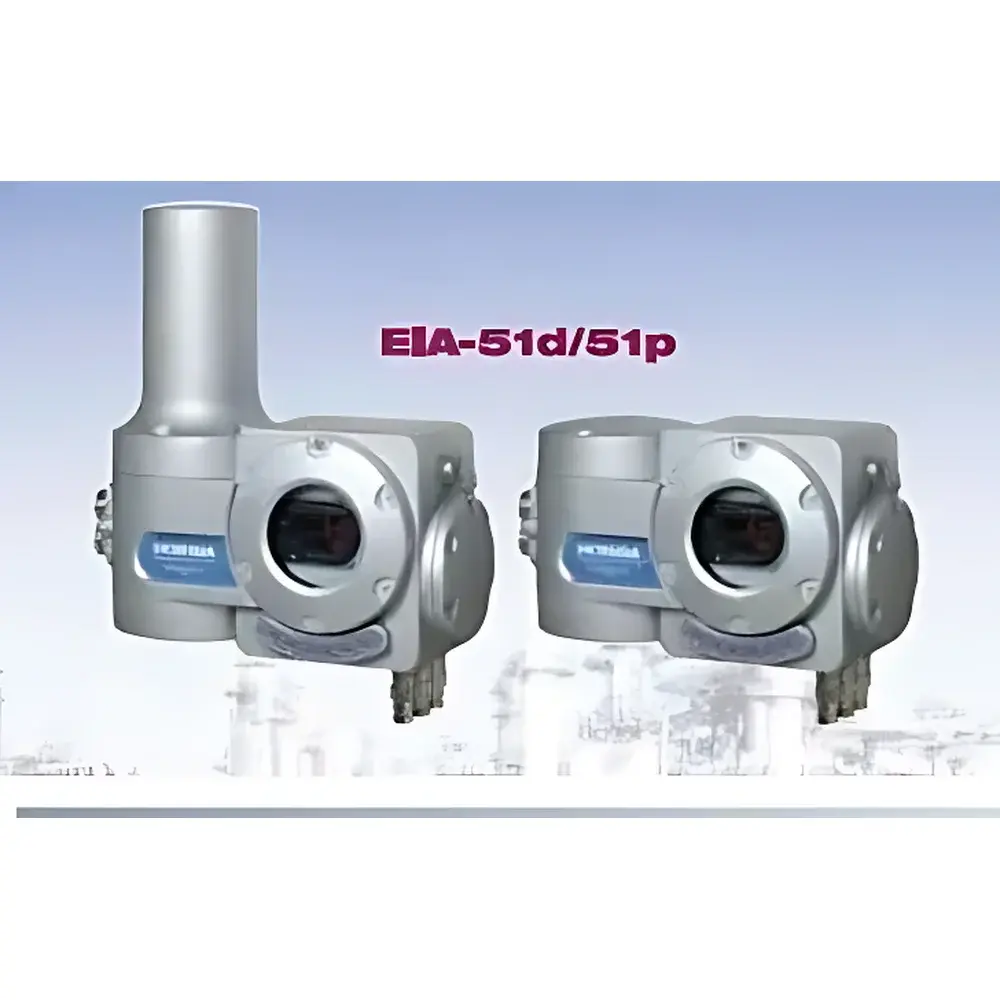
HORIBA EIA-51d / EIA-51p Intrinsically Safe and Explosion-Proof NDIR Gas Analyzer
| Brand | HORIBA |
|---|---|
| Origin | Japan |
| Model | EIA-51d / EIA-51p |
| Explosion Protection | Ex d IIB+H2 T4 (EIA-51d) / Ex p IIT4 X (EIA-51p) |
| Measurement Principle | Interference-Corrected Non-Dispersive Infrared (NDIR) Absorption |
| Detectable Gases | CO, CO₂, CH₄, and other hydrocarbons |
| Minimum Range | 0–0.11 vol% (gas-dependent) / 0–50 ppm |
| Maximum Range | 0–100 vol% / 0–2000 ppm |
| Repeatability | ±0.5% F.S. (standard range) |
| Linearity | ±1.0% F.S. |
| Zero & Span Drift | ±2.0% F.S./week |
| Response Time (T90) | ≤20 s (standard), ≤40 s (extended range) |
| Sample Flow Rate | 500 mL/min |
| Operating Ambient Temperature | –5 to +40 °C |
| Analog Output | Isolated DC 4–20 mA (optional 0–10 V, 0–5 V, etc.) |
| Communication | RS-485 Modbus-RTU (selectable baud rates: 1200–19200 bps) |
| Wetted Materials | SUS304, SUS316, FKM, CaF₂, Au |
| Calibration | Manual standard / Auto calibration optional |
Overview
The HORIBA EIA-51d and EIA-51p are certified explosion-proof gas analyzers engineered for continuous, reliable quantitative analysis of combustible gases—including carbon monoxide (CO), carbon dioxide (CO₂), methane (CH₄), and other hydrocarbons—in hazardous areas classified under IEC 60079 standards. These instruments implement interference-corrected non-dispersive infrared (NDIR) absorption spectroscopy—a dual-detector optical architecture that simultaneously measures target gas absorbance and compensates for spectral interference from co-existing gases, optical drift, mechanical vibration, and aging effects in the light source or measurement cell. This design ensures high measurement fidelity in complex process streams where conventional single-beam NDIR systems suffer from cross-sensitivity and long-term instability. The EIA-51d complies with Ex d IIB+H₂ T4 protection—enabling safe operation in environments containing hydrogen-air mixtures and Group IIB explosive atmospheres (e.g., ethylene, propane). The EIA-51p adopts Ex p IIT4 X pressurized enclosure protection, suitable for broader Class II applications requiring continuous purging with inert gas. Both models are manufactured in Japan and conform to stringent quality control protocols aligned with ISO 9001 and JIS Z 8101.
Key Features
- Explosion protection certified to IEC 60079-1 (flameproof “d”) and IEC 60079-2 (pressurized “p”) standards, with explicit approval for H₂-containing atmospheres (IIB+H₂) and general Class II industrial zones.
- Interference-corrected NDIR optical system featuring parallel measurement and reference detectors within a single optical path—minimizing errors from background gas interference, thermal drift, and mechanical perturbation.
- Wide dynamic measurement range: configurable from 0–50 ppm to 0–100 vol%, supporting both trace-level safety monitoring and high-concentration process control applications.
- Stable baseline performance: zero and span repeatability of ±0.5% F.S. (standard range); linearity error ≤±1.0% F.S.; zero/span drift ≤±2.0% F.S./week under controlled conditions.
- Rugged wetted materials including SUS304/SUS316 stainless steel, gold-coated optics, fluorocarbon (FKM) seals, and calcium fluoride (CaF₂) windows—ensuring chemical compatibility with aggressive sample matrices.
- Modular analog and digital interfaces: isolated 4–20 mA output (with customizable alarm thresholds from –10% to +110% of full scale), optional relay outputs, and RS-485 Modbus-RTU communication for integration into DCS/SCADA systems.
Sample Compatibility & Compliance
The EIA-51d and EIA-51p are designed for use with dry, particle-free sample gas streams at ambient oxygen concentrations ≤21% (v/v) and pressures ≥1.98 kPa (absolute). Recommended sample flow is 500 mL/min; optional sweep gas (N₂, 196–690 kPa) may be applied at 10 L/min during calibration or 0.5 L/min during normal operation. Instruments meet IEC 60079-0 (general requirements), IEC 60079-1 (flameproof enclosures), and IEC 60079-2 (pressurized enclosures), with temperature class T4 (maximum surface temperature ≤135 °C). They support GLP/GMP-aligned operation through audit-trail-capable manual calibration logs; auto-calibration kits (optional) provide time-stamped event records compatible with FDA 21 CFR Part 11 data integrity requirements when deployed with compliant software infrastructure.
Software & Data Management
While the EIA-51d/51p operate as standalone hardware analyzers, their RS-485 Modbus-RTU interface enables seamless integration with third-party supervisory systems—including Emerson DeltaV, Honeywell Experion, Siemens Desigo, and custom SCADA platforms. Communication supports configurable baud rates (1200–19200 bps), parity settings, and slave ID assignment. All analog outputs include programmable fault signaling (e.g., sensor failure, out-of-range, calibration overdue), and alarm thresholds can be set independently for each channel. For regulatory compliance, raw concentration values, status flags, and timestamped diagnostic codes are accessible via Modbus registers—facilitating automated data logging, trend analysis, and electronic record retention per ISO/IEC 17025 and EPA Method 21 documentation practices.
Applications
These analyzers serve critical roles across petrochemical refining, semiconductor fab exhaust abatement, biogas upgrading, landfill gas recovery, hydrogen production facilities, and pharmaceutical synthesis suites—where real-time detection of flammable gases in Zone 1/Zone 2 classified areas is mandated by OSHA 1910.119, ATEX 2014/34/EU, and local fire codes. Typical use cases include: continuous monitoring of flare gas composition prior to combustion; leak detection in hydrogen compression skids; CO/CO₂ ratio control in syngas conditioning; CH₄ concentration verification in anaerobic digester off-gas; and safety interlock triggering in solvent recovery units handling acetone, ethanol, or toluene vapors. Their dual-certification (d and p variants) allows flexible deployment across legacy flameproof infrastructure and modern pressurized analyzer shelters.
FAQ
What explosion protection categories does the EIA-51d support?
The EIA-51d is certified Ex d IIB+H₂ T4, permitting installation in locations where hydrogen, ethylene, or propane–air mixtures may be present, provided ambient temperature remains below 135 °C.
Can the EIA-51p be used in hydrogen-rich environments?
Yes—the EIA-51p’s Ex p IIT4 X certification includes special conditions allowing operation in hydrogen-adjacent zones when maintained under positive inert gas purge per manufacturer-specified flow and pressure parameters.
Is automatic calibration available as a factory option?
Yes—auto-calibration modules with integrated zero/span gas valves and solenoid-controlled reference gas delivery are available as optional accessories, supporting scheduled or event-triggered calibration routines.
What sample conditioning is required upstream of the analyzer?
A particulate filter (≤1 µm), moisture trap (dew point ≤–20 °C), and pressure regulator are strongly recommended; hot-wet sampling is not supported due to condensation risk in optical cells.
Does HORIBA provide validation documentation for IQ/OQ/PQ protocols?
HORIBA supplies factory test reports (FAT), calibration certificates traceable to NIST standards, and technical documentation packages supporting user-executed Installation Qualification (IQ), Operational Qualification (OQ), and Performance Qualification (PQ) activities in regulated environments.
Related Products







