
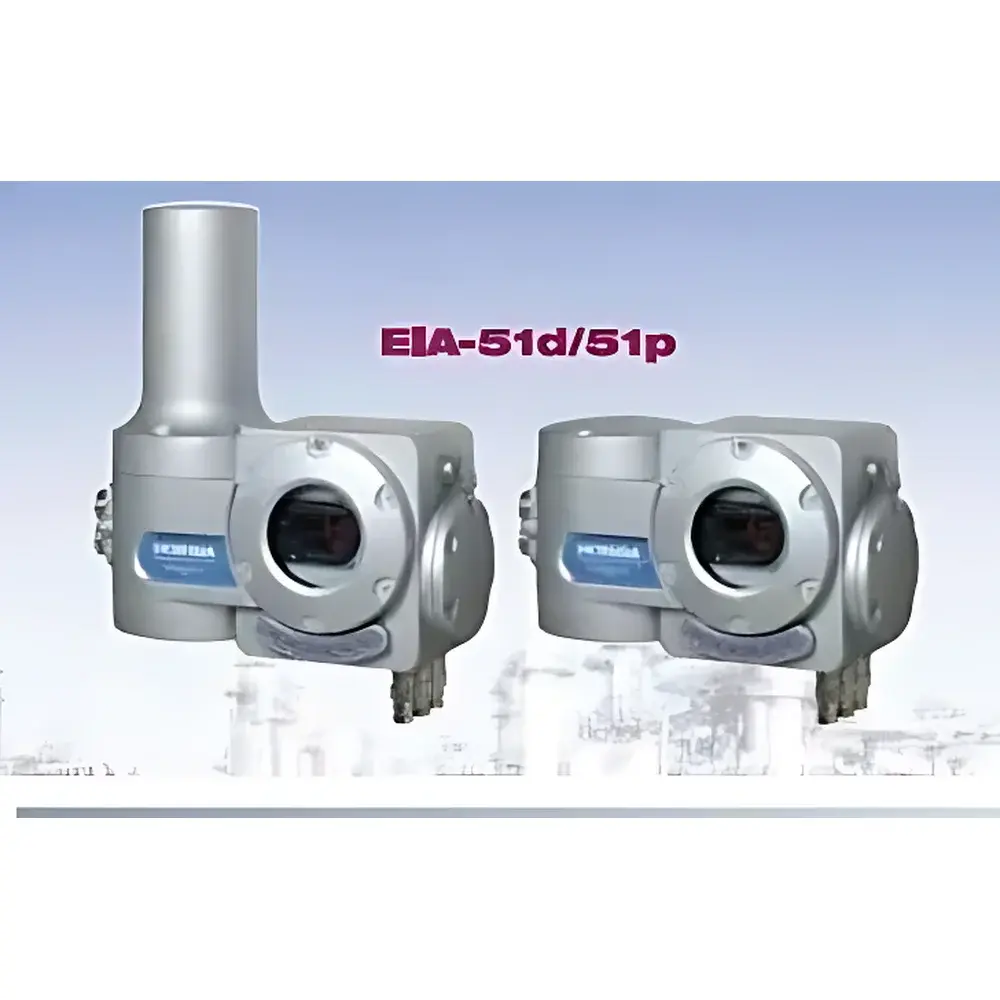
HORIBA EIA-51d / EIA-51p Intrinsically Safe and Explosion-Proof NDIR Gas Analyzer
| Brand | HORIBA |
|---|---|
| Origin | Japan |
| Model | EIA-51d / EIA-51p |
| Explosion Protection | Ex d IIB+H2 T4 (EIA-51d) / Ex p II T4X (EIA-51p) |
| Measurement Principle | Non-Dispersive Infrared (NDIR) with Interference Compensation |
| Detectable Gases | CO, CO₂, CH₄ (configurable per application) |
| Range | 0–0.11 vol% to 0–100 vol% (CO/CO₂), 0–50 ppm to 0–2000 ppm (CH₄) |
| Repeatability | ±0.5% F.S. (standard range) |
| Linearity | ±1.0% F.S. |
| Zero & Span Drift | ±2.0% F.S./week |
| Response Time (T90) | ≤20 s (standard), ≤40 s (extended range) |
| Sample Flow | 500 mL/min |
| Operating Ambient | –5 to +40 °C, RH <90%, vibration <0.3 m/s² @ 100 Hz |
| Analog Output | Isolated 4–20 mA (DC), optional 0–10 V / 1–5 V |
| Communication | RS-485, Modbus-RTU (selectable baud rates: 1200–19200 bps) |
| Sample Contact Materials | SUS304, SUS316, FKM, CaF₂, Au |
| Purge Gas | N₂, 196–690 kPa, 0.5–10 L/min |
Overview
The HORIBA EIA-51d and EIA-51p are certified explosion-proof infrared gas analyzers engineered for continuous, reliable measurement of combustible and hazardous gases—including carbon monoxide (CO), carbon dioxide (CO₂), and methane (CH₄)—in classified industrial environments. Based on non-dispersive infrared (NDIR) spectroscopy with proprietary interference-compensated optical architecture, these analyzers deliver high specificity and long-term stability even in complex sample matrices containing interfering species (e.g., water vapor, hydrocarbons, or mixed background gases). The dual-detector configuration—comprising a primary measurement detector and a reference compensation detector within a single optical path—minimizes signal drift induced by source aging, cell contamination, mechanical vibration, and spectral overlap. This design ensures metrological integrity under demanding process conditions where safety-critical decisions depend on trace-level accuracy and repeatability.
Key Features
- Two certified explosion-protection variants: EIA-51d conforms to Ex d IIB+H₂ T4 (flameproof enclosure for Zone 1); EIA-51p meets Ex p II T4X (pressurized enclosure with purge interlock for Zone 1/2).
- Interference-compensated NDIR optics—eliminates cross-sensitivity from overlapping IR absorption bands without requiring physical filters or chromatographic separation.
- Robust sample interface: stainless steel (SUS304/SUS316) wetted parts, gold-coated optical components, and fluorocarbon (FKM) and calcium fluoride (CaF₂) seals ensure chemical compatibility and longevity in corrosive or particulate-laden streams.
- Configurable analog output (4–20 mA isolated, with programmable alarm thresholds from –10% to +110% of span) and optional digital communication via RS-485 Modbus-RTU (baud rates up to 19.2 kbps).
- Zero and span calibration support: manual calibration standard; automatic calibration module available as factory-installed option with timed or event-triggered routines.
- Designed for continuous operation in ambient temperatures from –5 °C to +40 °C and relative humidity ≤90% non-condensing, with mechanical vibration tolerance ≤0.3 m/s² at 100 Hz.
Sample Compatibility & Compliance
The EIA-51d/51p is validated for use with dry, dust-free sample gases containing ≤21% O₂ and free of condensable vapors or aerosols. It complies with IEC 60079-0 (general requirements for explosive atmospheres) and IEC 60079-1 (flameproof “d”) / IEC 60079-2 (pressurized “p”) standards. Certification covers Group IIB+H₂ (EIA-51d) and Group II (EIA-51p), both rated T4 (maximum surface temperature ≤135 °C). The analyzer supports integration into safety instrumented systems (SIS) and meets functional safety prerequisites for SIL 2 applications when deployed with appropriate system-level redundancy and validation. All firmware and configuration logs adhere to audit-trail requirements aligned with ISO/IEC 17025 and GLP-compliant data governance frameworks.
Software & Data Management
While the EIA-51d/51p operates as a standalone hardware analyzer with front-panel navigation, its RS-485 Modbus-RTU interface enables seamless integration into distributed control systems (DCS), SCADA platforms, or centralized environmental monitoring networks. Register mapping supports real-time concentration values, status flags (e.g., fault, calibration mode, sensor health), and diagnostic counters (e.g., total operating hours, number of calibrations performed). When paired with HORIBA’s optional data acquisition software or third-party Modbus-compatible HMI tools, users can configure automated report generation, trend logging, and alarm escalation workflows compliant with FDA 21 CFR Part 11 electronic record requirements—provided system-level validation and user access controls are implemented per organizational SOPs.
Applications
These analyzers serve critical roles across multiple regulated sectors: biogas upgrading (CH₄/CO₂ ratio monitoring in anaerobic digesters), landfill gas management (real-time CO and CH₄ leak detection), syngas quality control in chemical synthesis, furnace atmosphere analysis in heat treatment facilities, and inerting system verification in pharmaceutical drying processes. Their certified explosion protection and interference-resilient NDIR platform make them suitable for installation directly in Zone 1 hazardous areas—eliminating the need for external sample conditioning skids or remote analyzer shelters in many deployments. The modular architecture also allows field-reconfiguration for alternate gas targets (e.g., switching from CO to CO₂ measurement) through firmware update and optical filter replacement—reducing lifecycle cost and operational downtime.
FAQ
What gas species can the EIA-51d/51p measure?
It is factory-configured for CO, CO₂, or CH₄; multi-gas configurations require optical reconfiguration and are subject to model-specific hardware options.
Is automatic zero/span calibration available?
Yes—optional auto-calibration modules support scheduled or demand-initiated routines using certified span gas and zero air, with full audit trail logging.
Can the analyzer operate in outdoor enclosures?
No—the unit is rated for indoor installation only; ambient temperature must remain between –5 °C and +40 °C, and direct solar exposure or condensation must be avoided.
What purge gas is required for the EIA-51p pressurized version?
Instrument-grade nitrogen (N₂) at 196–690 kPa, with flow rates of 0.5 L/min during operation and 10 L/min during purging cycles.
Does the device meet FDA or EPA regulatory requirements?
While not pre-certified for specific EPA Method or USP chapter compliance, its metrological performance, traceable calibration paths, and data integrity features support validation against 40 CFR Part 60, USP , or ASTM D6245 when integrated into a qualified system.







